Yesterday, the United States launched its “Operation Economic Pariah” campaign against Iran, aimed at strangling the Iranian regime and cutting off the financial and commercial arteries on which it depends.
It began with sanctions on more than 60 individuals, entities, and vessels, and expanded secondary sanctions to five vital sectors, giving countries deadlines to end specific activities with Tehran or face unilateral US measures that could extend to isolating their institutions from the dollar-based financial system.
US Treasury Secretary Scott Bessent said during a press conference last night that the operation was launched under the direction of US President Donald Trump, and that it is an unprecedented campaign involving US government agencies targeting Iran and those who enable and support it.
He said the measures would “strangle the Iranian regime” and target the Revolutionary Guard, and that the goal was to cut off the economic arteries that support Tehran and push it into isolation.
Two difficult choices
Bessent presented Iran with two options: “Complete global isolation and a subsistence economy,” or changing course and gaining a chance to return to the global economy. He said the process aims to “close off all other options” for Tehran.
Bessent announced sanctions on more than 60 individuals, entities, and vessels worldwide that Washington accuses of assisting Iran in activities related to nuclear energy, missiles, oil, and cyber operations, in addition to suspending general licenses that allowed some financial transfers to Iran.
The Treasury Secretary identified five vital arteries that he said Iran uses in other countries: digital assets, technology, gold, aviation, and maritime shipping. He emphasised that US authorities have identified “every point of contact, every facilitator, and every network” that Tehran has used to smuggle oil and circumvent sanctions.
Bessent said that Trump is in contact with world leaders to cut economic ties with Iran, and that teams from the U.S. Treasury, State and Defence Departments are in contact with their counterparts around the world to inform them of the required actions.
He added that Washington has set a timetable for each country to end certain activities, including closing Iranian bank branches abroad, warning that the United States will act unilaterally, using its powers if countries do not take the required measures.
Bessent threatened to exclude any entity that facilitates money laundering or the transfer of Iranian oil revenues from the dollar-based financial system, stressing that “no one is immune from US sanctions.” He said, “Those who stand with us will reap the benefits of our partnership, and those who tie their fate to the Iranian regime should expect isolation with it.”
Secondary penalties

In response to a question during the press conference, Bessent did not rule out imposing secondary sanctions on Chinese banks if they continued to facilitate Iranian transactions, and said that any bank or financial institution that helps convert Iranian oil revenues into funds would be subject to sanctions.
He added that Washington knows the entities that support the financial system linked to Iranian oil, and that those entities in turn know that they are targeted, warning them of the “hammer” of the Treasury Department’s measures.
The Treasury Secretary revealed that Washington will impose sanctions on a major financial institution before the end of the week due to transactions linked to Iran, indicating that the campaign will continue after Monday’s actions.
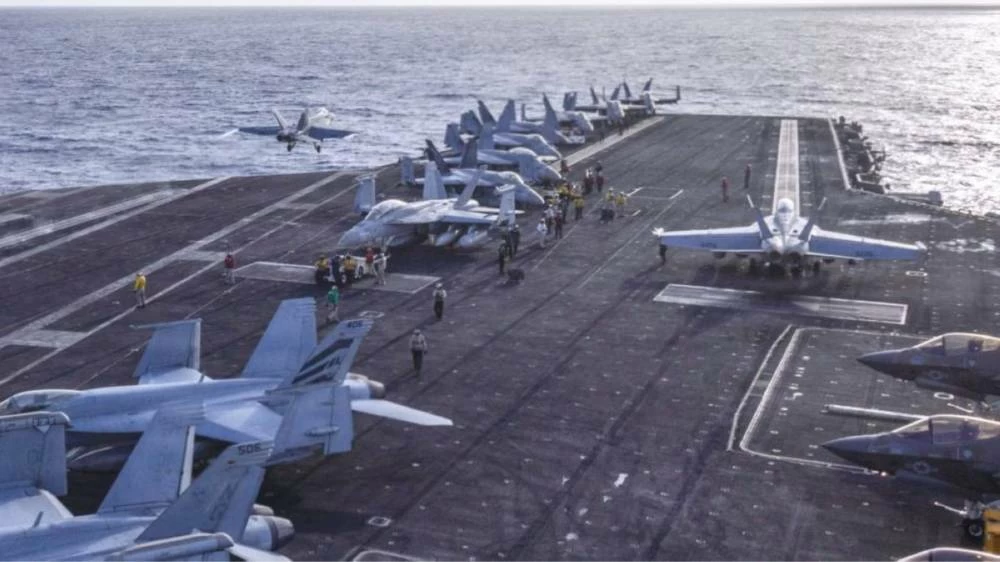
He said that the strength of the American economy allows Washington to launch this financial operation in parallel with its military power, and likened the economic offensive, in terms of mobilisation, to the Normandy landings during World War II.
While US President Donald Trump wrote on his Truth Social platform, hours before the press conference, that “Iran is collapsing completely,” Bessent linked the campaign to the deterioration of the Iranian currency, saying during the conference that the rial is “collapsing” and that its exchange rate has exceeded two million rials to the dollar, predicting that it will head towards three million rials to the dollar.
The Associated Press reported yesterday that the riyal hit its lowest level in history at 2.02 million riyals to the dollar on the unofficial market, compared to about 1.5 million riyals according to the official rate set by the Central Bank.
Living pressures
The currency collapse came as Iranian President Masoud Pezeshkian said yesterday that Iran is suffering from “major imbalances” in water, electricity, gas, fuel, the environment and the banking sector, and that it is facing a “comprehensive economic, military and security war.”
As reported yesterday by the Iranian news agency Tasnim, the governor of the Central Bank of Iran, Abdolnasser Hemmati, revealed that the authorities had anticipated “difficult circumstances” and therefore began stockpiling foreign currency in various locations since January. He stated that the move aimed to ensure the availability of the necessary currency for importing essential goods and medicines.
Official Iranian data shows widening living pressures, as data from the Iranian Statistics Center reported by Reuters on August 17 showed that annual inflation reached 66% in July, and consumer prices rose 87.9% year-on-year.
Meanwhile, food prices have risen by 128%. Reuters, in the same report, quoted three Iranian officials as saying that authorities fear additional US sanctions will exacerbate economic hardship and ignite renewed unrest.
The Iranian authorities’ concerns extend beyond the immediate economic repercussions to the possibility of renewed protests. Reuters reported on August 17, citing three Iranian officials, that Tehran fears the new US sanctions will exacerbate living difficulties and fuel widespread unrest, putting further pressure on the regime.
The agency quoted a government employee in the city of Yazd as saying that his salary was running out within days and that meat and chicken had disappeared from his family’s table, while business owners spoke of laying off employees and closing projects due to the halt in trade and rising costs.
In conjunction with these concerns, The New York Times reported in August that Iranian authorities had begun a campaign to close dozens of cafes in Tehran and other cities, amid tightening control over places where young people gather.
The newspaper quoted an artist in Tehran as saying that the authorities are treating gatherings of young men and women in front of cafes as potential protest gatherings, while a cafe owner described the measures as the beginning of a “campaign to control post-war Iran” in a society suffering from pressure and discontent.
The pressure has extended to oil, one of Tehran’s most important sources of foreign currency. Data from Kpler, cited by Reuters yesterday, showed that Iranian oil shipments to China fell to about 534,000 barrels per day in August, compared to 823,000 in July, after reaching 1.58 million barrels per day earlier in the year.
Faced with mounting economic pressures, Tehran continued to blackmail international shipping and the region in an attempt to export its crisis by putting pressure on global energy supplies and trade, in an attempt to create an energy crisis, as the Secretary of Iran’s Supreme National Security Council, Mohsen Rezaei, said on Sunday:
If the “economic war” continues, not a single drop of oil will be exported through the Strait of Hormuz or from anywhere in the region. On Monday, Tehran blacklisted 45 tankers, threatening fines, detention, and confiscation of their cargo.
Data from Kpler, published by Reuters yesterday, showed that only four ships crossed the Strait of Hormuz on Sunday, compared to 13 on Saturday and 16 on Friday. The UK Maritime Trade Operations (UKMTO) said that the traffic it monitored during the week ending August 21 remained about 90% lower than pre-war levels, and that it had recorded 23 incidents of ships being hit by shells in and around the strait since July 6.
United Nations Secretary-General Antonio Guterres warned yesterday of the global repercussions of the disruption to navigation in the Strait of Hormuz and the Red Sea, saying in a speech to the United Nations on freedom of navigation that the disruption of the waterways is hindering the movement of energy, fertilisers and basic commodities.
Traffic through the Strait of Hormuz has almost come to a standstill, while oil prices have remained about 33% higher since the start of the conflict and global container shipping rates have risen 84% compared to last year.
Diplomatic path
On the diplomatic front, Pakistani Army Chief Field Marshal Asim Munir arrived in Tehran yesterday as part of Islamabad’s mediation efforts. Reuters reported the same day, citing three Pakistani sources, that Trump had spoken with Munir by phone last week. One source said the main US request was for Islamabad to use its influence to help bring Iran back to the negotiating table.
The Iranian Foreign Ministry announced yesterday that Omani Foreign Minister Badr Al-Busaidi will visit Tehran today to complete consultations regarding the Strait of Hormuz. Meanwhile, China and Jordan, in a joint statement issued Monday following a meeting between Chinese President Xi Jinping and Jordanian King Abdullah II in Beijing, stressed the need to resume normal navigation through the Strait and return to dialogue and negotiations.