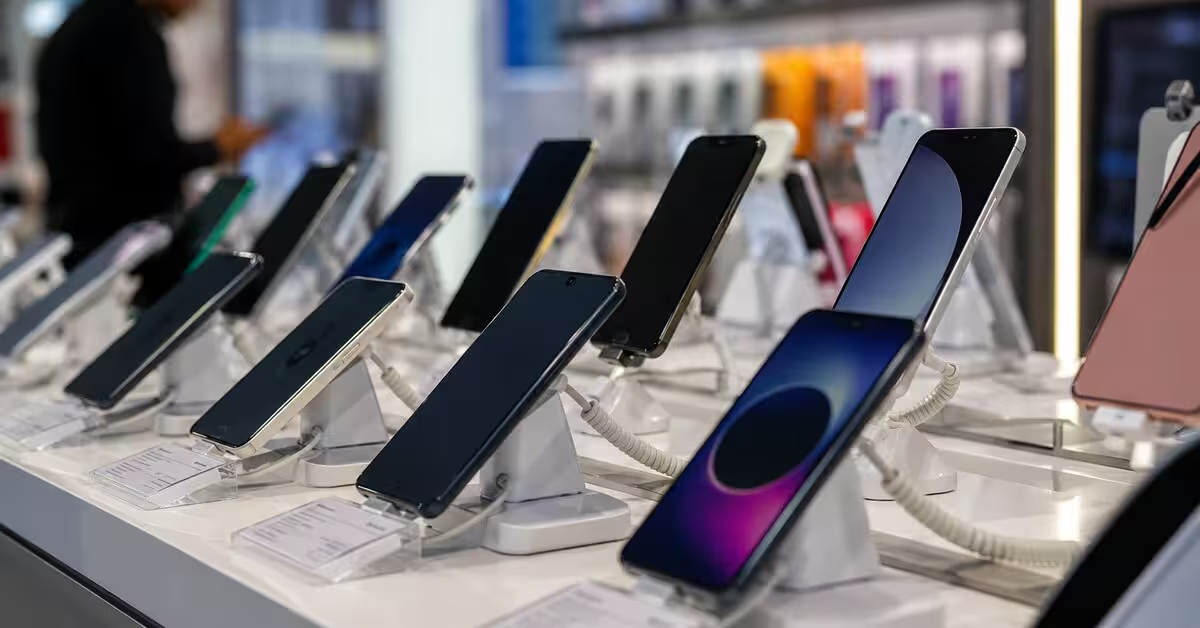
The festive season in India has long meant one thing for smartphone buyers: discounts. Whether they are planning to buy a new phone or upgrade to the latest model, consumers often wait for October offers that bring deep discounts and other deals. For retailers, these offers have traditionally been a major driver of festive sales.
This time around, however, India’s smartphone retailers find themselves in a tricky spot. Phone prices have risen sharply this year, primarily due to memory and other component costs. This leaves retailers with less room to offer the kind of deep discounts consumers have come to expect.
To tackle this, retailers and brands are moving beyond simple cuts in sticker prices, turning instead to a mix of cashback, exchange offers and easy financing to keep phones affordable, if not cheaper.
Why smartphone prices are rising so sharply
The increase in prices is most visible in the lower and mass-market segments. According to Counterpoint Research’s bill-of-materials analysis, component costs for similar low-end smartphone configurations rose by 70 per cent year-on-year during the quarter, with almost all of the increase coming from memory. Counterpoint’s global price tracker found that existing smartphone retail prices rose by 15 per cent globally in 2026 so far, while India recorded a 21 per cent increase, the highest among the markets it tracked.
According to data compiled by the All India Mobile Retailers Association (AIMRA), which represents 150,000 mainline retailers, prices of several smartphone models have risen sharply since November last year. Vivo’s T4 Lite 6GB/128GB variant, for instance, was launched at ₹10,999 in June 2025 and is now priced at ₹20,999, an increase of nearly 91 per cent.
Oppo’s F-series also shows the scale of the increase. The F31 8GB/128GB was priced at ₹26,999, while the upcoming F35 8GB/128GB is priced at ₹42,999. The new model offers minimal upgrades, including a 50 MP front camera against F31’s 16 MP camera and 8,000 mAh battery against F31’s 7,000 mAh battery, with an exponential 59 per cent price hike.
Rajveer Shah, global chief strategy officer at MITSUMI Distribution, said brands have passed on a meaningful part of the price hike through revised price lists, although distributors and retailers have absorbed some of the cost to protect shelf prices during the festive period. Wholesale price increases have been faster for premium models, while some mass-market brands have held prices for longer.
Naveen Malpani, partner and consumer & retail industry leader at Grant Thornton Bharat, said further upward pressure from component costs is expected.
Infographic created using ChatGPT
Festive discounts are changing shape
Brands and channel partners are increasingly using targeted support rather than simply cutting the wholesale or retail price. Shah said this includes margin support, price protection guarantees and sell-through incentives linked to retail movement.
Retailers are seeing the same shift. “We expect fewer outright price cuts on smartphones this festive season than last year. Offers are likely to shift towards affordability led offers like EMI and exchange bonuses,” said Shibashish Roy, CEO & MD, Infiniti Retail Limited, which operates Croma.
The offer package for the Oppo F35, which is set to be launched on October 10, is an example of how this is being structured. Buyers can choose zero-down-payment financing for up to 18 months on the F35 Pro and 15 months on the F35, or opt for up to nine months of no-cost EMI with 10 per cent instant cashback on select bank cards. Full payment and UPI transactions also carry 10 per cent cashback. The package additionally offers an exchange bonus of up to 10 per cent, an assured buyback of up to 70 per cent for ₹399, and a 50 per cent discount on OPPO Enco Buds3 Pro+ when bought with the phone.
Retailers feel the squeeze on margins
The shift also reflects pressure within the retail channel. Shah said margins per device were under strain, prompting distributors to rely more on volume-linked incentives, financing tie-ups, exchange programmes and after-sales support.
AIMRA Founder Chairman Kailash Lakhyani said traditional brand support had also become more constrained, with brands leaning more on bank cashback, upgrade bonuses, trade-ins and longer-tenure no-cost EMI schemes.
Retailers are also becoming more cautious about inventory. Rather than building large stocks in anticipation of higher prices, distributors are aligning inventory with confirmed brand commitments and pre-booked demand, Shah said.
Financing takes centre stage online
Amazon India expects strong smartphone demand during its Great Indian Festival, which begins on October 8. Zeba Khan, director of consumer electronics at Amazon India, said the company’s pitch is about affordability rather than just price cuts.
“During Prime Day 2026, we saw a large share of buyers use financing to upgrade, with one in four electronics purchases on EMI and four out of five of those on no-cost EMI. That value is already live in our Early Deals, where a customer can combine a 10 per cent instant discount with SBI credit and debit cards and credit card EMI with exchange value and no-cost EMI, along with 5 per cent cashback for Prime members on the Amazon Pay ICICI Bank credit card. For anyone who has been considering an upgrade, this is the right window with the year’s strongest value and the widest selection across price points,” she said.
Affordability, not discounts, may drive sales
Malpani from Grant Thornton Bharat said this festive season is moving away from deep-discount-led growth towards value-led affordability. Consumers are increasingly likely to use exchange offers, bank cashback and no-cost EMI, while some may opt for older-generation models, lower-priced devices or extend the replacement cycle. Refurbished phones could also benefit from the shift.
AIMRA’s Lakhyani, however, sees a sharper divide across income and price segments. He said buyers who have access to financing are using longer EMIs, while more price-sensitive consumers are moving towards lower-tier specifications, refurbished or second-hand phones, or simply continuing to use their existing devices for another six to 12 months.
Croma’s experience is somewhat different. CEO Roy said demand in the mid and premium segments remained steady and that the retailer was not seeing significant signs of consumers trading down or postponing purchases. He said the weakness in the lower-price segment was more a supply issue than a demand problem.
The two views point to a widening divide across price segments. Counterpoint has also found the ultra-premium segment relatively resilient, supported by financing, while the sub-₹15,000 segment has seen a much sharper contraction.
Festive price relief may be short-lived
For now, brands and channel partners appear willing to absorb part of the cost increase on volume-driving models during the festive period. But Shah said this was only a short-term cushion.
According to the industry players, some price increases are expected to follow after the festive quarter. That leaves retailers with a narrow window.
For shoppers, meanwhile, the festive bargain may increasingly come not from a large reduction in the phone’s sticker price, but from how the purchase is financed, what old device is exchanged, and which additional benefits are bundled into the deal.