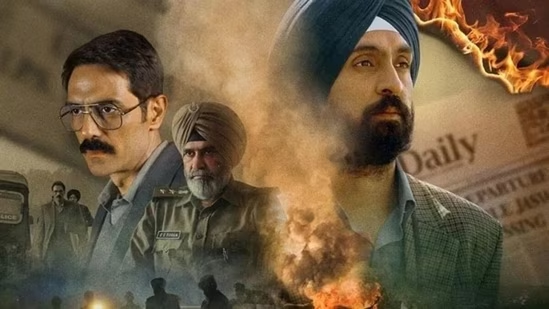
Do the names Govind Ram and Rajan ring a bell? No? I will introduce you to both, but a little later in this column. Let’s first talk about the movie, Satluj. I watched it the day it was released on OTT. I felt it forwarded half-truths and biased narratives about the period it is based on.
Some facts kept gnawing at me throughout the film. I am convinced that KPS Gill was not a villain, nor did the Punjab Police ever degenerate into a gang of brigands. The violence of the time threatened the very soul of Punjab and punjabiyat.
The distress the security forces and people faced can be understood from the accounts of Major AK Ravindran. One afternoon, he received information about an incident near Harike. At the spot, he found a mother and her three daughters, broken and distraught. How he tracked down seven terrorists — the women’s captors — gave chase and killed them is a story for a different day. The women’s testimony gave away the contours of Punjab’s tragedy of those years. Their ordeal moved the battle-hardened soldier to tears. The terrorists, the self-styled religious zealots, raped the women throughout the preceding night. Their bodies bore deep gashes and bite-marks. This is just one example among the thousands of documented atrocities people suffered.
Satluj conveniently forgets it all.
On June 15, 1991, in Ludhiana, ‘marjeevde’ (suicide-mission militants) killed 76 train passengers in two separate incidents. Those gunned down were non-Sikhs, profiled and segregated. Many such massacres were given effect, but, again, Satluj remains silent.
In those dark, turbulent times, between 1980 and 1990, shops in Punjab would shut before sunset. People would speak in whispers, hesitating even before friends. Even neutrality could mean death at the hands of the zealots. Thousands fled Punjab, both Sikhs and non-Sikhs. Between 1981 and 1993, close to 22,000 people were killed by terrorists in Punjab. More than half were civilians.
Highways remained shut throughout the night and buses plied under police protection. In the border districts of Firozpur, Amritsar, and Gurdaspur, bus routes were changed. Trains passing through Punjab would empty out in Haryana. Terror, though, didn’t spare even places outside the state — cities such as Chandigarh, Delhi and Mumbai saw blasts and attacks that killed or maimed targets. Satluj glosses over all this, too.
The movie fails to mention that when KPS Gill became the director-general Punjab Police in 1988, the law and order situation in the state had completely collapsed. Punjab’s trademark zest for life had given way to fear. Police morale was at an all-time low. The terrorists would release a “hitlist” and the terrified family members of the police personnel named would publish disclaimers in newspapers announcing their piety and profound belief in Sikhism.
The turnaround that Gill achieved is unparalleled. That’s the reason banning Satluj doesn’t seem irrational.
Now, let’s come back to Govind Ram and Rajan. Govind Ram was a 1975-batch IPS office, posted in the terrorist-affected Batala district. One day, he took Rajan, his son, to the market to buy stationery for him. Terrorists ambushed the duo and Rajan was killed. After the incident, citing security reasons, Govind Ram was transferred to Punjab Armed Police’s (PAP) 57th Battalion as its commander.
Paramilitary campuses are considered safer than civil police establishments. But, on January 10, 1990, a bomb planted in a desert cooler exploded, killing Govind Ram. How could the bomb breach a high-security facility? Who planted it? Terrorists and their informers had infiltrated even the most secure government places.
What was Satluj’s protagonist, Jaswant Singh Khalra, doing at the time? He was the editor of a magazine, Khalistan Liberation. Khalra considered Bhindrawale as the guiding light of the Sikhs. He viewed Indira Gandhi’s killers as greater martyrs than Bhagat Singh. Until then, he hadn’t become a human-rights activist. It’s possible he assumed the mantle of a human-rights activist when he saw peace returning to Punjab. His voice carried more weight in the gurudwaras of Canada and Britain than in Punjab. In 1995, he vanished. That shouldn’t have happened. But innocent Hindus and patriotic Sikhs who stood up to the terrorists shouldn’t have been butchered either. The human rights of policemen and their families should have been preserved.
Satluj remains silent about it all.
But then, we are in the age of propaganda films. People forget popular films aren’t portraying true history. All they do is foment social discord. This trend needs to be checked, once and for all.
(Shashi Shekhar is editor-in-chief, Hindustan. The views expressed are personal.)