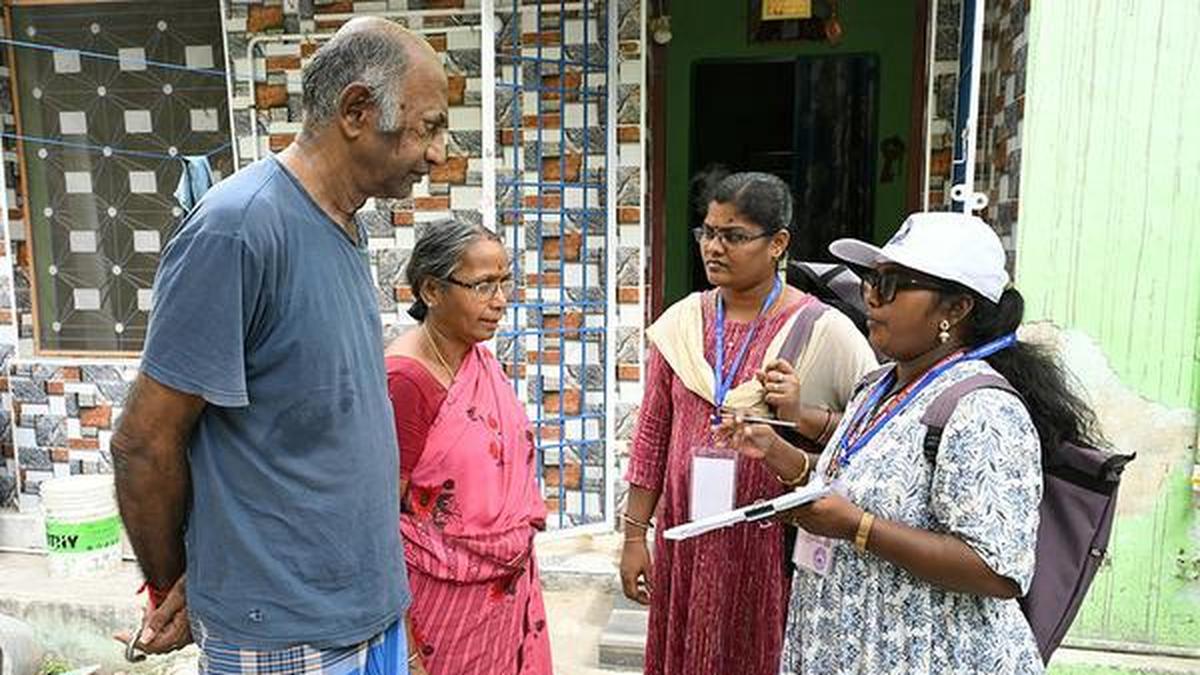

The Supreme Court on Monday (October 5, 2026) agreed to hear a petition questioning whether State governments can undertake a fresh delimitation of wards and alter the boundaries during an ongoing Census exercise.
A three-judge Bench headed by Chief Justice of India Surya Kant indicated listing the case on October 9 for hearing.

The petition filed by Paka Suresh, a former Mayor of the Kadapa Municipal Corporation in Andhra Pradesh, said the question of law was of general public importance concerning the conduct of Census 2027, with implications for the entire country.
Rule 8(iv) of the Census Rules 1990 requires State governments to “freeze the administrative boundaries of districts, tehsils, towns, etc.” from the date intimated by the Census Commissioner.
It is during this period that the exercises for conducting the Census, including the coding of units and the formation, house-listing, and enumeration of blocks take place. The freeze ensures that every unit is enumerated against a fixed territorial frame, so that no area or person is omitted or counted twice, and the data remain comparable across units and across Censuses. If boundaries change midway, blocks already formed and coded would no longer correspond to the units on the ground.

The petitioner, represented by advocate Mahfooz Ahsan Nazki, said the Registrar General and Census Commissioner of India issued the period of prohibition under the rule on August 13, 2025. This had frozen the boundaries of administrative units from January 1, 2026, to March 31, 2027.
However, the question of whether ‘administrative blocks’ would also mean ‘wards’ came up for a decision before the Andhra Pradesh High Court.

The High Court, in a judgment on October 1, held in favour of the Andhra Pradesh government that the prohibition against delimitation, issued under the Census Act, related only to an ‘administrative block’ such as a ‘municipality’ and did not extend to a ‘ward’.
Mr. Nazki, in an oral mentioning, submitted that the High Court’s conclusion was contradictory to a Madhya Pradesh High Court judgment, which had held that the prohibition on delimitation under Rule 8(iv) of the 1990 Rules extended to wards within a municipal area.
“There is a direct conflict between two High Courts on a provision of a Central statute that operates uniformly throughout India, and an authoritative pronouncement of the Supreme Court is required,” Mr. Nazki submitted.

He said a ‘ward’ is a basic territorial unit on which the Census is conducted in urban areas.
“If changes in ward boundaries are permitted at this advanced stage, the entire exercise carried out by the Registrar General and Census Commissioner of India would be rendered meaningless. Each reconstituted ward would have to be assigned a fresh code, and the house listing and enumeration blocks drawn within the old wards would no longer correspond to the new ones,” the petition said.