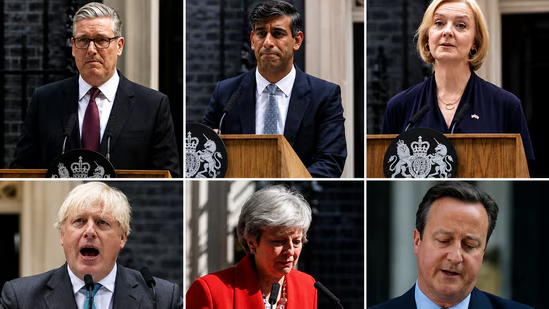
The United Kingdom is preparing for yet another change at the top, extending an extraordinary period of political churn that has reshaped British politics over the past decade.
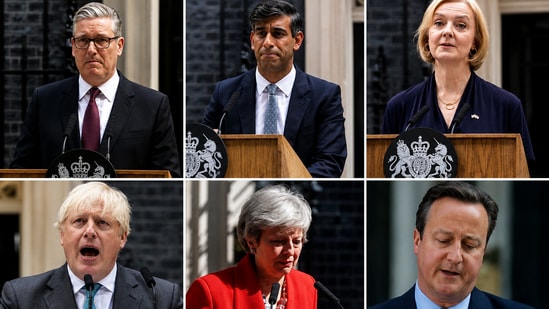
Andy Burnham has been confirmed as the new Labour Party leader and the UK’s Prime Minister-designate. The former Mayor of Greater Manchester is expected to move into 10 Downing Street next week, replacing outgoing Prime Minister Keir Starmer.
Starmer’s departure comes less than two years after taking office. His popularity declined sharply as his government struggled to deliver on its promise to “rebuild Britain”, ultimately leading to his resignation.
Also read | Andy Burnham confirmed as new Labour leader, UK PM-designate
The latest leadership change marks another chapter in a period of unprecedented political instability. The past 10 years have seen a rapid succession of British prime ministers — something without precedent in modern British political history.
David Cameron (2010 to 2016)
David Cameron resigned as Prime Minister in July 2016 after six years in office, following Britain’s vote to leave the European Union. Having campaigned for the UK to remain in the bloc, Cameron accepted responsibility for the referendum outcome and wished the country “continued success” in its post-Brexit future.
During his tenure, Cameron had promoted what he described as a “special relationship” with India and developed a rapport with Prime Minister Narendra Modi, particularly during Modi’s visit to London in November 2015.
Also read | Keir Starmer 6th UK PM to resign in last 10 years: List of ‘unpopular’ PMs in Britain’s ‘House of Cards’
After stepping down as Prime Minister, Cameron also announced he would resign as a Member of Parliament, saying he did not want to become a distraction for his successor, Theresa May.
Theresa May (2016 to 2019)
Theresa May succeeded Cameron and inherited the difficult task of leading Britain out of the European Union after the divisive Brexit referendum.
Britain’s second woman Prime Minister after Margaret Thatcher, May remained in office for 1,106 days before announcing her resignation on May 24, 2019.
Her government struggled to secure parliamentary approval for its Brexit agreement, while more than 35 ministers resigned during her tenure, ultimately forcing her to step down.
Boris Johnson (2019 to 2022)
Boris Johnson took over after winning the Conservative Party leadership contest against then foreign secretary Jeremy Hunt.
A former journalist educated at Eton and Oxford, Johnson led the country until July 2022 before resigning after a wave of resignations by senior ministers protesting against his leadership.
Liz Truss (2022)
Johnson was succeeded by Liz Truss, whose premiership lasted just 45 days, making her the shortest-serving Prime Minister in British history.
Read more| Is Andy Burnham more than just a smart-casual Keir Starmer?
Only a day before resigning, Truss had declared that she was “a fighter and not a quitter”. However, her controversial “mini-budget” triggered market turmoil, weakened the British pound and led to a collapse of support within her own party.
She resigned on October 25, 2022.
Rishi Sunak (2022 to 2024)
Rishi Sunak became Britain’s first Prime Minister of Indian origin after winning the Conservative Party leadership race. At 42, he was also the country’s youngest Prime Minister since David Cameron.
However, the Conservative Party’s 14-year rule ended in 2024 as anti-incumbency and declining public support brought Labour back to power. Sunak resigned on July 4, 2024, bringing his time at Downing Street to an end.
Keir Starmer (2024 to 2026)
Keir Starmer led Labour back to power after more than a decade and entered office with a promise to change Britain’s fortunes.
His government was expected to restore political stability after years of leadership changes. Instead, Starmer’s administration struggled to fulfil key promises on economic growth, public services and the cost of living. Labour’s poor performance in recent elections further weakened his position.
His premiership also came under pressure after he appointed Peter Mandelson as Britain’s ambassador to the United States. Mandelson was later found to have had more extensive ties with disgraced financier Jeffrey Epstein than previously known.
Facing mounting pressure from Labour MPs and cabinet colleagues, Starmer announced his resignation on Monday, June 22.
Burnham prepares to take over (2026)
Burnham’s elevation now marks the latest leadership transition in Britain’s turbulent political decade.
He is expected to formally replace Starmer at 10 Downing Street next week.