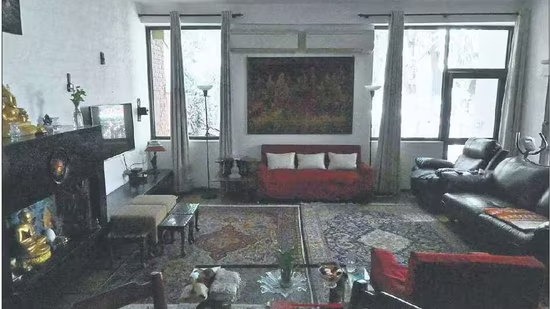
The rarest site in a city of over 22 million people is a single-storey, two-bedroom bungalow. Casa Pia is tucked away in south Delhi’s Hauz Khas area, sitting amidst prime real estate while choosing to preserve its original structure of Chandigarh-inspired Delhi Modernism.

The architect of the house was Indur Mirchandani, who bought the plot of land and began construction in 1972. Mirchandani came from fantastic architectural training. He was a civil engineer who worked in Himachal Pradesh and with the team of Chandigarh architects Le Corbusier and Pierre Jeanneret. Later, he was also the civil engineer who worked on the building of IIT-Delhi.
ALSO READ | The house Sir Sobha Singh built after Rashtrapati Bhavan
For his own home, he wanted to build a bungalow inspired by Pierre Jeanneret, Maxwell Fry, Jane Drew, and Le Corbusier’s design fundamentals. The primary focus revolved around modernist functionalism, tropical adaptation, and social utility. He emphasised cost-effective residential architecture and user-centric, ergonomic furniture. In a way, he integrated “Garden City” concepts with social infrastructure and recessed facades to create shadow and cool indoor spaces. The outdoors was dressed with iron works from Nahan Foundry.
Modernism as a term was too theoretical for me until I had the chance to stay in Maison Pierre Jeanneret in Chandigarh – the house Pierre Jeanneret built for himself while planning the city and its elements. That house was ground zero of practice and planning. I began to see what modernist austerity was. It became clear what the vernacular in the international script of modern architecture meant. The bricks, the breezeblocks, the gardens, the furniture – each simple yet dynamic.
The 1950s were an exciting time for India. Laying the foundation for a modern city, Jawaharlal Nehru once said: “There comes a time, which comes but rarely, when the soul of a nation long suppressed, finds utterance.” It was Nehru’s vision that laid the agenda for Chandigarh; it was to be “a symbol of the nation’s faith in the future.”
ALSO READ | Inside a professor’s 1970s house in north Delhi’s university precinct
Within this backdrop, Indur Mirchandani – the civil engineer who worked with the team in Chandigarh and was then chosen in Delhi to work on building IIT Delhi, on which he worked for over 10 years. Between Chandigarh and Delhi, he began pining for a home in Delhi. South Delhi at this time was different. Hauz Khas and Mayfair Gardens were large swaths of agricultural fields, in between which a small colony of just over a hundred houses was planned surrounding the Sabzwari Makhdum Tomb, where Sindhis migrating to Delhi were beginning to build.
Arun Mirchandani, who still lives in the house, recalls this land being a cabbage patch that belonged to the Shahpur Jat village. In 1956, AIIMS was coming up, and Yusuf Sarai back in the day was just fields and ruins. As the family began building this house, they kept it for renting to tenants for over a decade while Arun lived like a bachelor above the garage. That room remains in the same state, although now more like a storage room – but still a keeper of the books and notes of a young civil engineer.
Delhi was taking substantial influence from Chandigarh, and this house is the perfect example of North Indian Modernism. Designed as a red brick house with a front garden and a backyard, the house’s design facilitated ventilation critical for an Indian home given the density of smells of an Indian kitchen.
ALSO READ | Tara Apartment in Alaknanda: Charles Correa’s Indian modernist futurist maisonettes
What fascinated me most about this house is its ability to function self-sufficiently across the year. That is the thing about modernism: the engineers really understood the climatic conditions of the place they were building in and responded to them in ways that were climate sensitive. This house was built before we used coolers or air conditioners. Its windows distil light to make the house energy efficient and low impact. For the winters, the house has a fireplace in the drawing room with tiles made by Delhi’s favourite modernist, Satish Gujral.
The bedrooms are classic, with ample lofts for storage, furniture from the 1960s with aerodynamic softness and plywood texture. Each bedroom opens into the backyard with access to the backlane and the garage room.
The family has lived in this house for about 50 years, and the only upgrades they have done are light furnishings and shelving. The signs of age in a house like this are negligible, as every year they maintain it before monsoon.
What is incredible for a house in south Delhi these days is its choice to remain a single-storey, two-bedroom house, especially at a time when real estate has become the main source of income for many families. As Delhi expanded, south Delhi real estate became positioned just after central Delhi as one of the most expensive in north India. Some parts of the city rival pricing with New York and London, yet the family continues to live in a simple modernist house – because it works better than more post-contemporary, amenity-loaded houses.
Sometimes a house like this needs more love for its legacy to remain the way it is. It is modernist frugality that makes this house a solid one to continue living in.
Anica Mann works on archaeology and contemporary art in Delhi. The views expressed are personal