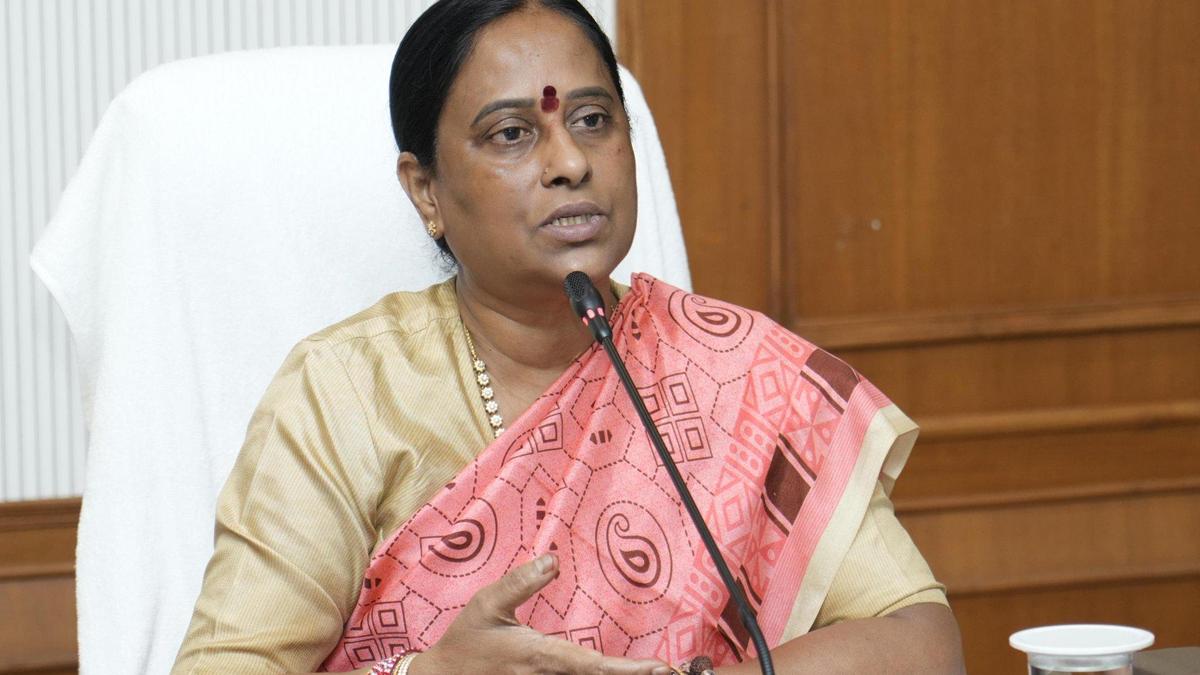

The dismissal of Endowments Minister Konda Surekha from the Telangana Cabinet is among the strongest political and disciplinary decisions taken by the Congress government since it came to power, and sends a clear message that continued indiscipline will eventually invite action irrespective of a leader’s political identity or social background.
For nearly a year, Ms. Surekha was given considerable latitude despite a series of controversies that periodically embarrassed the government and the Congress. The party appeared reluctant to take an extreme step against a senior woman leader and a prominent face from Backward Classes (BC).
The decision to finally recommend her removal suggests that the leadership felt the political cost of allowing the conduct to continue had become greater than the embarrassment of dropping her.
What makes the decision particularly significant is that Congress governments in recent times have generally avoided taking such a harsh step against their own senior colleagues. The Telangana leadership too had largely managed to insulate the government from statements and actions by some of its own leaders.
Rajgopal Reddy’s uncomfortable questions
Munugode MLA Komatireddy Rajgopal Reddy, for instance, had raised uncomfortable questions on several occasions. But his statements were largely interpreted in the context of the political understanding under which he had returned to Congress from the Bharatiya Janata Party (BJP). His grievance was seen more as being directed at the Delhi leadership over the Cabinet assurance reportedly made to him before the Assembly elections rather than as a direct challenge to the functioning of the Telangana government.
The Surekha episode was different. Her conduct increasingly came to be viewed as an issue of discipline and the authority of the Chief Minister himself.
Series of controversies involving Konda Surekha
Ms. Surekha had been controversial for some time. The episode involving her OSD Sumanth and the behaviour of her daughter Sushmita when the police attempted to arrest him over allegations of threatening a businessman for money, had already caused some damage to the government’s image.
The latest controversy, however, appears to have crossed a political red line; Ms. Sushmita’s comments questioning the authority of the Chief Minister were particularly difficult for the party to overlook. Ms. Surekha’s silence on those remarks was perceived within the Congress as tacit approval rather than an attempt to distance herself from them. That was effectively the final trigger.
The party also appears to have been careful about following the prescribed disciplinary process before acting. The disciplinary committee conducted an inquiry and submitted its report, providing the leadership with a formal basis for proceeding against her. Some senior Ministers are learnt to have made efforts to save Ms. Surekha and avoid the embarrassment of removing a Minister from the Cabinet. But the All India Congress Committee (AICC) eventually appeared unwilling to make another concession.
Ms. Surekha’s political defence increasingly took on a social justice dimension. She questioned whether she was being targeted because she was a woman from Backward Classes and sought to position the action against her as an issue of representation.
The Congress response appears to have been politically calculated. The government has sought to blunt that argument by simultaneously giving important positions to BC women leaders. Gadwal Vijayalakshmi has been appointed Vice-Chairperson of the Telangana State Planning Board with Cabinet rank, while Nerella Sharada has been appointed Chairperson of the Telangana State Commission for Women.
Former MP G. Sudha Rani’s appointment as Kakatiya Urban Development Authority (KUDA) Chairperson adds another prominent woman leader from the Warangal region to the government’s institutional structure. She belongs to the Padmashali community, to which Ms Surekha also belongs.
The government can therefore argue that the action against one leader should not be equated with a reduction in representation for BC women. The appointments also fit into the broader political narrative projected by the Revanth Reddy government, which portrays women and BCs as being given greater representation.
The government has highlighted the appointment of a woman as Vice-Chairperson of the Planning Board as a first in the State’s history and contrasted its record with the previous Bharat Rashtra Samithi (BRS) regime, which, it argues, did not provide adequate representation to women in ministerial and corporation Chairperson positions.
Another important dimension
There is another important dimension to the episode. The induction of Ministers is largely an AICC decision, with the Chief Minister having a relatively limited role in the final selection. Therefore, the removal of a Cabinet member cannot be seen simply as a personal decision of Mr. Revanth Reddy. It represents a larger Congress leadership decision on how far individual Ministers can go in publicly challenging the government and party leadership.
For Mr. Revanth Reddy, the episode also reinforces the authority of the Chief Minister at a time when the government is approaching the midpoint of its term. The message to Ministers and legislators is that political differences and individual ambitions may be accommodated, but publicly questioning the authority of the government or the party’s central leadership has limits.