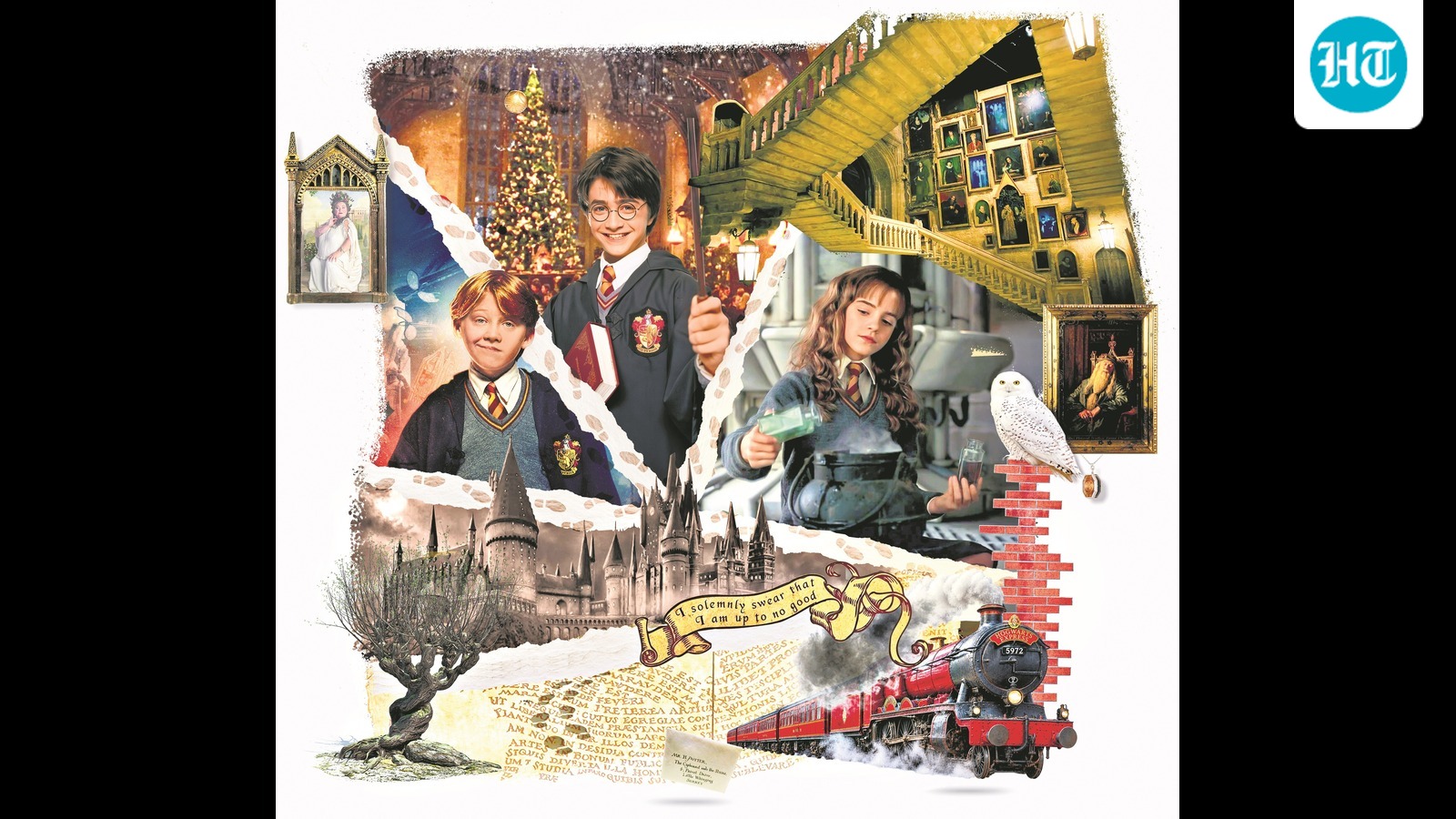
Since the turn of the century, children have half hoped on their 11th birthday that a magical owl will arrive on their street, with news that there really is a world of spells and sorting hats.
Of course, there is no letter in emerald green ink. We’re all just Muggles, and won’t ever get to run through a brick wall at Platform 9¾.
Still, the magic lingers, of those seven enchanted titles released between 1997 and 2007. As the books became mega movies, they introduced millions more to the spectacled boy wizard and the world of Hogwarts. This year marks 25 years since that first film, Harry Potter and the Sorcerer’s Stone (2001).
The Potter empire now extends to eight movies; companion books and films such as Fantastic Beasts and Where to Find Them; a play, Harry Potter and the Cursed Child, set 19 years after the end of the books; as well as merchandise, collectibles, six theme parks (across the US, UK, Japan and China), and endless spin-offs, including an official guide to baking wizard treats.
A new HBO series, Harry Potter, based on the seven core books but aimed at a younger, newer audience, is due for release in December.
Meanwhile, with more than 600 million copies sold, author JK Rowling, 61, has gone from a struggling mother and teacher to one of history’s richest writers (and, in recent years, a highly controversial one, as a result of what are seen as trans-exclusionary views).
Her books have prompted Harry Potter courses at universities that include Yale in the US, Durham in the UK and at the National University of Juridical Sciences in Kolkata. Academics study the moral philosophy and religious undertone of the books, their treatment of prejudice and identity, as well as the legal and ethical dilemmas woven into the plots.
FANTASTIC BEASTS
“Mr and Mrs Dursley, of number four, Privet Drive, were proud to say that they were perfectly normal, thank you very much.”
That’s how the books begin. But how did they get their start?
It can all be traced, as with so many extraordinary tales, to a perfectly ordinary day.
Stuck on a delayed train between Manchester and London, Rowling wondered what it might be like if one of the young, bespectacled boys around her came to learn he was a wizard.
The world soon took on vivid form, with a school of magic, invisible platforms, secret buses, wand and owl shops, invisible inks, sports such as quidditch, broomsticks, horcruxes, Dumbledore, Voldemort and Hagrid.
It could have been just another fantasy series, if not for the complexity of the people Rowling placed at its heart.
There was Harry, the brave and lonely orphan boy, living in a cupboard under the stairs, with a cruel aunt, uncle and cousin.
Ron, his clumsy and loyal best friend. Hermione, a curious and talented young witch born to Muggle parents. Dumbledore, the all-knowing, wise headmaster of the Hogwarts School of Witchcraft and Wizardry. Hagrid, the generous half-giant groundskeeper. Severus Snape, the sour-faced Potions master. And Voldemort, the fascist villain determined to rule the world of wizards by torture, tyranny and death, if necessary.
THE LIMITS OF MAGIC
The flights of fancy are what first cast a spell, as one makes one’s way through the books (the wizards’ weird treats alone are an exercise in whimsy). But the other half of that spell lies in just how plausible all of it instantly feels.
It helps that the characters are of our world. Their magic is a learned craft, they struggle to master the spells, get into scraps, miss deadlines, and are scolded for incomplete homework.
This is fantasy with roots in the ordinary, says Anthony Jack Gierzynski, a scholar of politics and media studies at University of Vermont, and author of Harry Potter and the Millennials (2013), which explores how the series influenced the worldview of a generation. “Harry, Ron, Hermione are basically like any ordinary kids. That drew people in. Children, or even their adults, reading the books could instantly connect with them.”
The magic also lies in Rowling’s subversion of the fantasy genre.
“Harry goes off into this magical world, and is it any better than the world he’s left? Only because he meets nicer people,” the author said in a 2005 interview with Time. “Magic does not make his world better significantly. The relationships make his world better.”
A SIRIUS RECKONING
These messages aren’t tucked away subtly. The books and films encourage children to engage with ideas of justice and freedom, in unusually complex ways.
“This is fantasy not meant to be merely consumed but inhabited,” as Lana A Whited puts it.
The professor of English at Ferrum College, Virginia, is editor of three books that trace the extensive impact of the series, on areas that range from publishing to political scholarship.
The way the Potter books were written, she adds, prompts the reader to ask questions such as “What house would I be sorted into?” and “What does that say about me?”
DEFENCE AGAINST THE DARK ARTS
From that early sorting hat query, came others that were even deeper.
“In the foreground, we explore prejudice through the wizarding world’s obsession with blood purity. Muggle-borns like Hermione are treated as inferior to someone from a long magical lineage, like Draco Malfoy,” says Whited. “In the background, Rowling establishes a timeline that overlaps with the history of race-based persecution in Europe.”
Amid it all are three children whose clarity and courage take the form of resistance to authoritarian power, unquestioning acceptance of differences, and opposition to prejudice.
Harry, Ron, Hermione and a growing group from their school advocate for equal rights for all: wizards, Muggles, those of mixed heritage, and all magical creatures. Voldemort mirrors the dictators and totalitarians of the world, pushing for a world of pure-blooded wizards.
Decades on, the books are used to invoke ideas of justice, diversity, bravery, love. Protestors against dictatorial governments carry placards that declare themselves part of “Dumbledore’s Army”. The headmaster, after all, is the embodiment of this specific liberal worldview.
How we respond to a world in crisis defines us, he notes, in Harry Potter and the Chamber of Secrets (1998): “It is our choices, Harry, that show what we truly are, far more than our abilities.”
Harry, meanwhile, prevails not because he has extreme talents or capabilities but because the idea of wavering from the path of good simply doesn’t occur to him. He confronts difficulty by framing plans to change things for the better, then invites others along: friends, allies, people in power.
AFTER ALL THIS TIME?
“Fiction’s power often lies precisely in the unselfconscious absorption of ideas,” says Gierzynski. “And stories don’t merely reflect the values of their times; they can also help reinforce and shape them.”
In a time of complexity, conflict and morally ambiguous heroes, these tales offer something vital: comfort, in the knowledge that the road ahead may not be easy, but there will be a right way to go down it.
Rowling, through Dumbledore, said it herself, in Harry Potter and the Deathly Hallows (2007): “Words are, in my… opinion, our most inexhaustible source of magic.”