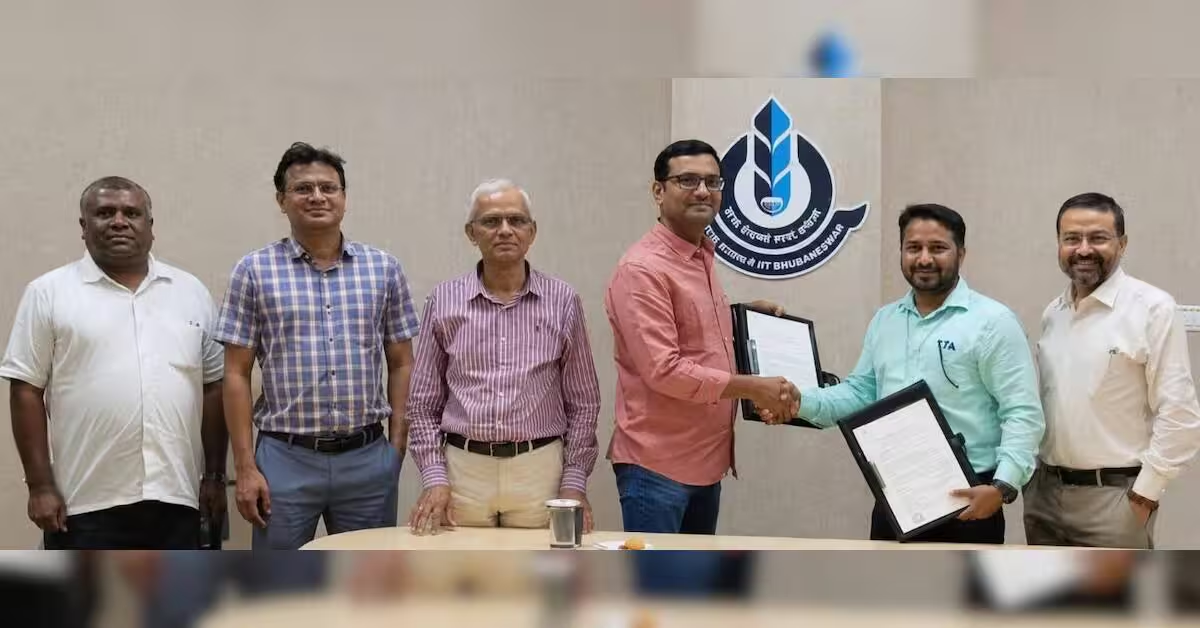
Indian Institute of Technology (IIT) Bhubaneswar has partnered with Odisha-based Coratia Technologies Private Limited to undertake collaborative research and develop advanced underwater communication systems and robotic platforms, with potential applications in defence, maritime security, infrastructure monitoring and ocean exploration.
The IIT has expertise in underwater acoustic communication and signal processing, while Coratia Technologies is known for designing and developing unmanned underwater vehicles (UUVs). They will develop indigenous systems and bridge the gap between laboratory research and industry-ready solutions in a technology domain important for India’s strategic and maritime requirements.
According to the agreement signed on Friday, the focus will be on developing high-data-rate and robust underwater communication systems, which face considerable technological challenges because radio-frequency signals do not travel efficiently through water.
Underwater communication relies largely on acoustic technologies, where factors such as signal attenuation, ambient noise, multipath propagation and changing underwater conditions can affect the reliability and speed of data transmission.
The collaboration aims to address some of these challenges by combining advances in acoustic communication and signal processing with practical requirements arising from underwater robotic operations. The two organisations will also work on integrating advanced communication modules with underwater vehicles to enable more reliable data exchange, monitoring and control during underwater missions.
Beyond research and design, the partnership envisages joint technology development, prototyping, testing and field validation to accelerate the transition of indigenous technologies into deployable systems.
This could strengthen the capabilities of underwater vehicles to undertake inspection, surveillance, data collection and other operations in environments where human intervention is difficult, expensive or potentially hazardous.
The technologies developed under the collaboration could find applications in the inspection and monitoring of critical underwater infrastructure, including dams, bridges, ports, pipelines and offshore assets.
Other potential areas include defence and security, marine exploration, disaster management and scientific research. Reliable underwater communication and autonomous robotic systems are relevant for monitoring submerged infrastructure, conducting seabed surveys and collecting oceanographic data.
Debendra Pradhan, co-founder and CEO of Coratia Technologies, said advancing India’s underwater technology capabilities requires close collaboration between industry and academia.
“Our partnership with IIT Bhubaneswar brings together complementary expertise in underwater communication, signal processing and robotics, creating opportunities to take research beyond the laboratory and towards practical applications. We look forward to contributing to India’s growing underwater technology ecosystem,” he said.
The partnership will further explore joint participation in research programmes sponsored by the government, defence establishments and industry, opening up avenues for technology development in areas of national strategic importance.
Coratia Technologies has already signed a tripartite technology licensing agreement with the National Institute of Ocean Technology (NIOT) and the National Research Development Corporation (NRDC) for the autonomous underwater profiling drifter (AUPD), an indigenous ocean-monitoring technology capable of measuring temperature, salinity and depth at depths of up to 2,000 metres.
The technology is designed to support ocean observation and data collection, adding an oceanographic research dimension to the company’s existing work in underwater robotics and inspection systems.
P R Sahu, a professor at IIT Bhubaneswar, said the collaboration would help bring academic research closer to industry requirements in an emerging and strategically important technology domain.
“We have been encouraging innovation, facilitating technology development and creating opportunities for students and researchers to engage with real-world challenges by combining research expertise in underwater communication and signal processing with industry capabilities in underwater robotics,” he said.
Coratia Technologies develops indigenous remotely operated vehicles (ROVs) and autonomous marine systems for underwater inspection and intervention across defence, infrastructure and industrial sectors. Its capabilities include underwater visual inspection, sonar surveys, bathymetry, non-destructive testing, structural assessment and robotic cleaning.
Systems designed by the firm support the inspection and assessment of submerged infrastructure such as dams, bridges, ports, ships, pipelines and offshore installations, where conventional inspection methods can involve significant operational costs and safety challenges.
The collaboration also provides for a longer-term research and knowledge-sharing framework, extending beyond specific technology development projects. The two organisations will explore joint research initiatives, proof-of-concept development and access to testing and prototyping facilities.