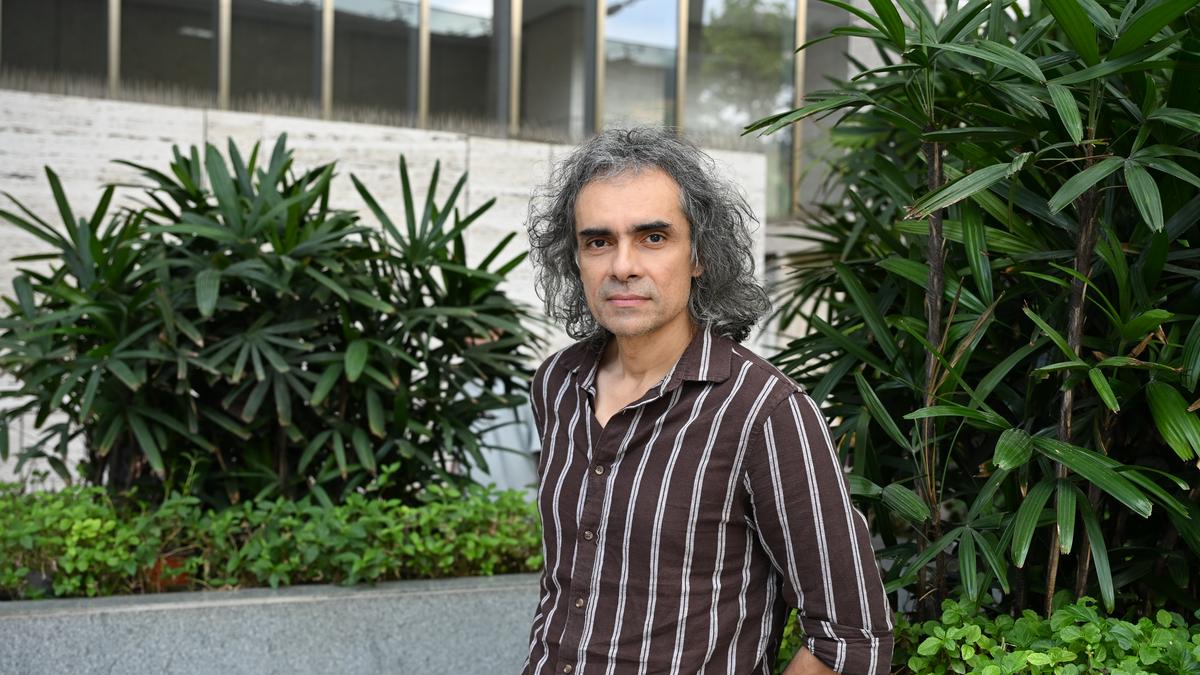
Soon after its release on June 12, 2026, Main Vaapas Aaungawas proving to be a typical Imtiaz Ali movie at the box office. Several of his films are celebrated as classics years after underperforming in theatres, and Main Vaapas Aaunga seemed to be following a similar trajectory. The film had a limited release and footfalls were far from encouraging.
Then, social media became the movie’s biggest ally. One post of appreciation led to another, and more people began turning up at theatres to watch Main Vaapas Aaunga. Confessions of crying inside cinema halls followed. Fans wanted to meet, discuss the film, and have a “group crying session”. Tweets and Instagram stories urged people to watch the movie.

“People felt a sense of ownership,” Imtiaz tells The Hindu. “They watched the movie, liked it and urged their friends and families to watch it. They made Instagram reels about it. The reels had so much earnestness in them that everybody was surprised and they came to see what the movie was about.”
Seeing the outpouring of love, Imtiaz decided to personally champion the movie by participating in ground-level promotions. He began meeting fans after the show, discussing the movie and thanking them for their support. En route to theatres in Bengaluru, the Jab We Met director discusses the remarkable turnaround of his movie.
“My friend Anurag Kashyap, who now resides in Bengaluru, called me to say the film had very few shows in the city,” he recalls. “A week later, they increased, and there was even a 6.30am show, which was filling fast. I was surprised that people were waking up this early to watch a movie. Bengaluru woke up, and parallelly, the entire nation woke up to show love for Main Vaapas Aaunga,” he says with a relieved smile.

Diljit Dosanjh and Naseeruddin Shah in the movie.
| Photo Credit:
SPECIAL ARRANGEMENT
Main Vaapas Aaunga centres on Ishar Singh Grewal, a 95-year-old Sikh man (Naseeruddin Shah) who has spent his life haunted by a promise he made to his first love, Jiya (Sharvari Wagh), to return to her after they were separated during the violence of the 1947 Partition. Diljit Dosanjh plays Ishar’s grandson, who decides to fulfill his grandfather’s final wish.
With two timelines, fundamentally two different people in love, and a conflict that pushes the couple to consider eloping before they get separated, the trailer of Main Vaapas Aaunga suffered from a sense of familiarity. Imtiaz’s biggest hits, such as Love Aaj Kal and Jab We Met, had similar tropes.
“When the trailer of Main Vaapas Aaunga was out, many felt it was another Love Aaj Kal. A bit of worry crept into my team,” admits Imtiaz. “However, I was very sure that this was a different movie. This movie has two timelines, and a young man and his older self are pivotal to the plot. This was something we saw in Love Aaj Kal. To make sure that Main Vaapas Aaunga doesn’t resemble that, I didn’t cast the same actor in the young and old roles. If the young and old characters were written for the same actor, we could have signed a big star. We didn’t go in that direction. We wanted two authentic performers representing two timelines. I also knew that when we reveal more about the core concept — Partition — they would wash away all the reminisce of Love Aaj Kal,” explains the filmmaker.

Sharvari Wagh and Vedang Raina in ‘Main Vaapas Aaunga’.
| Photo Credit:
SPECIAL ARRANGEMENT
While an earnest Vedang Raina essayed the young Ishar, Naseeruddin Shah played the older version of the character. In what is easily one of the finest performances by an Indian actor this year, Shah fully embodies Ishar, suffering from dementia and burdened by the painful memories of the Partition. Imtiaz says Shah is an actor who defies methods.
“It took four hours for him to be ready for scenes because of the prosthetic makeup. He had to lie down, and we had to wire him and put chest leads. So, every time we had to change the light or a shot, he had no option but to lie down on the bed. While the lightman would climb on top of him to change the settings, he would be mumbling. Naseer saab would talk to himself all the time. Sometimes, when I got close to him to explain a scene, I heard him mumble bogus words. That was his way of staying in the character of a person suffering from dementia and to keep the mood of the scene alive,” describes Imtiaz.
He further says, “He had a childlike interest in the movie. He looks like a khadoos man, like an angry professor. But when it comes to acting, he performs with the energy of a passionate young actor.”

Naseeruddin Shah in ‘Main Vaapas Aaunga’.
| Photo Credit:
SPECIAL ARRANGEMENT
Main Vaapas Aaunga is perhaps Imtiaz’s second film after Chamkila to deal with a social subject and to use a relationship as a tool to drive the theme. For someone celebrated for depicting the complex dynamics of relationships against gorgeous backdrops, Imtiaz seems to have evolved as a filmmaker trying to say something significant through the stories of his lead couples.
“That’s a fair point,” he agrees. “I haven’t done it deliberately, though. I wanted to make a film on the dichotomy of Punjab. I felt the story of Chamkila was perfect for it. That’s the reason you see the Punjab-ness of the plot in the forefront. Similarly, I wanted to say something about the Partition. What did we lose from it? What did we break? Why don’t we mention it often? Then came a story to answer these questions.”
Does that mean Imtiaz has turned into a political filmmaker? “Not really. But, you can’t avoid the politics of a place,” he points out. “I am also wary of using the word politics, because today, politics means party politics. The dynamics of the relationships come first in my movies. Sometimes, politics is adopted as a convenience for those relationships to prosper. For instance, in Main Vaapas Aaunga, the couple doesn’t want Partition to happen because they want to be together.”

Imtiaz Ali on the sets of ‘Main Vaapas Aaunga’.
| Photo Credit:
SPECIAL ARRANGEMENT
Main Vaapas Aaunga has gone on to overpower popular franchise movies (Cocktail 2and Welcome To The Jungle) to stage a remarkable victory.
Imtiaz confesses that he does not usually track collections. “But for this movie, I am keen on numbers. I want to tell people how this movie has performed, because they have stood by me. Rahman sir is asking me about the collection. I have to tell Anurag and Shekhar Kapur about it. I feel filmmakers are seeing their battle in the battle of this movie,” notes Imtiaz, adding that the entire industry is rallying behind him. “For directors every boardroom discussion revolves around selling the movie. There are people constantly throwing diktats at you. They tell you how much your movie has to achieve on the opening day. This forces you to make a certain kind of film. So, when a movie like Main Vaapas Aaunga, the kind of film many wish to make, succeeds at the box office, they want to support it to the fullest.”
As the afternoon show ends at a multiplex in Bengaluru, Imtiaz greets his audience. Several talk about ancestors from Lahore. Some of them tear up, saying the Partition is a haunting memory for the nation. Some question his love for heart-breaking love stories and the idea of lovers recollecting their past as they yearn to reunite.
“Inevitably, every memory has a tinge of sadness. Because memory is based on the past, and change is a process of loss. The loss of age, friends, time, or the loss of who you were,” says Imtiaz, adding, “There is always a sense of poignancy in memory.”