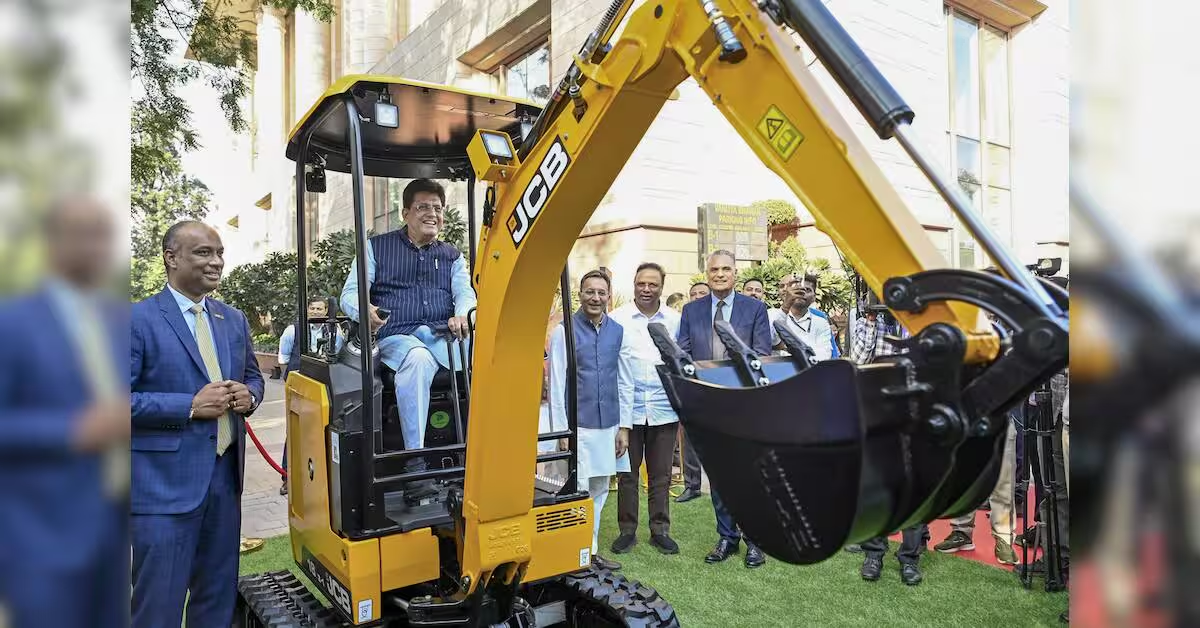
India on Monday flagged off its first consignment—a JCB machine manufactured in Maharashtra—to New Zealand under the terms of the free trade agreement (FTA) that comes into force on Tuesday. Indian engineering goods are set to enjoy zero-duty market access in New Zealand under the deal.
The consignment flag-off marks the beginning of emergence of more opportunities for Indian businesses in the Oceania nation, Commerce and Industry Minister Piyush Goyal said at the event. “It is an agreement that will open up doors for literally every section of society in both countries—for innovators, educationists, students, and farmers,” Goyal said.
The first consignment is a JCB-18Z mini-excavator, an executive from JCB, who was also present at the event, said.
Besides engineering goods, New Zealand has offered zero-duty access from day one to Indian pharmaceuticals, marine products, textiles, chemicals, leather and footwear, gems and jewellery, and electronic goods. It has also committed to eliminating tariffs on plastic articles and farm products.
India has also offered duty concessions on 70 per cent of tariff lines, covering 95 per cent of New Zealand’s export value to the country, while keeping sensitive domestic industries outside tariff liberalisation.
New Zealand’s Minister of Trade and Investment Todd McClay, who joined the event online, mentioned that the work did not end with the implementation of the agreement. “The success of the agreement will ultimately be measured by the opportunities it creates and the extent to which businesses use them,” McClay said.
“Effective implementation will, therefore, be essential. Governments must continue the work together to ensure businesses understand the agreement,” McClay added.
India’s annual trade with New Zealand has so far remained modest at around $1.2 billion. But tariff concessions under the agreement are expected to widen the trade basket, as the two countries aim to double bilateral trade by 2030.
The agreement is expected to boost services trade as well as ease mobility between the two regions. The deal provides for 5,000 professional visas for skilled Indians, work opportunities for Indian students, and extended post-study work rights, along with market access commitments across 118 services sectors and sub-sectors, including information technology (IT), healthcare, and engineering.
The deal also includes an investment commitment of $20 billion by New Zealand over 15 years.
India and New Zealand launched negotiations for the pact in March 2025, and concluded them in December, making it one of New Delhi’s fastest-negotiated trade deals. The two countries signed the agreement in April this year.