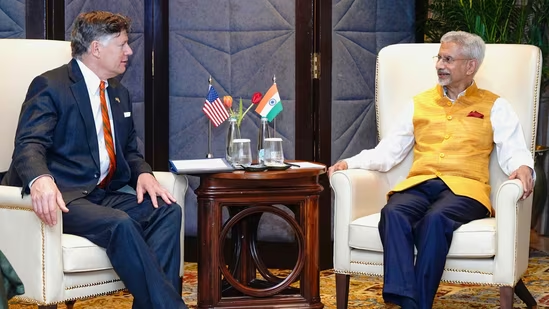
US Deputy Secretary Christopher Landau on Tuesday said that India and the US are “very, very close” to signing the trade deal and need to get over “that last hurdle.” Noting that India is “one of the great powers of the world,” the official said that it’s important that both countries reach a closure on the trade deal.

Talking to the reporters on the sidelines of the Select USA Investment Summit at National Harbour in Maryland, Landau said that India and the US have been negotiating for months, and it was important for the two sides to “reach some closure” and move on with the many other issues on the agenda, news agency PTI reported.
He reiterated the importance of India at a global level and said that both countries need to get over “that last hurdle,” without giving specific information.
“I don’t have any huge inside information to provide on when that is coming, but I can just reiterate that I believe that we are very, very close,” said Landau, who recently visited India.
Talking about the importance of India, Landau said that there is “no question” that India is “one of the greatest powers.” He further said that while India has great economic potential, it was not fully realised for many decades because of the “economic models that India chose to pursue.”
“But I think India is now poised to have massive economic development and to lift many hundreds of millions of people out of poverty,” Landau said.
India and the US announced the framework of the bilateral trade agreement on February 2 and released the text of the deal on February 7. Indian negotiators were in the US last month for discussions on the trade agreement.
India is seeking preferential access to the US markets as part of the agreement, as the two countries eye the target of achieving bilateral trade of USD 500 billion by 2030.
According to that framework, the US had agreed to reduce tariffs on India to 18 per cent, from 50 per cent. It had removed the 25 per cent tariffs on Indian goods for buying Russian oil and was to cut the remaining 25 per cent to 18 per cent under the pact.
But on February 20, the US Supreme Court ruled against Trump’s reciprocal tariffs, which were imposed under the 1977 International Emergency Economic Powers Act (IEEPA).
In the wake of the Supreme Court order, India is seeking to recalibrate and redraft the agreement to ensure that its interests are protected under the new global tariff framework.
(With inputs from PTI)