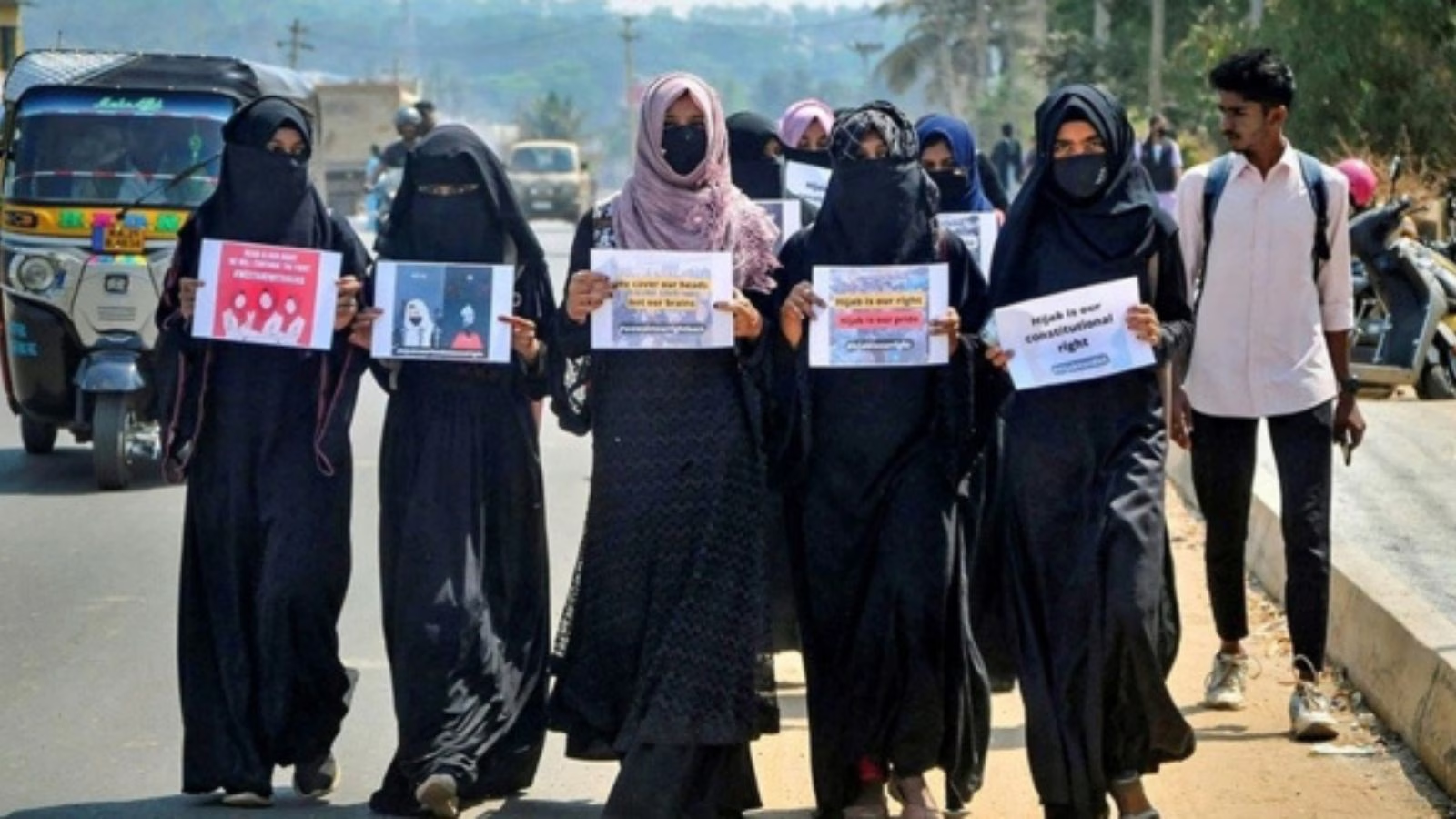
Once they were schoolgirls. Then, they became the face of a fight they would rather not have fought. Four long years and several promises later, the Karnataka government’s withdrawal of the order that in 2022 effectively barred wearing of hijab in pre-university colleges (Classes 11 and 12) is a victory that holds little meaning for them.
However, they hope, it will mean more — that other girls who want to wear the hijab won’t have to make the choice between it and an education.
Aliya Assadi, one of the six students of Government Pre-University College in Udupi who stood her ground over “the right to wear hijab”, says the government’s reversal of the February 22 order is an “acknowledgement” of this, even if “delayed”. “Hijab requires neither politics, nor permission nor public approval. But I am happy that those who come after me will be free to wear hijab in classrooms.”
The hijab row had erupted in late 2021-early 2022 after the six protested over not being allowed to attend classes wearing the head scarf. The protests spread to other districts, and as right-wing Hindu bodies launched a counter-agitation, there was communal tension at several places. In February 2022, the then BJP government in the state passed an order asking students to stick to prescribed uniforms in pre-university and degree colleges. Since hijab is not a part of the uniform, it effectively ruled the head scarf out.
On Wednesday, the Karnataka government withdrew that order, allowing students to wear limited religious- or faith-based symbols along with the prescribed uniform.
The fact that private pre-university colleges allowed the hijab as part of their uniform meant that in the one year after the Karnataka government’s 2022 order, Udupi district saw a significant shift of Muslim students from government to private colleges, admissions data accessed by The Indian Express showed.
For Aliya, A H Almas, Resham Farooq, all of Udupi, and Muskan Khan of Mandya, too, life was not the same after February 2022.
A H Almas
Story continues below this ad
She was among the six students who protested against the Udupi government pre-university college restricting them from wearing hijab. In Class 12 at the time, she didn’t return to class after the 2022 government order, skipping the annual exams and losing a year.
“Finally I wrote an all-India open school examination to pass my Class 12 because no school would let me write the exam in hijab,” Almas says. Now she is in the third year of a B.Sc degree, travelling 65 km to Dakshina Kannada district to college, and wants to become a physiotherapist.
Almas says because of her involvement in the hijab fight, getting admission in Udupi was difficult. “Every day that I go to college now, I thank God for giving me a chance to get an education. Several of my friends dropped out of school. Most of them did a diploma and ended their education. Some got married.”
One overlooked aspect, the 22-year-old adds, is that the hijab restriction also affected Muslim teachers. “It’s not just friends that I lost to the hijab ban. I lost teachers too,” Almas says.
Story continues below this ad
Looking back, she says: “I was too young, I am too young, to fight these battles.” And yes, she is still apprehensive; she doesn’t want to give the name of the college where she is enrolled.
Resham Farooq
Among the students of the Udupi Government Pre-University College who protested against the institute’s hijab order, Resham was at the time in Class 12. While she was also among the petitioners in the Supreme Court against the government order, Resham never pursued studies after the face-off.
Her mother says: “Resham began working at a clothing shop, where she was employed for nearly two years.” Soon after, she got engaged, and a month ago, got married.
While the parents refuse to share Resham’s number, they hope that other girls don’t have to discontinue their education under similar circumstances.
Aliya Assadi
Story continues below this ad
Aliya, who was also in Class 12 at the Udupi pre-university college at the time and joined the Supreme Court petition against the Karnataka government order, says the row only made her more determined to fight for her rights. So, she decided to pursue law, and is now in her third year.
Talking about the days after the hijab restriction, Aliya, 21, says: “We had to take transfer certificates and finish our Class 12 via open schooling… But, we fought, so that no one could deny us the right to education because of hijab.”
While the government withdrawing the 2022 order makes her happy, she wants it to do more. Many of her friends dropped out of school because of the order, Aliya says. “The government should compensate them for those lost years. Those sisters who could not give their exams should be encouraged to appear now, and those who did not complete their studies should be encouraged to finish their schooling.”
Muskan Khan
In Mandya, a town 600 km away from Udupi and its communal politics, Muskan’s defiance in the face of a crowd of young men heckling her for wearing a hijab and raising communal slogans, had become a stark symbol of the fight.
Story continues below this ad
However, soon after, Muskan, who was in the second-year of her B.Com course at the noted PES College of Engineering, dropped out.
Her father Mohammad Hussain says it was a traumatic time for the family. “Muskan wanted to study and later she approached two more colleges for admission, but they also told her that hijab would not be allowed in class.”
According to Hussain, Muskan also explored the option of open university, but a friend said there too she would not be allowed for exams in hijab. So she stayed at home and pored over law books, having developed an interest in the subject, he says.
While Muskan could not be contacted, Hussain, a father of three who runs a gym and an electronics shop, says his other daughter is doing engineering while his son helps him in business. Muskan wants to rejoin college too now, Hussain says.
Story continues below this ad
Abdul Azeez Udyavar, who is associated with the Udupi District Muslim Okkutta that supported the girl students at the time, says the Karnataka government’s reversal of the 2022 order is welcome. “But it should also be made clear that religious practices must never prevent anyone from getting an education. A uniform must not be a bar,” Udyavar says.
CPI (M) Dakshina Kannada secretary Abdul Muneer Katipalla asks why the Congress government in the state took so long to reverse the order. “The Congress had promised to do it in its 2023 poll manifesto, but waited three years. The 2022 order hit the education of so many as well as the secular fabric of society,” he says.
Katipalla adds that people from both sides fanned the row, with the BJP seeking to polarise votes based on religion ahead of the 2023 elections, and the Muslim fundamentalists using it to gain ground. The new order too may be used by the BJP against the Congress in the 2028 elections, the CPI(M) leader warns.
The Jamaat-e-Islami Hind, Karnataka, says the government’s changed stand will help ensure that Muslim girl students can continue their education. Its president Mohammad Saad Belgami says: “Educational institutions must remain spaces where students feel secure, respected and confident about pursuing their studies.”