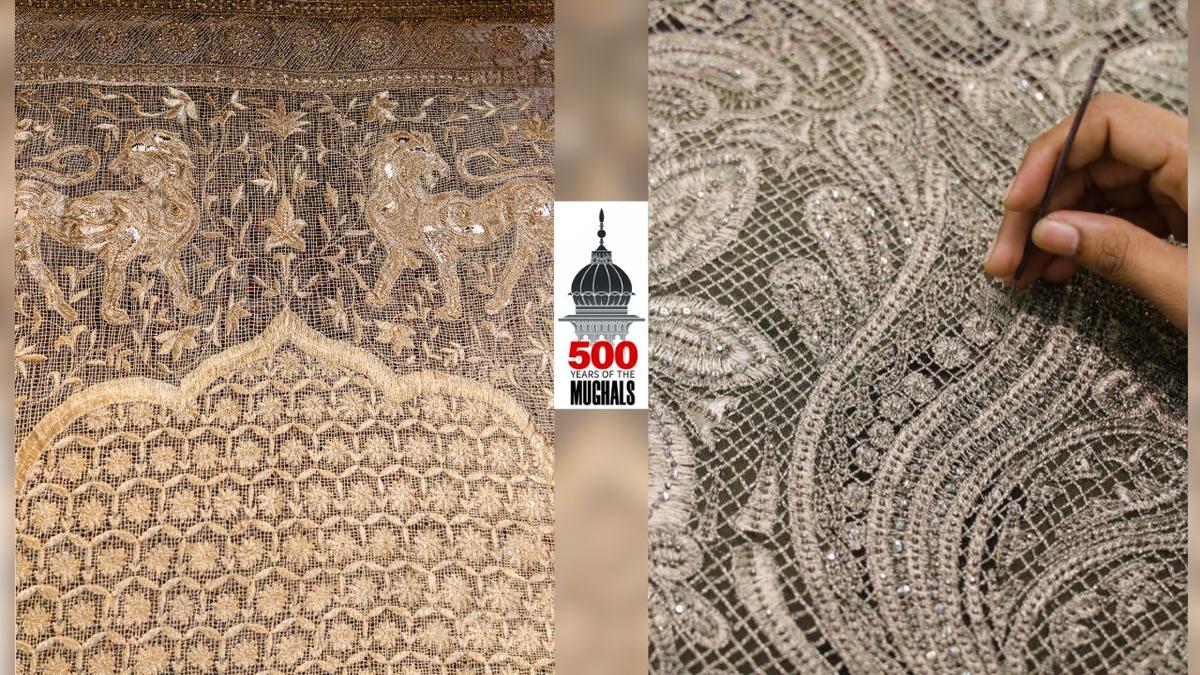
Last year, on a nondescript day, luxury fashion brand Jade by Monica and Karishma’s Monica Shah found herself admiring a jacket. It was among the global textile house Chanakya International’s extensive archive of over 10,000 historical textiles and more than 100,000 craft explorations. “The vintage jacket was one of the pieces Karishma and I collected during our travels across the world,” she says. The jacket, made from pure silver taar for an erstwhile child, was a remnant of the Mughal rule. This month marks 500 years from the First Battle of Panipat (1526), which led to the establishment of the Mughal reign under Babur in India. Shah says, “What I discovered was that the jacket had no base fabric!” It seemed like its silver shell was woven into the air itself. This led her on a sartorial adventure — tracing the history of the craft of kasab — only to realise that only a few master craftspeople who can execute this intricate embroidery technique exist today.

Monica Shah (right) and Karishma Swalli of JadeByMK.
| Photo Credit:
Special arrangement
Originating in Persia, the precious metal-coated silk used in this fabric-less craft was introduced to India by the Mughal Empire in around the late 16th century. A form of zardozi work, kasab, kasav or kasab–zari uses fine gold, silver or copper-wrapped threads that are couched and stitched over itself with an Aari needle to create a brilliant effect. “Every time the design or motif takes a new direction,” explains Shah, “one has to apply a technique called madkan, simply put, an act of knotting the thread so it doesn’t come undone, which takes substantial expertise.” Every floral petal, or delicate paisley curve, is knotted and secured throughout to ensure it doesn’t fray over generations. “It’s like how the warp and weft hold each other; these knots create the skeleton since there is no base fabric to rely on.”

A kasab-zari stitch on fabric work by JadeBYMK.
| Photo Credit:
Special arrangement

A kasab-zari stitch on fabric work by JadeBYMK.
| Photo Credit:
Special arrangement

Jewellery designer Shweana Poy Raiturcar in a kasab-zari lehenga-choli-dupatta by JadeBYMK on her wedding day. She married Vikram Salgaocar, nephew of Mukesh Ambani.
| Photo Credit:
Via Instagram
Revival of a centuries-old craft
“It took me half-a-year to figure out how we can replicate this technique from that piece we had, and make it viable,” Shah reminisces. “What surprised me most was that it was possible at all,” she continues. “A craft as rare as this to be revived is complete glory — it can only happen in India.” Shah went back to Jade’s parent company, Chanakya, which houses and trains hundreds of artisans. “We are extremely fortunate to have 13th- or 14th-generation craftsmen working with us who helped figure it out. And that was a huge advantage,” she says. These master craftspeople, who decoded the art of kasab-zari with Shah, took apprentices under their wing to resuscitate the time and labour-intensive technique.
Shah started creating jackets and blouses for her and the kaarigars to understand the technique completely. “We saw massive demand for the craft very quickly, and it proved to be very, very popular among the customers of Jade.” It was around this time that Shah undertook the colossal task of creating an entire kasablehenga, a piece destined to be worn by jewellery designer Shweana Poy Raiturcar on her wedding day. “We made sure we stayed true to the craft, and the lehenga did not touch the sewing machine even once,” Shah reminds. Just as garments were constructed in the days before machinery, “for this lehenga, every kali (panel) was meticulously handsewn into the other. That’s how the choli and dupatta were made as well,” she beams. Some of the 22 panels themselves took about a thousand hours to craft, Shah mentions, while the entire ensemble took about 15,000 man-hours to put together.

A kasab-zari lehenga by JadeBYMK.
| Photo Credit:
Via Instagram
For the blouse, Shah explored the Mexican technique of macramé and reinterpreted it with the kasab taar. The borders, tassels and embellishments — all self-crafted from the zari technique — were utilised to maintain the no-fabric rule. “To see it all come to life was enchanting — it is the highest form of craftsmanship and haute couture,” adds Shah. She made sure, throughout the process, that no part of the craft was altered. Except for one major change. “Since we couldn’t make the entire piece with pure silver, we instead used a precious alloy,” says Shah.
Beyond its radiant appearance, the craft embodies the very essence of luxury through the slow-paced artistry required to create every such garment. While a growing number of requests for kasab have flooded the Jade inbox, Shah has also embarked on various other projects, from ikat to Banarasi brocade to Madras checks.
“We recently worked on a lehenga with gold-plated pure silver threads, woven in Varanasi.” For her, South Asia’s millennia-old cocktail of cultures and crafts serves as an endless repository for inspiration. The future of Indian fashion, she says, is not to be built without a mindful consideration of the past.
The Mumbai-based writer, artist and editor reports on fashion and culture.