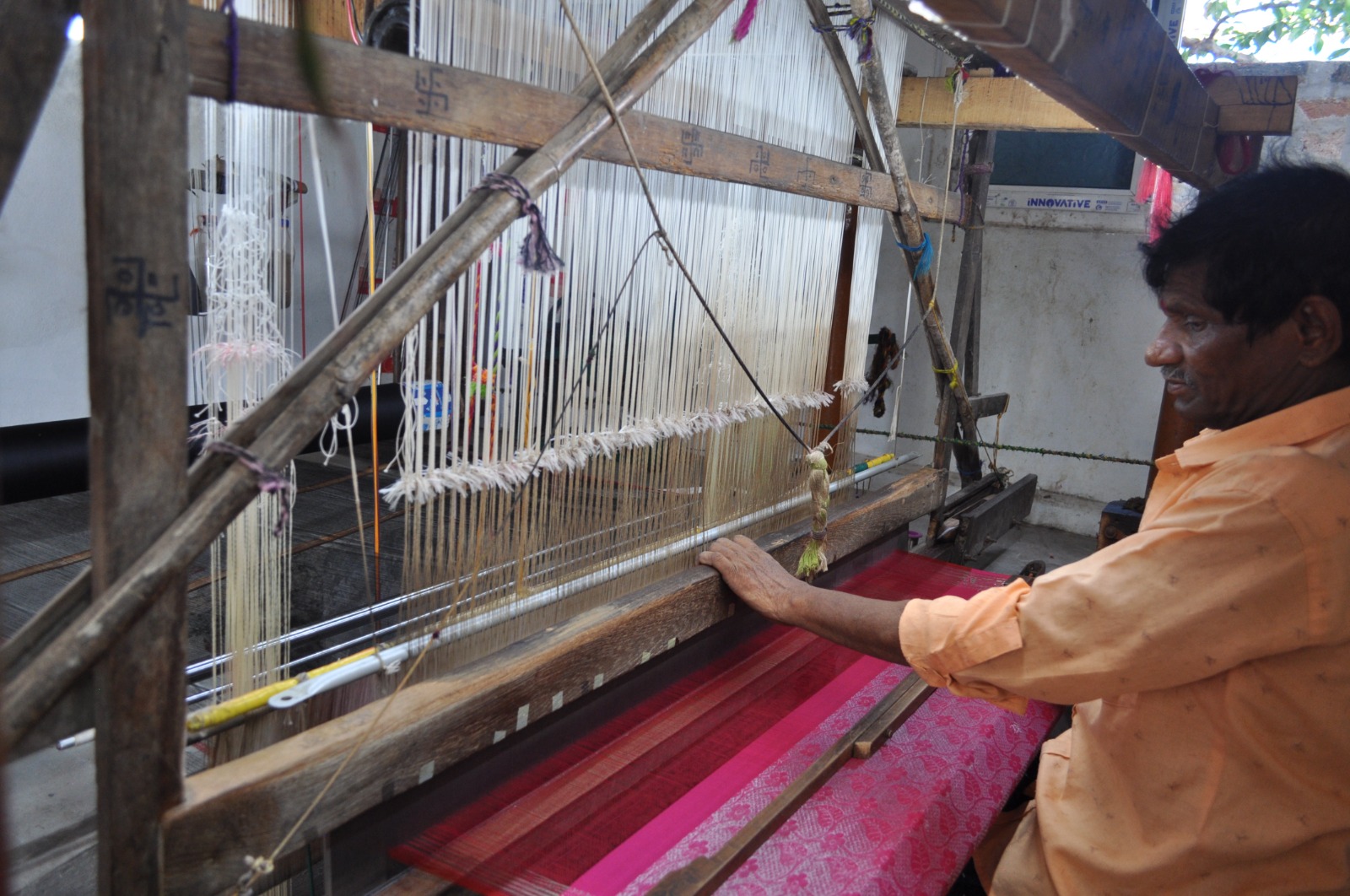
Visakhapatnam: The heritage of exquisite Payakaraopeta handloom cotton and silk saris, featuring intricate designs and weighing barely 600 grams, has endured the numerous challenges posed by mechanisation and unjust marketers.
Despite the struggle, creations of Payakaraopeta Handloom Weavers Cooperative Society retain the beauty of the bygone era. According to society’s manager G.V. Nageshwar Rao, even now, 24 women weave the traditional saris daily in the society’s building, while an additional 292 members contribute their works intermittently.
Payakaraopeta handloom workers compete with power looms. They continue to create jamdani saris, a craft introduced in 1994. Jamdanis from Payakaraopeta occupy a unique niche in the market. Known for their all-over designs, border patterns and palla butta motifs, these saris are admired for their elegance and craftsmanship.
Each sari requires more than 10 days to complete, with prices ranging from ₹3,500 to ₹20,000. They are distributed far beyond Payakaraopeta in cities such as Hyderabad, Bengaluru and Chennai.
While sourcing raw materials from Hyderabad, Vijayawada and Chirala, weavers voice concerns about inadequate marketing facilities and their dependence on traders, who control much of the trade.
In Payakaraopeta’s Yarraveedhi, local shop owner Malla Sambasiva Rao Chinnaji reflects on a unique fabric called “Nool Number”, which has disappeared due to a lack of branding. He compares it to Uppada cotton, which gained wider recognition. “If our ancestors had branded Nool Number, it would have stood alongside Uppada or Ponduru cotton,” he maintains.
The closure of cooperative society shops has relegated Payakaraopeta’s artisans to work as labourers for suppliers of raw materials from Hyderabad, Chirala and Uppada, who dominate the market.
Artisan G. Trimurthulu, over 60, states that he has stayed in the craft for lack of any alternatives. His eldest son supplements the weaving income with masonry work, as they cannot rely solely on handloom work. Rising prices of silk and yarn have reduced production, with each worker producing barely six saris a month and earning around ₹6,000 or less.
“Although saris are being made, there is not enough income due to the lack of fair pricing,” maintains handloom artist G. Naga Satti Babu.
Adding to these struggles is climate change. “Everyone talks about climate change, but we experience it at the loom,” say weavers in Nakkapalli. “We work from 4.30 am to 9 am or 10 am. The increasing heat prevents us from weaving in the afternoon. Even a single drop of sweat can stain the sari,” says one of the weavers.
Payakaraopeta society manager Nageshwar Rao characterises the story of Payakaraopeta as a tale of both resilience and decline. Once renowned for its delicate cotton and silk saris and unique fabrics, the town now struggles to sustain its weaving tradition. While jamdani saris still find buyers in major cities, a lack of branding, marketing support and fair pricing has left artisans vulnerable.
Younger generations are increasingly turning away from the craft, leaving only older weavers to carry forward a legacy that risks fading into obscurity. Payakaraopeta’s handloom industry, once a symbol of artistry and pride, now stands at a crossroads.
“Our survival depends on recognition, support and renewed interest in preserving traditional weaving against the tide of mechanisation,” says Bandaru Ramalakshmi.