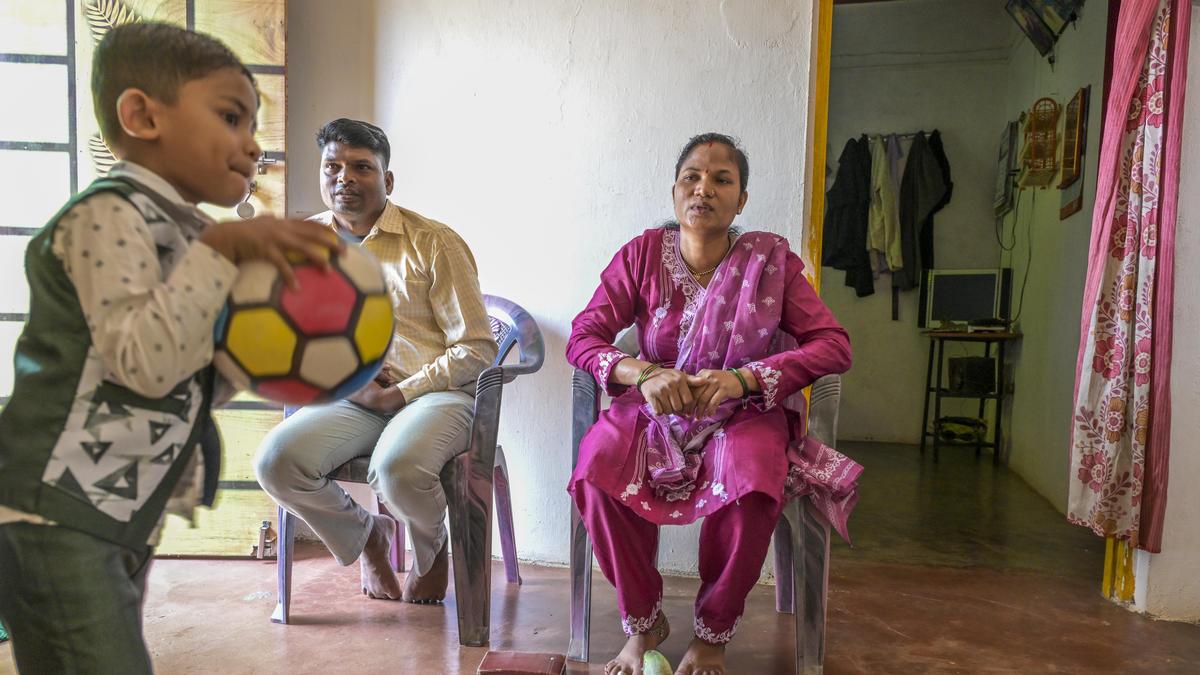
Janu and Sainu Somji Hedo have two children and a parakeet that yells “Mummy-Papa” at regular intervals. The family of five lives in a three-room house in Navjeevan Vasahat, a settlement of former Maoists in Murkhala village, Gadchiroli, which is one of the last Maoist-affected districts in Maharashtra.
It is 44°C, and a narrow stretch of kutcha road leads to the house whose whitewash has been fading through the sun and rain since 2019-20, the year the house was built.
Janu and Sainu fell in love and married in 2008, as young Maoists. They surrendered in 2015. Both hail from the Bhamragad region in the once-dreaded Dandakaranya forest. They were a part of the company which led some of the most violent attacks on the police in the 2000s.
Sainu is among the 50 men who have undergone surgeries for the reversal of vasectomies since 2005 in Gadchiroli. As a part of the Maoist movement, young men have traditionally undergone vasectomies to avoid having families. After they started surrendering, the Maharashtra Police began helping arrange surgeries for them. So far, 13 of these 50 men have become parents.
This year, the vasectomy reversal operations were conducted under Project Sanjivani, an umbrella of welfare schemes aimed at the rehabilitation of surrendered Maoists. A camp was held at SEARCH in Gadchiroli to reverse the vasectomies of 14 surrendered Maoists. SEARCH, founded in 1986 by Dr. Abhay and Dr. Rani Bang, is the Society for Education, Action and Research in Community Health, which has done pioneering work in rural health care and research.
Living a family life
The family is unbothered by the heat. A small fan revolves overhead. The couple sits on plastic chairs as their son jumps on the single bed-cum-sofa. They struggle to take away the mobile phone from the 5-year-old’s hands. He settles down to watch reels on social media.
It is difficult to imagine that in 2009, they were part of a team that ambushed 16 police personnel in the jungles of Hattigota, an act which had shaken the security establishments then and has gone down in history as one of the worst attacks of the Maoist movement.
Janu takes the lead in the conversation. Sainu looks at her every time a question is asked. When he answers, she gently fills in the years, the dates. Both of them currently work in different departments at a factory of Lloyds Metals and Energy Limited. A bus comes every morning to take them to work. The job has been facilitated by the Gadchiroli Police.

Maoists who underwent vasectomy reversal in Gadchiroli.
| Photo Credit:
Emmanual Yogini
“When he had undergone the surgery, we did not think much of it. If our commander said that we should not have children, we obeyed the order,” says Janu. She wasn’t informed before the vasectomy was performed on Sainu. He was taken away for two days and was brought back after the surgery. The question of consent did not arise for either Janu or Sainu. The flow of authority and order was strict. The commander was the one who spoke with the families when the two had fallen in love as teenagers. And they had to follow the order of the Dalam as a part of the Maoist movement.
“Where will we keep children in the jungles? We were told that when you are a part of the movement, you cannot have children. They are a liability on the movement,” says Sainu.
They speak Marathi awkwardly; their language is what they call “boli bhasha” (spoken language). They are happy to be giving both their daughter and son an English-medium education.
Within the complex that extends across 13.67 acres, surrendered Maoists have been allotted 174 plots of land by the government. Each is 1,356 square feet, meant for them to construct their own houses. Janu and Sainu Somji Hedo’s is one of the oldest homes. It was built under the Shabari Gharkul Yojana run by the Maharashtra government. The scheme provides support to construct concrete homes for eligible people from a Scheduled Tribe.
A practice from an old life
In the same settlement live Sushila and Ashok Hodi, who surrendered in 2010. They say the last 16 years have been different. All the surrendered Maoists have been imparted skill training. Today, Ashok works as a driver, drawing a salary of ₹12,000 per month.
His earlier gig as a mason did not earn him much, he says. Sushila has given up work to take care of their newborn baby and a daughter. In 2018, she had lost her son within three days of delivery. The couple now has two daughters.

Ashok and Sushila Hodi with their daughters at home in Navjeevan Vasahat.
| Photo Credit:
Emmanual Yogini
“When I was in the movement, I was a part of the Chetna Natya Manch (the propaganda wing of the Maoist movement). We used to sing and entertain people in various tribal hamlets. We had joined the movement in 2004, and used to travel to different places,” Sushila says, her smile warm, eyes twinkling. She hails from Pengunda, a tribal hamlet in Bhamragad taluka.
She doesn’t remember any of the songs now. “It has been so many years,” she exclaims. Their modest two-room house, a basic structure without any paint, is a place full of joy for her, she says. “We find it difficult to sustain ourselves on only one salary now. The prices of everything have been going up. We are left with no savings, as we use up the salary for our daily requirements and medical needs,” she says.
Bhupati alias Mallojula Venugopal Rao alias Sonu Dada, who surrendered with 60 others last year, was a prominent central committee member of the CPI (Maoist). He says until a few years ago the vasectomies were done dogmatically. He did it as a young man, and so had several others.
“In 1997, I started questioning why it was compulsory. We thought that there should be liberty for couples to choose. After June last year, we got a few couples married. But we did not get vasectomies done for them. In recent years, I have myself been instrumental in getting these vasectomies reversed,” he says.
The thought of going back
Neither Sushila and Ashok nor Janu and Sainu want to go back to their native village anymore. In fact, after surrendering, Janu and Sainu went to their native village for the first time this year.
Another surrendered couple, Kishna Masa Dorpeti and Manda Kishna Dorpeti, say there’s no work where they came from. “What will we do there? There are no jobs, no income. Our relatives take care of the farmland there. All our documents are from here. Our Aadhaar card, ration card, and bank account have all been made here. We will not leave Gadchiroli now,” says Masa. They recollect their violent past, narrating incidents of police ambushes.
Many of them are either unlettered or can just about read and write. After undergoing the reversal of vasectomies and having children, they now want the children to be well-educated.
“There are good schools here. Our children study in English-medium schools. What will we get in the village?” says Masa.
For Ramesh Rainu Katvo and Jyoti Ramesh Katvo, the real concern is the safety of their families back home. “After we surrendered, they (Maoists) used to trouble our families. The villagers and family members had urged us to not come back. For their safety, we stayed away for all these years. Last month, though, we went home to meet my ailing father. There is no fear anymore. Many of the Naxals have surrendered,” Ramesh says.
Those below 35 who have surrendered over the past few months and undergone the reversal of vasectomies feel differently. Right now many are under police observation. Some had bounties on their heads.
“After reading Sonu Dada’s letter, we were convinced that we should lay down our arms. The options were to surrender or to get killed,” says Ramu Karam from Mudvendi in Chhattisgarh. Sonu Dada or Bhupati had written a long letter explaining his position to cadres before he surrendered. Security agencies say his surrender broke the back of Maoism in Maharashtra.
“We are young now, but when we get old, who will take care of us? That is the thought with which I decided to get the reversal operation done,” Karam adds.
Oyam Sanna and Shivkumar Telam also surrendered last year. They are all currently under police observation, even as the process of getting their documents is not yet complete. “Once my Aadhaar card comes, I will go back to my village and farm,” says Telam.
State support
For the Gadchiroli Police, these surgeries are a part of their multi-pronged approach to eradicate the Maoist movement. Anti-Maoist operations are carried out aggressively, but there are also incentives for surrender.

Holding all the records, keeping an eye on all the surrenders, and facilitating their rehabilitation, is a special cell of the Gadchiroli Police called the Surrender Cell. It keeps a record of all the 814 Maoists who have surrendered since 2005 in Gadchiroli, as per sources. The cell has so far facilitated the making of Aadhaar cards of 356 surrendered Maoists. It connects the former Maoists with vocational or skill training centres and assists them in getting bank accounts, voting cards, ration cards, and other documentation. When those surrendered encounter a problem, they approach the cell. For a year after surrendering, the Maoists are under the observation of the Gadchiroli police.
“In 2025 alone, 112 cadres surrendered before us, and a lot of them showed the willingness to reverse their vasectomies. The Gadchiroli Police took concerted efforts with SEARCH, so that they can lead their lives like any other citizen of the country,” says Nilotpal, a senior IPS officer who was the Superintendent of Police when these surgeries were done recently.
Medical intervention
For the last five years, a team of Mumbai doctors and anaesthetists led by Dr. Nitin Mokal and Dr. Shrirang Purohit have been travelling to Gadchiroli every three months to hold surgery camps free of cost for the tribals of Gadchiroli.
In March, they also conducted the surgeries for the reversal of vasectomies. “We have been going to SEARCH as a team for plastic surgeries. We perform reversal of vasectomies and cleft palate surgeries; we operate to cure post-burn secondary deformities. A vasectomy reversal involves a microplastic surgery, which is not complicated but skill-based. The procedure takes 2-3 hours,” says Dr. Mokal. The complete healing process takes around three months.
He says that after the surgery there is a 100% chance of reproduction. The teams fly in over weekends, on tight schedules, often conducting back-to-back surgeries for hours before flying out. “It is a pleasure to provide treatment for people at the grassroots level. SEARCH provides extraordinary facilities. There is great satisfaction in this work, which helps people lead a better life,” says Dr. Mokal.