By Paul Newman
Adam Parore is thinking back to the day he almost died attempting to reach the top of the world. “I was caught in a massive collapse in the icefall,” says the former New Zealand wicketkeeper who remains the only international cricketer to climb Mount Everest. “It was just after our first failed attempt at reaching the summit.
“It must have been an area the size of a football field, only metres behind me, just disappeared. It just vanished. Gone. The noise was like a 747 taking off underneath me… I’ll never forget the sound. It was like being in Donkey Kong. Nuts. All I could think was, ‘Stay on your feet and you’re a chance’. There were four of us on these big blocks and all the ice was moving, but then it just stopped.
“I survived but I got lucky. Dead lucky.”
It is an incredible story told in the course of a compelling hour-long conversation with a man who overcame all the odds to achieve a highly difficult and extremely dangerous ambition after being encouraged to take up climbing in cricketing retirement.
“I shouldn’t have survived to be honest,” Parore tells The Athletic from his home in Auckland. “There’s a saying: ‘The mountain doesn’t know you’re an expert’. There have been a number of highly accomplished climbers who have been killed by making amateur mistakes. It was just a mistake by us being in the ice bowl after 5pm.
“It was an absolute no-no. That’s how you kill yourself. It was our first attempt at the summit and we took a chance. We tried to get a square peg in a round hole. It failed but we got through somehow (Parore and his three companions) and we made it in the end.”
That big moment, when Parore reached the 8,848m summit of Everest at the second attempt, should have been one of the greatest days of his life. But so exhausted was he, and so challenging had his expedition been, that it was something of an anti-climax.
“To be honest I don’t remember too much about getting to the summit,” he says of the 2011 venture. “I was extremely hypoxic. Your footwork goes. I was always very good on my feet. But suddenly your crampons are catching and your footwork is not quite perfect.
“You feel overcome. We spent about half an hour on the summit. It was brilliant sunshine. There was not a breath of wind. The view from the top is breathtaking. You are so high you can see the ends of the earth.
“It’s quite extraordinary. The sky is on top of you. It was unbelievable. But after 20 minutes or so I just had this feeling of, ‘Yes this is great, but we need to get down now’.”
Perhaps that feeling arose from the knowledge that Parore’s mission was not yet complete. “I was very conscious that only half the job was done because most of the issues people face come on the way down, not on the way up,” he says. “It’s also sobering because you know the stories of those who have not made it. They’re all still there, and you see them on your way back down.
“You can’t get the bodies back down from there. There’s a point where it drops 800ft and you can see those who have fallen. But we had a relatively straightforward climb down and I know how privileged I am to have done that. It was literally like going to another world. Not many people get to do that.”
The scaling of Everest was the highlight of a six-year spell, between 2011-2017, when Parore climbed semi-professionally and regained the sense of achievement and purpose he thought was behind him after retiring, suddenly, at 31 after playing his last Test for New Zealand against England at his home ground of Eden Park in 2002.
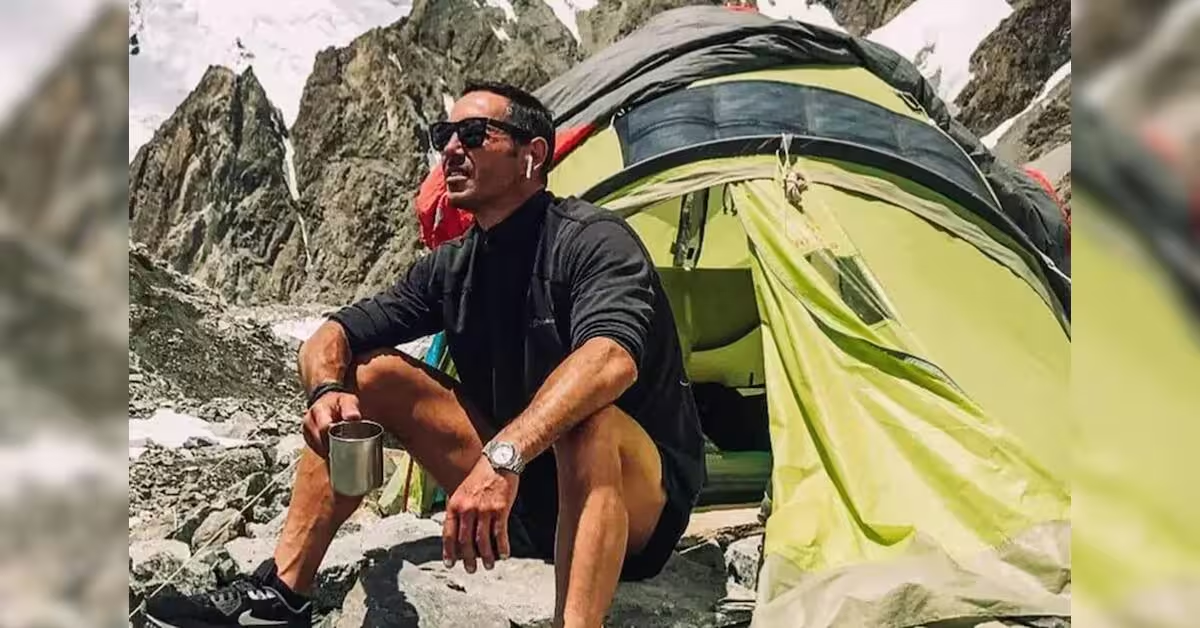
“It came about by chance,” says Parore. “My brother-in-law, a guy called Johnny Davidson, was a high-altitude mountaineer and we’d lost touch for a while, but I bumped into him in Auckland when he was on his way to Everest.
“He said to me: ‘Why don’t you come to Queenstown and let’s do a climb’. I thought, why not? So I went there for three days and Johnny talked me through the basics because I was very much a rank amateur at that stage and I just kind of got the bug.
“He then introduced me to Russell Brice and the Himex guys (owner of a New Zealand climbing expedition company), and Mark Woodward who became my climbing partner. They sent me off to Manaslu in the Himalaya (the eighth-highest mountain in the world) and I climbed it with the Himex team as a sort of a test to see if I was up for it.
“I found that the whole thing felt very familiar to me. The rhythm of high-altitude mountaineering felt very similar to being in a cricket team. A bit like cricket, it’s 90 per cent sitting around doing nothing and then 10 per cent ‘go for your life’.
“When I got back into an elite sport environment I realised how much I loved being in the group and how stimulating and aspirational I found it. I took to it like a duck to water.”
That trip to Manaslu gave Parore his first taste of how perilous mountaineering can be. “The weather turned on us and we were pretty close to getting blown off the mountain. I thought I was finished. It’s a very strange feeling. There’s nothing you can do. You’d think in that situation you would panic, but I was calm and fortunately the wind dropped just in time to save us.
“Three hours later there was brilliant sunshine.”
But he was far from put off and, even after climbing Everest, was keen to take on another steep mountaineering challenge.
“Everest lit the fuse,” he says. “On that trip I lobbied Russell Brice to climb K2 (on the border of Pakistan and China) but it wasn’t commercialised at all. It was for professional mountaineers only, and I just remember having many nights on that trip with Russell sitting around having a whisky trying to convince him he should take us to K2. And Russell was extremely reluctant.
“But we obviously got through to him because a couple of years later he opened it up to us.
“Once I’d done Manaslu and Everest I was just drawn to K2. I don’t know why but she had me. When I actually got there that expedition was just mind-blowing. The Karakorum makes the Himalya look like Disneyland. It’s insane. But it’s the most beautiful and spectacular place I’ve ever been to.”
Sadly for Parore, he could not quite make it to the top of K2. “We turned around just under camp four,” he says. “It was the first time I’d retreated, but that climb was like a lot of my experiences in cricket where you’re behind the game. You’re always chasing.
“It was the most challenging but also the most enjoyable, probably, because it was so vertical. There’s no walking, you just go up straightaway. But the weather turned against us and we made the call to pull the pin about a week before the end.”
Long before he was a mountaineer, Parore was a key member of the New Zealand sides of the 1990s and early 2000s — he played 78 Tests and 179 one-day internationals for his country — both as an accomplished batter and a wicketkeeper known for his combative and, at times, spiky behaviour.
“It was a role that was required within the side,” he says of his aggressive demeanour. “When I reflect on it now it was very organic. It developed over multiple years but it was a persona. It’s not me. I’m not combative and aggressive. That’s not what I am as a person. I just don’t get into situations with people.
“I don’t like it. It doesn’t feel good to me. It gives me anxiety, makes me uncomfortable and it’s not something I enjoy. I didn’t really realise any of this stuff when I was playing. I didn’t really know who I was as a person. It was just after I finished that the lights started going on over the behaviour, the circumstances and the way I got myself through it all.
“But I did grab that role with both hands and enjoyed it. It was fun.
“It was also a bit of a coping mechanism to try to bridge the gap with the quality of the players I was competing against. I was five to 10 years younger than most of them and they were better than me, so I had to find something. That was the mechanism I used which was quite effective. I just don’t think it was particularly healthy for me as a person.”
Those methods worked well for Parore, one of the first cricketers of Maori heritage to play for New Zealand, who cites new England Test coach Stephen Fleming as integral to the success of himself and his New Zealand sides.
“Flem was one of the most influential people in my career,” he says. “We played a lot of cricket together through the age groups and he was pivotal in developing our side to become a really high-quality Test unit.
“It took a long time but there was no question who was in charge. Flem was cool, calm and astute, and strategically and tactically very good. And a great man-manager. He squeezed the best out of people like Chris Cairns and myself and we weren’t the easiest guys to manage.
“He’ll do an outstanding job with England. I’m expecting all of the positive stuff that England have developed under Brendon McCullum’s leadership to be polished. The hard work has been done. People follow Brendon. I’ve known him since he was 12. He’s a generational talent and Flem fits into that category as well.
“They’re guys who have got the X-factor and the chemistry between Brendon and Flem will be really important. They will work very well together and I’ll be very surprised if England don’t materially improve over the next couple of years.”
Parore will watch his old friends and team-mates progress from afar having now retired contentedly from both his sporting ‘careers’. “I think my days on the big mountains are done now,” he adds. “I’m 55 and I’ve got four kids and a business to run. I’ve got to the point where, on a risk and reward basis, it wouldn’t make much sense to go climbing again.
“I rarely talk about all this now. When the opportunity comes up to discuss it, like this, I really enjoy it but it’s not something that I talk about. It’s because it’s such an inward experience, and there’s a lot of respect that goes with it.
“You learn that culture as you go along. You don’t really celebrate reaching a summit because you’re not conquering the mountain. You’re being allowed to progress and, ultimately, that’s not really up to you. There are no outward signs of emotion. That’s just not something you feel. And it’s not something you think about as an achievement.
“This is a pursuit where a lot of people have lost their lives and you carry that with you. There are climbers who never come down and that is the sobering reality.
“It mutes any triumphal invective you might have. I’ve always regarded my time in this as a partnership between me and the mountain. The mountain will give you what it feels you deserve and you have to respect that because otherwise it will kill you. That’s something I will never take lightly nor forget.”