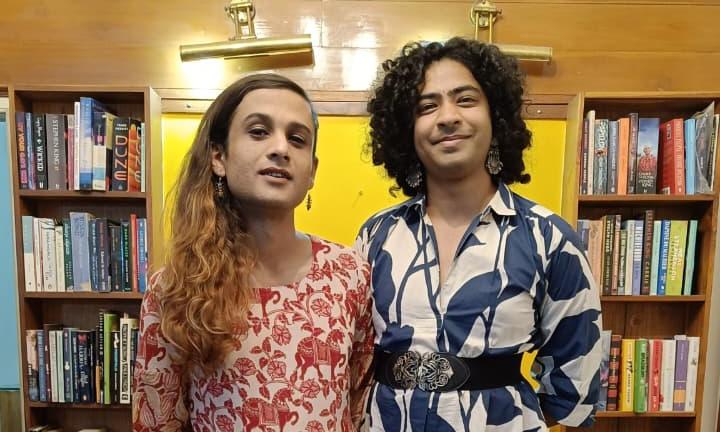
Patruni is sipping chai when we speak over a call. They laugh about it. We’re talking about Chai Hona, a monthly queer gathering built around the simple act of sharing tea, and here they are.
The name is disarmingly simple: Chai Hona – do you want chai – as Hyderabadis casually ask each other everyday. The logic behind it is equally so: If you want people to show up and share their stories, you give them tea and coffee, not charge them at the door. “That’s the bare minimum,” Debbie says. “That’s where you start.”
Debbie Das founded For&Bi a few years back, with the help of Patruni Chidananda Sastry, the collective within which Chai Hona sits.
“Hyderabad has had active queer engagement events for the past few years,” Patruni says. Big scale gatherings, club nights, queer organised parties. “But not everyone wants to come to loud events. Sometimes they just want to sit and talk with each other. Know people. Create a chosen family.” Just people, in a room, with time.
It is designed to amplify the voices of those most often unheard: disabled people, trans people, and anyone within the queer community who doesn’t feel seen.
Preserving Third Spaces
Debbie has lived in Hyderabad more than any other city. And for a long time, even in a city she kept coming back to, there wasn’t really a place to land – not as a queer person proud of their identity, who also didn’t want to spend exorbitant amounts of money to share a coffee with like-minded people.
The concept of third spaces that does not require one to be able to spend money on it has been shrinking. Public spaces, hangout places, or even simple, affordable cafes that speak to you of the city culture without burning your UPI balance, are practically non-existent. What remains are pubs, bars with excessive influence of booze, or hangout spaces only the affluent can afford. And for queer individuals, well, it reduces even the very few doors open to them.
Lamakaan is perhaps the closest thing most Hydarabais can imagine. But one space isn’t enough for a city.
“That’s another reason we have it on the last Saturday of the month, so that when people run out of money in the month end there’s still one space that they can access for free regardless of financial status,” Debbie adds.
No One is Free Till Everyone is Free
For & Bi is an intentionally no alcohol, no drugs space.
“It is a trap which a lot of young people fall for, especially when they don’t have support from their own family. As they find themselves isolated for being themselves, addiction could look like one of the things that accepts you,” Patruni says. The solution would be to create and share accepting spaces.
While Debbie being a recovering addict did push the thought towards keeping it a sober gathering, the introspection is also about what kinds of spaces are available for people to enjoy as a group – queer or not.
When the Trans Amendment Bill issue came up, many found Chai Hona to be a place to process it. Trans youth who had nowhere to process what was happening started showing up. Questions, fear, grief, no one at home to talk to. It was a place that understood them even without explaining too much, yet ready to listen as they process.
The values themselves continue to evolve – the stance against AI, for example, is relatively recent – but the core has stayed consistent: sober, trans-led, minority-centred, and free.
It also evolves from the understanding that everyone’s liberation is connected to one another. When the city’s green spaces are attacked, it is not an issue that exists out of their area of concern. “The parks and green spaces are one of the first ever spots queer and trans individuals shared to be themselves. These spaces are part of the queer history of this city. We can’t ignore it and say okay, queer rights are different, environmental rights are different,” Patruni sighs.
Logistics, logistics, and more logistics
Eight months in, eight meetups done, and the number of attendees kept going up – from ten to fifteen to twenty five to forty.
Debbie isn’t even in Hyderabad anymore. Kali, a friend and facilitator, holds the sessions now, logistics and all. Patruni is who Debbie calls their moral compass – the person they consult when they’re not sure which way to go.
“To be honest, we don’t have to even try too much to make people attend. But many still show up, which has made me realise that’s all what they wanted – a space where they can exist and are not forced to do anything. Facilitating the space doesn’t feel like work anymore. We are all just coming together, sometimes making clay art, sometimes painting, but mostly just sitting together and talking,” Kali says.
The venues rotate around the city as the plan was always to take Chai Hona to different parts of Hyderabad rather than anchoring it in the usual spots. But it’s been harder than expected.
“If there is one thing Hyderabad could do better – would be to be more forthcoming in regards to them being a safe space for queer community,” Kali insists.
Many spaces that present as queer-friendly turned out to be less so – be it lack of gender neutral washrooms or disability washrooms or worse, unexpected hostility. So far, they’ve found four venues that actually work.
The shape of the meeting too, keeps changing. A friend who works as a makeup artist came to Debbie with an idea – a free workshop for trans people in Hyderabad, using makeup as a way of feeling more like yourself. For & Bi helped make it happen. There have been online sessions too, including one for mental health professionals working through what it means to practise care during a genocide. The shape of the thing keeps changing, which seems to be the point.
Debbie is trying, increasingly, to step back. To let other people take charge. To make For & Bi less dependent on any one person and more like what it actually is – a collective, not an organisation. “The only reason we are still doing it,” Debbie says of Chai Hona, “is because people love it.”
She is thinking about starting something similar in Bangalore. When she has more energy, perhaps. Until then: the chai is on, the door is open, and Hyderabad is showing up.
This feature is part of a series on third spaces and their evolving role in urban communities.