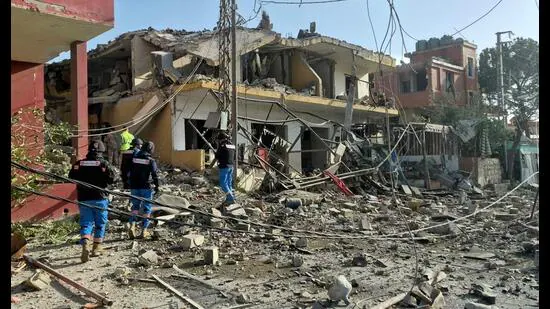
A characteristic of contemporary wars is that the ethics of fighting are increasingly receding to the background. During the initial days of the ongoing war in West Asia, the world was shocked by a US missile strike on a school in Iran that killed more than 150 children. Earlier in Gaza, operations by Israel Defence Forces, while targeting Hamas terrorists, often caused disproportionate casualties, mostly innocent civilians. These casualties largely occurred as a result of mistaken identity by AI-driven smart munitions. How many of the close-to-72,000 killed in Gaza so far fell prey to such reasons is hard to say with certainty, but whatever the toll, it would surely be disturbing.

The principles of discrimination and proportionality are assumed to guide the conduct of war. As per these principles, it is unethical to target civilians, with a caveat that there may be unintentional deaths in crossfire. The acceptance of collateral damage was to be constrained by the principle of proportionality, i.e., whether civilian casualties were commensurate with the achieved military gains.
Wars now are characterised by precision strikes that are undertaken from long stand-off distances. The combatants of opposing militaries rarely come in contact. The kinetic variety of the non-contact wars (NCW) is waged by employing technology-enabled long-range weapons and munitions like missiles, rockets and drones. One of the major incentives of NCW is reduction in its own casualty rates.
Initiating NCWs is relatively easier for two factors. First, due to longer stand-off distances of engagements, operations are conducted from the respective comfort zones. Second, the efforts behind planning and preparing contact wars were relatively more demanding.
While initiating NCWs are easier, terminating the same is challenging due to the reduced asymmetry between contesting militaries. Cheap drones employed by weaker militaries, countered by expensive interceptors by the stronger adversary, have tilted the arithmetic of conflicts in favour of the underdog. In new wars, the sense of superiority of a stronger adversary is illusionary vis-à-vis the new wars. We are witnessing this in the ongoing war in West Asia.
The ease of initiating wars, incentivised by reduced combatant casualties, has come at the cost of putting the civilian population of the warring parties in harm’s way. To be sure, civilian casualties were not unusual in wars in the past. But the character of wars has changed in the present times. It seems to have reduced this seminal ethical ponderance of war-fighting to almost a non-issue, or at least an issue that doesn’t merit too much concern. Collateral damages today are blamed on the algorithm dictating the course of an armed device or weapon. The humans who design the models to run such algorithms, which then guide the weapons, are rarely held accountable.
Canadian scholar Paul Robinson, in his research paper “Ready to kill but not to die”, argues that since the combatants cannot identify the targets that are being engaged, they are unrestrained while applying their firepower. He cited the Nato bombing of Yugoslavia in 1999, wherein the aircraft flying at an altitude of 15,000 feet rained bombs without any consideration of the nature of targets being engaged. The advantage of minimising one’s own casualties has always incentivised such engagements, increasingly dehumanising wars.
War-fighting changed in a big way in the decades after the September 11 terror attacks. These changes were visible in Afghanistan, where the US battled the Taliban. These changes have continued to gain traction, as is evident in the horrors visited in the battle zones of West Asia. The advent of disruptive technologies have been a shot in the arm for the proliferation of such engagements, which are gaining traction equally among the strong and the purportedly weak.
The warrior of yesterday had turned into a killer of today: Ready to kill but not ready to die. This diluted state of accountability among the global comity of nations has led to the statutes of international law becoming “the vanishing point of jurisprudence”, and the example set by the Nuremberg trials, merely a relic of past.
Before the widely respected conventions of the past, both formal and informal, are abandoned wholesale, the global community should insist on a course correction. Otherwise, it will be too late before the world realises that too many people have died. This is not going to be easy since global bodies such as the United Nations are at their weakest since World War II.
Shashank Ranjan, a retired colonel with experience in counter-insurgency operations, teaches at OP Jindal Global University, Haryana. The views expressed are personal