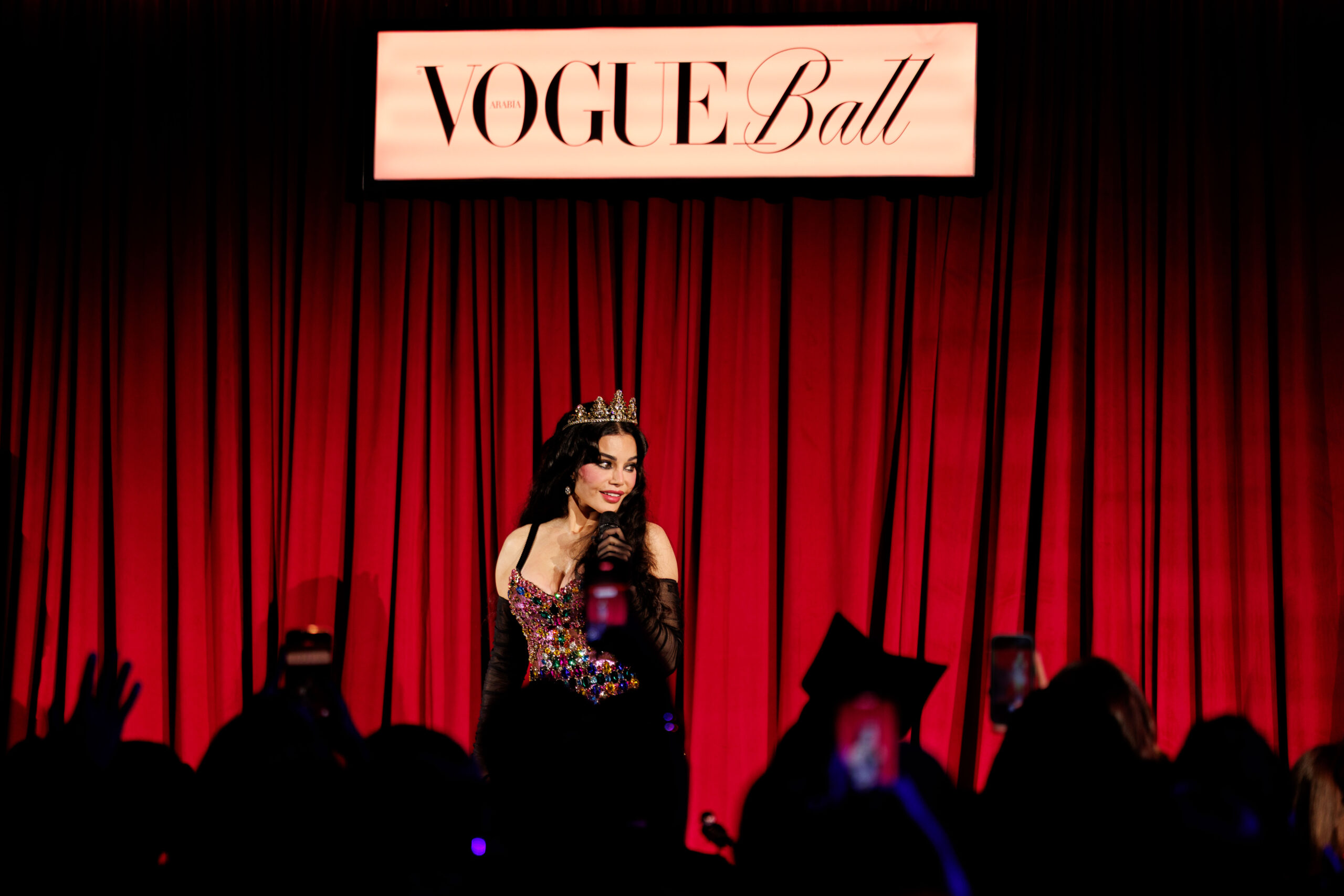
DUBAI: Egyptian designer Youssef Karam Hussein was named the winner of the Creators of Craft Design Challenge at the inaugural Vogue Arabia Ball: Art Edition, held at Delano Dubai on Bluewaters Island on Friday.

Hussein, a Cairo-based jewelry designer, won for a mashrabiya-inspired necklace. He was one of five finalists from Egypt, Lebanon and the UAE whose work was displayed at the event.

The black-tie ball, the magazine’s first, was themed around celebrating art through the female gaze, with Vogue Arabia positioning itself as a patron of the arts in the region.
“We have a responsibility not only to document the region’s cultural landscape, but also to contribute to its growth by creating platforms that bring its creative voices to the forefront,” Manuel Arnaut, head of editorial content at Vogue Arabia, told Arab News.

The work of Emirati artists Shaikha Al-Mazrou and Dhabia Al-Qubaisi informed the ball’s artistic direction and immersive environments. “The female gaze is central to this vision, celebrating women’s perspectives and their contribution to the region’s cultural identity,” Arnaut said.
The initiative also extends beyond the evening through a partnership with Art House Education Dubai, which gives UAE residents the chance to win free fine arts courses through a creative challenge to reimagine Vogue Arabia’s November cover.

“True patronage does not end when the red carpet is rolled up,” said Thomas Khoury, managing director at Conde Nast Middle East, which publishes Vogue Arabia. “The glamour of the evening is the catalyst, but the lasting legacy of Vogue Arabia’s Ball is supporting arts education and ensuring a continuous pipeline of Arab creative talent.”
The evening was hosted by Tunisian presenter Azza Slimene, while the red carpet was hosted by Australian Lebanese model Jessica Kahawaty and Jordanian presenter Mohanad Al-Hattab, who spoke to guests as they arrived.

Kahawaty wore a custom Kristine Romanos gown featuring drawings by children from Dubai’s Rashid Center for People of Determination, paired with jewelry from Kahawaty Jewels.
Many guests took the art theme as their cue. Egyptian actress Amina Khalil wore a Valentino lace-and-purple-taffeta look from the label’s Autumn/Winter 2027 collection. “To me, it feels like wearing a piece of art,” she told Vogue Arabia.

Egyptian actress Mai Omar also chose Romanos, in a hand-painted corset gown, while Egyptian actress Huda El-Mufti wore a Marie Antoinette-inspired Dolce & Gabbana look.
Lebanese actress Nadine Nassib Njeim arrived in a customized gown from Georges Hobeika’s Spring/Summer 2026 haute couture collection, finished with a Swarovski crystal-and-pearl headpiece and embroidered lace gloves.

Saudi influencer Lojain Omran wore a custom Charbel Karam gown that paired flowing chiffon with a sculpted silver bodice, along with a crystal-embellished crown. Emirati Yemeni singer Balqees Fathi wore a feathered couture look by Krikor Jabotian.
Turkish actress Hande Ercel wore a black Zuhair Murad couture gown with floral embroidery and feather trim. Iraqi American beauty entrepreneur Huda Kattan wore a white off-the-shoulder gown with a jeweled choker and corset by Khaled and Marwan.

French model Cindy Bruna and Saudi model Amira Al-Zuhair were also among the guests, along with Tunisian actress Dorra Zarrouk, Egyptian actresses Yasmina El-Abd and Salma Abu Deif, Jordanian actress Saba Mubarak, Kuwait-based social media personality Nour Al-Ghandour, and Egyptian couple Laila Ahmed Zaher and Hisham Gamal.
The evening continued with a private dinner, where Palestinian Chilean singer Elyanna performed an intimate set that included her new song, “Ghazali.”

The dinner was followed by a party headlined by Lebanese singer Haifa Wehbe, the cover star of Vogue Arabia’s November issue, who performed three songs, including “Badna Nrou’a” and “Fakerni Hatbaak.” For the performance, Wehbe wore an archival Dolce & Gabbana look inspired by Italy’s traditional luminarie.
Arnaut said future editions could explore “architecture, design, cinema, music, photography and many other creative disciplines,” while Khoury said the ball could travel to other cities in the region.

“A ball in Riyadh or Doha, for instance, would look and feel fundamentally different from one in Dubai, highlighting a completely different roster of local designers and artistic perspectives,” he said.
Additional reporting from Jamila Musayeva.