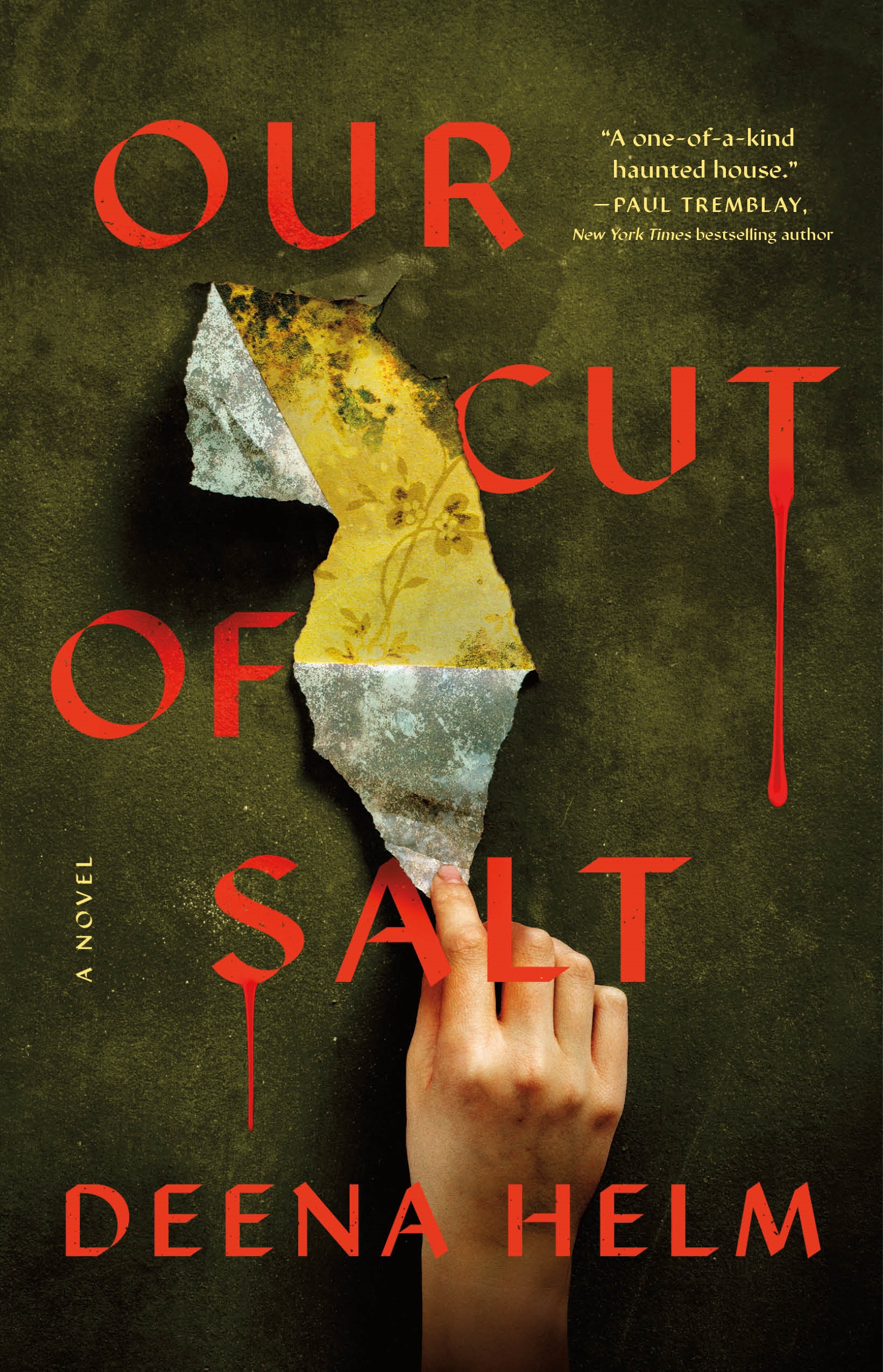

JEDDAH: In Palestinian American writer Deena Helm’s debut novel “Our Cut of Salt,” a family home in Haifa becomes the keeper of history and rage after its Palestinian family was forced out by the Israeli occupation during the 1948 Nakba.
Forthcoming from Tor Nightfire, Tor’s horror imprint in the US, and UK publisher Orbit, on Sept. 22, the propulsive gothic horror novel follows three generations of Palestinian women as they reckon with a home lost during the Nakba.
“Something I thought about a lot in the writing of ‘Our Cut of Salt’ was what the homes remember,” Helm told Arab News.
Her novel brings her lifelong relationship with storytelling to a subject that is both historical, personal, and painfully contemporary.
“The novel was not based on anything in my life or in my family’s history,” she said. “I have always wanted to write about Palestine and weave in expressions of the realities I’ve faced during my visits.”
After the death of her grandmother Nuhud, the protagonist Marina, a Palestinian American woman living in Chicago, becomes determined to visit the house in Haifa, Palestine, that she has known only through family stories.
Dar Sayadi is a home turned haunted, a shelter turned wound, and its violence is the violence of the Nakba, ongoing and accruing interest eight decades later.
“I grew up listening to my mother’s stories of how everyone was forced to leave still with their house keys in hand,” the author said.
The house key is one of the most enduring objects of Palestinian memory: an ordinary domestic artifact transformed by dispossession into evidence of a return that may never come. “It made me wonder that when we leave all these emotions in the places we live in, what happens when something so deeply traumatic and immediate happens?”
The symbol and inherited image of the key further pushed Helm toward the line of questioning that envelopes the story: “Do our homes miss us? Are there scars left on the wood and stone just like there are on the land and its people?”
Telling this tale of Palestine through the perspectives of three generations of Palestinian women was a deliberate choice for the storyteller.
“I wanted the house to exist in a place that had long experienced occupation,” she explained. “(I) wondered what it would pass down from the horrors it had inherited, which naturally lent itself to the women’s stories and following three generations.”
The women’s perspectives anchor the novel to various sites of Palestinian struggle: Marina in Chicago, disconnected from a homeland she has only ever heard about; her mother Haifa, named for the city her family lost, carrying trauma she cannot always name; and Nuhud, the grandmother whose death sets the novel in motion, who never returned to Dar Sayadi after 1948 but continued to carry it in her heart until death.
“I think women carry a lot in this world, and especially in times of horror,” she said, drawing an explicit line from her fiction to the present-day reality in Gaza, where she described women “struggling with reproductive issues, menstrual issues, and miscarriages due to a lack of access to healthcare and a loss of safety due to the genocide.”
She added: “I worry about what they will have to deal with when, years into the future, there will be issues whose roots are being planted now.”
Helm was on what she called “a bit of a haunted house binge” when the idea behind “Our Cut of Salt” came to her: “As I read through other horror novels, I realized that nowhere made more sense for a house to become haunted than Palestine.”
For Helm, fiction can create a kind of intimacy that cold, hard facts can struggle to achieve, making it “much more personal.”
“I do wish it was easier to connect to statistics and facts, but even for myself, I’ve often found myself learning far more through fiction than I would otherwise.”
She is unambiguous about why horror, specifically, was the right vessel for this story. “Horror felt like the most honest reflection of the current reality with the ongoing genocide in Gaza and the history I wanted to tell,” she explained. “It also feels like the best genre when there are horrors we are seeing in real life, because it allows you to confront them in a haunted house, or a monster, or a ghost.”
The Kansas-raised author is working within a tradition of writers who have used the haunted house as an instrument for interrogating structural violence, and she extended it to the specific machinery of Israeli military occupation and the dispossession of Palestinians since 1948.
She cited Shirley Jackson’s “The Haunting of Hill House” and its Netflix adaptation by Mike Flanagan as formative inspirations, alongside Helen Oyeyemi’s “White is for Witching,” which she describes as a haunted-house novel “that signifies white supremacy.”
Language itself is another site from which she explores inheritance, and coming from a mixed background herself, Helm said it “feels like an added weight to diaspora and displacement.”
In the novel, Nuhud’s childhood friend Rania translates Arabic for Marina, and a friend Sara translates for Haifa, both bridging the older generation’s words to younger women who cannot fully access them unmediated.
“There is a sense, growing up, that you may never understand or connect to your larger family, and it feels like a pre-grieving,” the writer said of her own mixed heritage, noting that the decision to leave certain Arabic phrases untranslated on the page was a deliberate extension of that same experience to the reader.
The Arabic words in “Our Cut of Salt,” she said, “expand and open the world, but they also distance the reader at times,” replicating, in miniature, “that same pre-grieving of not always understanding the full story being told.”
As for what it means to publish this book as a debut Palestinian American author while the history it depicts continues, unresolved, into the present, she resisted any claim to speak for a singular Palestinian experience.
“There is no one way to tell the story of Palestine — we’re a mosaic of histories and lives,” she said, offering fellow writers a simple reassurance: “Your story is valid, people from all walks of life will connect to it, and it will surprise you.
“Humanity is fundamentally good, and we are all working on understanding one another more deeply when we seek out art.”
Helm’s own writing process is immersive, and this can be felt in the transportive reading experience: “When I write, it takes me a very long time to start, but once I’m into it, I’m there for a while and completely close myself off to the world.”
Her next novel, part of the same two-book deal with Tor Nightfire and Orbit UK, is “a possession horror that follows a Palestinian-American woman whose body is slowly taken over by an entity while on a trip to Palestine.”
If “Our Cut of Salt” is any indication, Helm’s sophomore novel will employ, once again, horror to gaze directly into the heartless abyss of Israeli occupation.