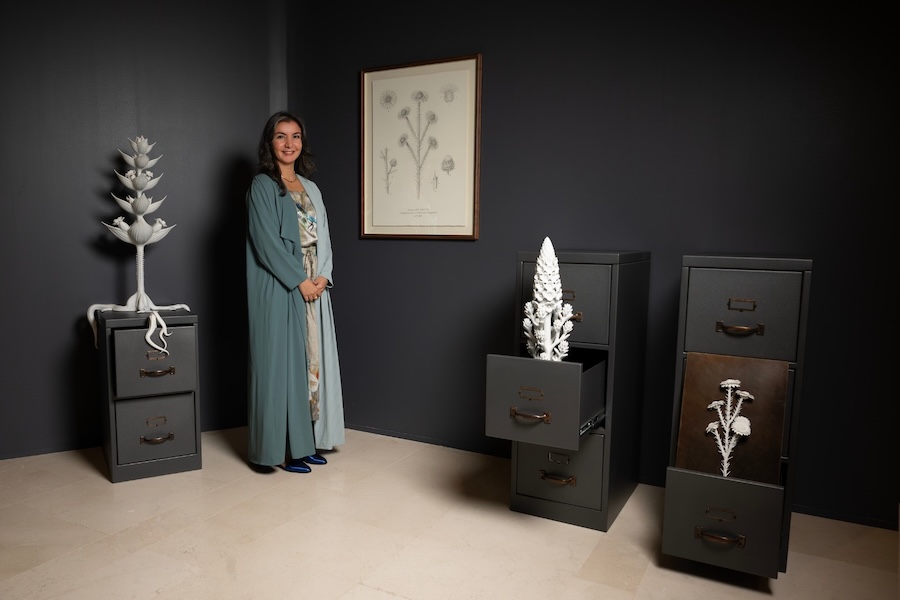

DUBAI: Kuwaiti artist Aseel Al-Yaqoub has been named the winner of the seventh Ithra Art Prize for her work “Flora Incognita” (2026).
Al-Yaqoub was announced as the recipient during a ceremony at the King Abdulaziz Center for World Culture, or Ithra, in Dhahran, Saudi Arabia, on Oct. 1. She receives a SR376,000 ($100,000) grant to support her practice, while her winning work will become part of Ithra’s permanent collection.
“Flora Incognita” takes the form of a botanical herbarium featuring hybrid desert plants. Through 3D-printed sculptures, steel cabinets and graphite drawings, Al-Yaqoub examines the history of botanical classification in the Gulf and how systems of naming and categorization have shaped ideas of knowledge, identity and place.
The work is part of an exhibition featuring the five finalists for this year’s prize, which aims to support contemporary artists from across the Arab world. The exhibition brings together practices spanning installation, painting, textile and conceptual art.
Syrian artist Bady Dalloul presents “Drawing in Matchboxes,” a series of miniature works created inside matchboxes. His practice, which began in 2016, explores the relationship between imagery, personal experience, history and collective memory.
Egyptian artist Heba Y. Amin Elmahamly’s “The Last Carrier: Iteration I” uses textiles to reinterpret an 18th-century depiction of Egypt’s Mahmal procession. The work considers the colonial history embedded in archival imagery and reclaims the historical representation through collaborative making.
Jordanian artist Ala Younis presents “Lifted Arches,” an installation inspired by architect Minoru Yamasaki’s buildings in Dhahran and Riyadh. The work explores light, modularity and the relationship between Islamic architectural traditions and modernism.
Palestinian artist Jawad Al-Malhi’s “Ashes of Absence” is a mixed-media series depicting ghost-like figures. The work examines disappearance, loss and the fragile traces left by people and communities.
“This year’s selection reflects a profound intellectual rigor and creative boldness,” said Farah Abushullaih, programs manager at Ithra.
The finalists were selected by an international jury consisting of Abushullaih, Tarek Abou El-Fetouh, Dr. Nada Shabout, Jerome Sans, and Nadia Kaabi-Linke.
All five finalists received production grants for their works, with the exhibition remaining on view at Ithra until March 2027.