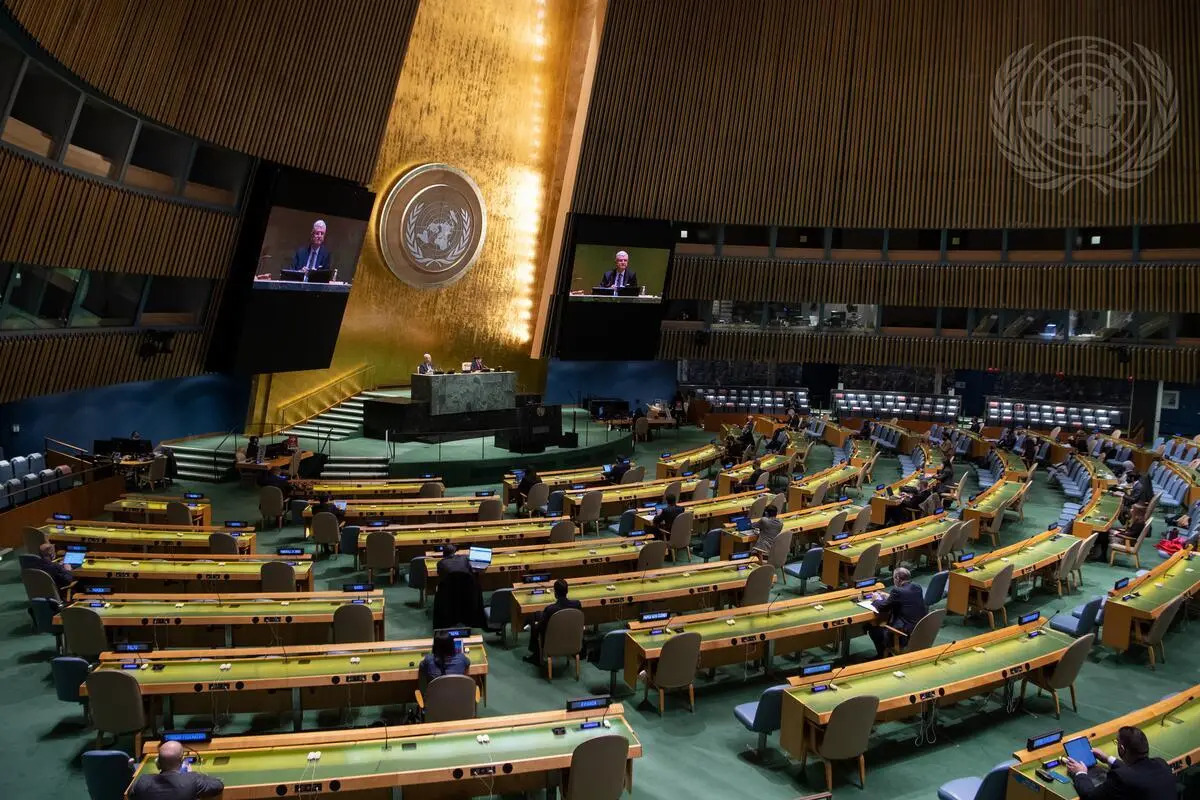

Walking through the UN General Assembly in New York this year, one of the more striking diplomatic contradictions concerned Myanmar.
For most countries represented at the UN, there is little ambiguity about who speaks for the state. Governments appoint ambassadors, ambassadors represent governments and both claim authority over the same country. Myanmar was different. Its presence at the UN exposed a question that runs through the country’s entire political crisis: who actually speaks for Myanmar?
At the UN, Myanmar continues to be represented by Ambassador Kyaw Moe Tun, who publicly rejected the military takeover of February 2021 and remains an outspoken opponent of military rule. The authorities in Naypyitaw insist that he was dismissed years ago and again challenged his status shortly before this year’s UNGA. Yet he remains in place.
Outside the UN, however, another Myanmar is taking shape. Across Asia, governments are increasingly dealing with the military-backed authorities in Naypyitaw on trade, refugees, borders, investment and diplomacy.
In New York, one Myanmar speaks in the language of democratic legitimacy. Across the region, another is increasingly treated as the authority with which practical business must be done. The world, in effect, now has two Myanmars.
This is more than a diplomatic curiosity. Myanmar exposes a weakness in one of the central assumptions of the international system: that territorial control, political legitimacy and international representation normally belong to the same government. Increasingly, they do not.
The UN is built around states. But states are abstractions. Someone must speak for them. Myanmar no longer fits the traditional model.
There are not literally two Myanmar states. There are, however, two increasingly distinct diplomatic realities.
Dr. Azeem Ibrahim
The authorities in Naypyitaw operate the formal institutions of the central state and retain diplomatic relations with foreign governments. The national unity government claims democratic legitimacy from the political forces displaced by the 2021 coup. Ethnic armed organizations control substantial territory and administer large populations. Kyaw Moe Tun, meanwhile, continues to occupy Myanmar’s seat at the UN even though the authorities controlling the Foreign Ministry say he has no authority to represent them.
No single actor therefore possesses every traditional attribute of sovereignty. One has international representation. Another controls the machinery of central government. Others exercise territorial authority.
Different governments consequently encounter different Myanmars depending on the problems they are trying to solve.
For Thailand, Malaysia, China and other regional states dealing with trade, migration, energy, borders and security, practical engagement with Naypyitaw can become unavoidable regardless of the unresolved argument over political legitimacy.
Malaysia illustrates this clearly. Prime Minister Anwar Ibrahim has said his government is not ready to recognize Myanmar’s current government, in line with the Association of Southeast Asian Nations position, while also arguing that Kuala Lumpur needs an authority with which it can negotiate practical issues such as refugee return.
Recognition, in other words, is becoming layered rather than binary.
A government can withhold full political recognition while holding negotiations. It can restrict participation in some multilateral forums while maintaining bilateral contact. It can expand economic ties without offering full diplomatic endorsement.
Myanmar is therefore not simply recognized or isolated. Different aspects of its sovereignty are accepted by different actors for different purposes.
Modern civil wars increasingly produce political landscapes in which international recognition, territorial control and popular legitimacy are divided among competing authorities.
Rather than simply asking who the government is, we may increasingly need to ask three different questions: Who controls the institutions of the state? Who controls the territory? And who is internationally accepted as entitled to speak for the country? Myanmar currently produces different answers to each.
International agreements may consequently be negotiated with authorities that cannot implement them throughout the country. Diplomats may represent states whose central governments reject them. Armed organizations can administer territory and populations while possessing little formal international status.
The Rohingya crisis demonstrates the difficulty. Foreign governments can negotiate with Naypyitaw about refugee return, yet the authority capable of signing an international agreement may not possess the territorial control required to implement it safely.
Malaysia’s current return program illustrates the tension. Kuala Lumpur has negotiated directly with Myanmar and this week began returning around 1,500 Myanmar nationals. Yet the UN Refugee Agency has warned that conditions inside Myanmar do not support safe and sustainable refugee return.
The international system was not designed for this degree of fragmented sovereignty. Similar tensions are emerging in other prolonged conflicts where governments retain international seats while rival authorities exercise effective control over territory and populations.
Someone must still occupy Myanmar’s UN seat. Someone must sign treaties. The formal architecture of international relations requires a single answer even when political reality supplies several.
Kyaw Moe Tun’s presence at the UN represents a continuing judgment about political legitimacy. Regional engagement with Naypyitaw reflects a different calculation about practical authority. Both can exist simultaneously.
There are not literally two Myanmar states. There are, however, two increasingly distinct diplomatic realities. One exists at the UN, where representation reflects an unresolved struggle over legitimacy. The other exists across much of Asia, where governments are increasingly dealing with authorities that possess enough practical power to negotiate over trade, refugees and security.
Neither alone captures Myanmar as it exists today. That may be the larger lesson I took from this year’s UNGA. In an era of fragmented states and prolonged civil wars, sovereignty itself is becoming fragmented.
The question is no longer simply who represents a country. It is what representation means when power, legitimacy and control no longer belong to the same people.