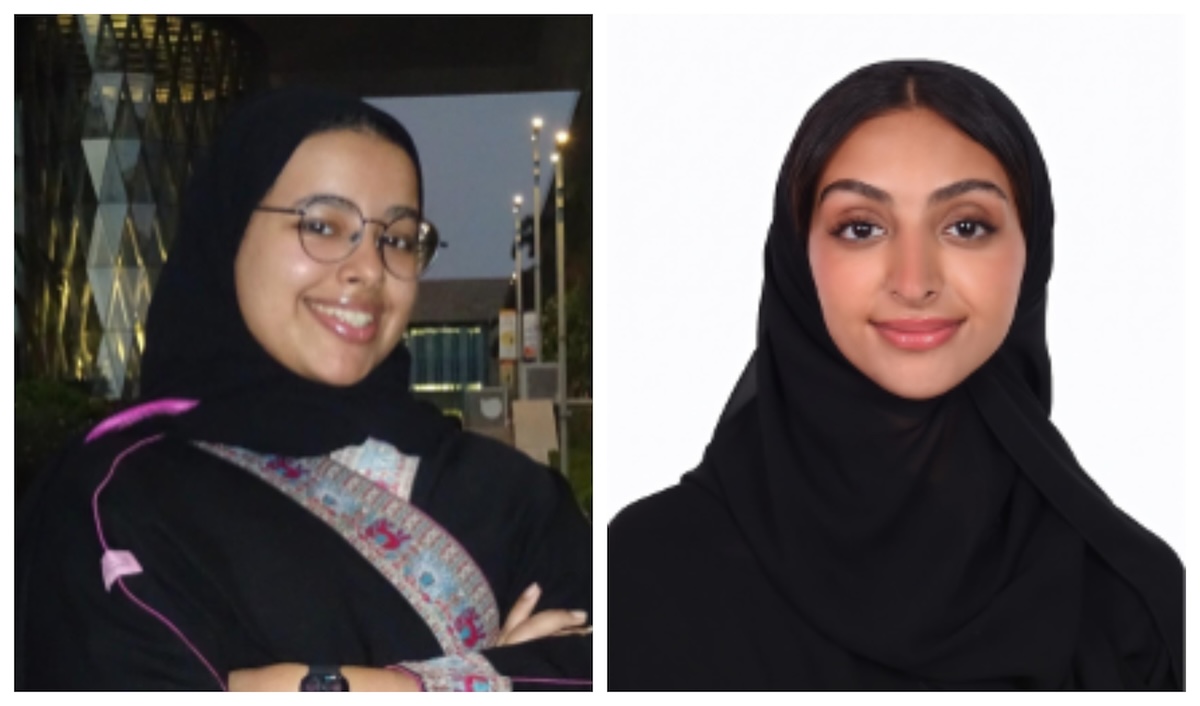

RIYADH: Joudi Al-Ahmadi and Lena Al-Shanafey have won the prestigious Rhodes Scholarships for Saudi Arabia this year.
The duo will head to the University of Oxford in the UK in October next year to undertake post-graduate studies, joining a cohort of more than a hundred other scholars from around the world.
The Rhodes Scholarship is the world’s preeminent and oldest graduate fellowship, based at the University of Oxford since 1903. Saudi Arabia’s first scholarship was established in 2018 with a gift from Muhammad Al-Agil, and the second was added in 2020 through Abdulrahman Al-Agil’s sons. The donors are co-founders of Jarir Bookstores.
Today, two scholarships are awarded each year to outstanding candidates. Education is a core element of Vision 2030 and the Rhodes Scholarships enable exceptional students to fully develop their skills and knowledge in fields that will help the Kingdom achieve its goals.
Many of those who apply for a scholarship find the rigorous selection process is a positive experience which leaves them well placed to either become a Rhodes scholar or explore other opportunities.
The process aims to choose young people with proven academic excellence who also show exceptional character, leadership, the energy to use their talents to the full and a commitment to solving humanity’s most profound challenges. It includes a rigorous review before the finalists are interviewed by a committee comprising renowned experts and leaders in diverse fields.
Rhodes scholars form a lifelong community of alumni in many fields and careers, united by a commitment to having a positive impact on the world. So far from Saudi Arabia, 20 students have been awarded a Rhodes Scholarship at Oxford with many going on to pursue careers in areas such as genetics, medicine and the creative arts.
This year’s winners continue the legacy of excellence.
Joudi Al-Ahmadi has a first-class honors degree in physics from the King Abdulaziz University and is currently pursuing a Master of Science degree in quantum technologies at the University of Oxford, with her research spanning computational and experimental physics.
For her graduation project, she used density functional theory to investigate defect-engineered molybdenum disulfide. At King Fahd University of Petroleum and Minerals, she modeled frequency-selective surfaces and polarization rotators, contributing to a peer-reviewed publication in Progress In Electromagnetics Research Letters.
At the University of Cambridge, she conducted experimental research on tin-lead perovskites in Prof. Sam Stranks’s group and later completed KAUST’s ELEVATE program in advanced materials characterization. She is the founder of Zamakan, a student science journal that communicates complex science in Arabic, and served as co-president of the Physics Club at King Abdulaziz University. At Oxford, she plans to pursue a doctorate of philosophy in atomic and laser physics, focusing on atom interferometry and quantum sensing, to advance the development of deployable quantum technologies in Saudi Arabia.
Lena Al-Shanafey is a senior at the University of Pennsylvania pursuing a dual degree in economics at the Wharton School, with concentrations in finance and healthcare management, and political science in the College of Arts and Sciences.
She is a Benjamin Franklin Scholar and Joseph Wharton Scholar and her honors thesis uses hospital records to examine diagnostic pathways and access to treatment for menopausal women in Saudi Arabia. She also conducts research in Penn’s Department of Healthcare Management and has led consulting projects for healthcare companies and startups.
She has worked at Boston Consulting Group and at Sanabil Investments, the venture arm of Saudi Arabia’s Public Investment Fund. She founded Novus Digest, a youth-led publication, and has written for Arab News.
At Oxford, she plans to pursue a Master of Science degree in global health science and epidemiology, followed by one in applied digital health. She hopes to return to Saudi Arabia to work across health policy and healthcare investing, using population-level evidence to identify gaps in women’s healthcare and guide investment toward models of care that reach women earlier.