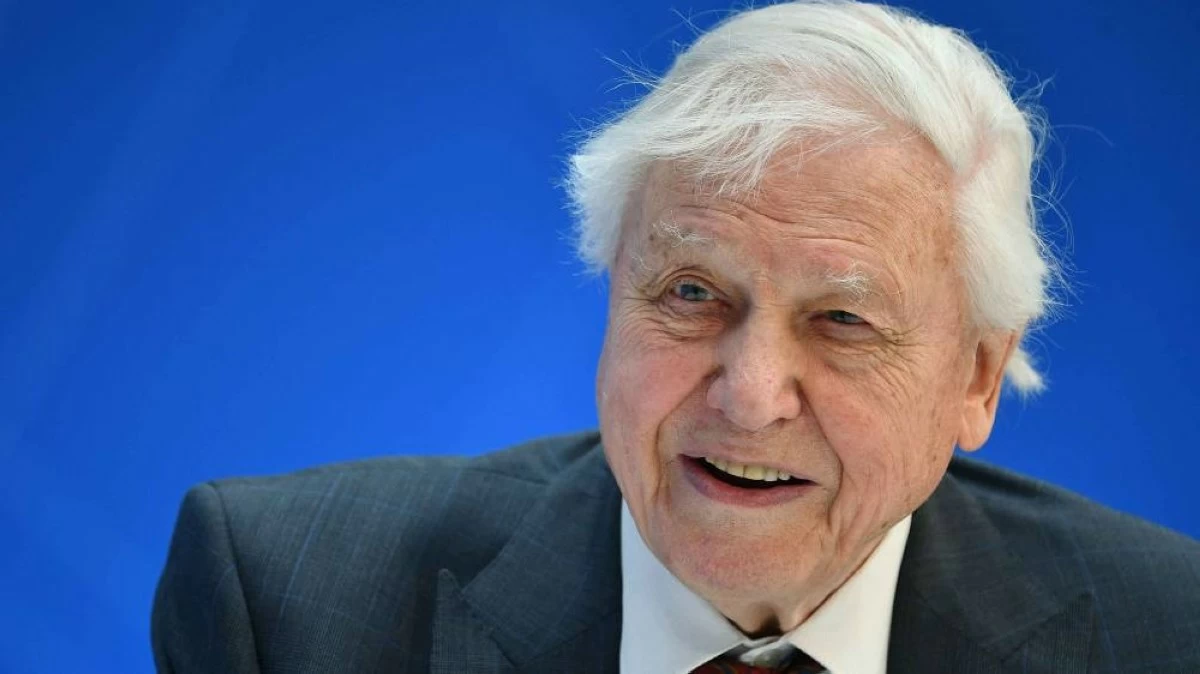

London: Britain’s David Attenborough, who has for decades been the world’s most authoritative voice on the natural world and whose documentaries have been watched by hundreds of millions, will on Friday celebrate his 100th birthday.
After more than 70 years of film-making, Attenborough’s instantly recognisable voice is synonymous with the story of nature. He is still at the vanguard of efforts to protect the environment and has produced some of his most impactful work in recent years.
Counting Britain’s royal family, Barack Obama and pop star Billie Eilish among his admirers, Attenborough’s charisma, humour and warmth, alongside the depth of his knowledge and his flair for storytelling, have made him a broadcasting superstar.
“Your ability to communicate the beauty and vulnerability of our natural environment remains unequalled,” was how the late Queen Elizabeth summed up his achievements in 2019.
‘Lonesome George’ and the fragile environment
Attenborough’s films have communicated the wonder and also the tragedies of the natural world to viewers across the globe.
Standout scenes include his encounter with two playful young mountain gorillas who clambered onto him during his landmark 1979 series “Life on Earth”.
He also made his audience marvel at the teamwork of a pod of orcas hunting a seal by creating waves to break up ice, and his telling in 2012 of the story of “Lonesome George”, the last surviving Pinta Island tortoise, moved people to tears.
“He’s about 80 years old, and getting a bit creaky in his joints – as indeed am I,” Attenborough, then 86, said.
George’s death, two weeks after he was filmed, marked the extinction of his species.
“He’s focused the attention of the world on the fragility of our environment,” Attenborough said at the time.
While Attenborough has topped numerous national popularity polls, being named the country’s most admired man and the greatest living British cultural icon, friends say he rolls his eyes when he is labelled a “national treasure”.
“What he feels is that he’s a public servant. He feels that he had the unique opportunity to be the voice for nature, to tell everybody about the wonders of nature,” Mike Gunton, a television producer who has worked with Attenborough many times, told Reuters.
As climate change has accelerated and the threat to much of the world has become more urgent, Attenborough devoted much of his 90s to raising public awareness.
His 2017 blockbuster “Blue Planet 2”, which highlighted the scourge of plastic in the ocean, achieved some of the highest viewing figures on British television before being sold to broadcasters around the world.
Albatrosses unwittingly feeding their chicks plastic fished from the ocean jolted public opinion and led the British government and major retailers to announce measures to reduce the use of plastics.
“I think every single person who’s seen anything that Sir David has done has been inspired to care about nature,” said Doug Gurr, director of the Natural History Museum in London.
Special BBC broadcasts and events
In Britain, Attenborough’s centenary is being marked with a week of special broadcasts on the BBC, a live concert at the Royal Albert Hall, events at museums, nature walks and tree planting.
The broadcasts include his new series “Secret Garden”. At 99, he remains heavily involved in programme-making, say BBC colleagues, driven by his enduring curiosity and joy of storytelling.
“That’s typical David. He makes everything really enjoyable,” said Mike Salisbury, who has worked as a producer on several Attenborough documentaries.
Born on May 8, 1926, Attenborough spent his childhood collecting fossils, insects and dried seahorses.
His BBC career took off in 1954 when he presented “Zoo Quest”, which involved him travelling to far-flung parts of the world and bringing animals back to London Zoo.
By the 1970s he had risen to be programme controller at the broadcaster but decided he wanted to return to making nature documentaries.
Screened in 1979 when he was 52, “Life on Earth” made him a household name. He wrote the entire 13-hour script and travelled the world for three years to tell the story of evolution from simple organisms to humans.
Dozens of documentaries followed, including “Blue Planet,” “Frozen Planet” and “Dynasties”. As the decades passed, his sense of the need to act only increased.
“How could I look my grandchildren in the eye and say I knew what was happening to the world and did nothing?” Attenborough said.