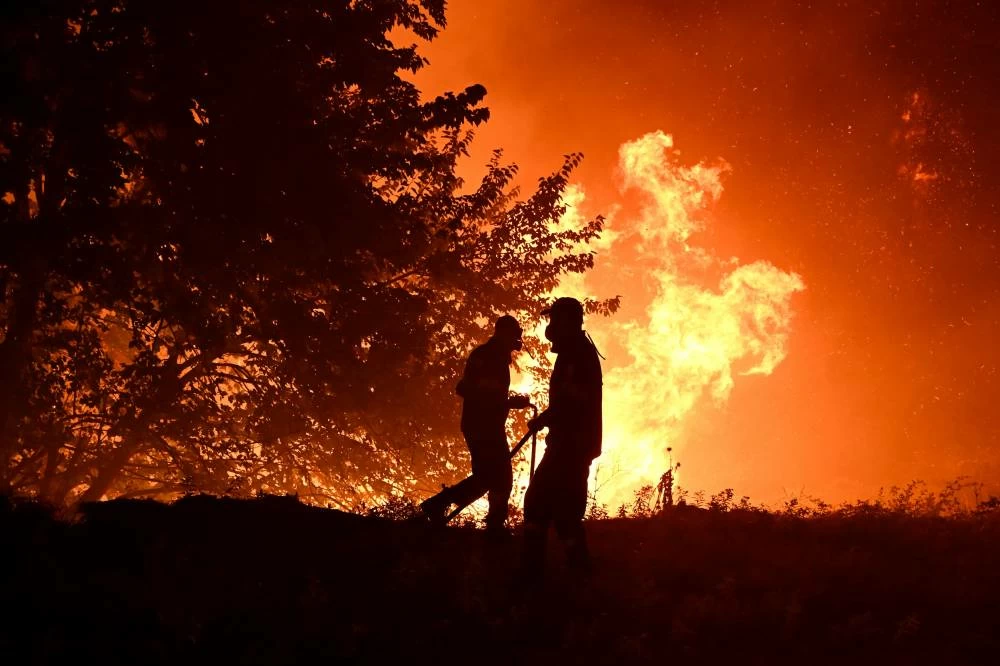
Athens, Greece: Hundreds of firefighters continued battling major wildfires in Portugal and Greece on Sunday, as authorities warned of dangerous conditions ranging from fast-moving flames to toxic smoke.
In Portugal, more than 1,200 firefighters, supported by nearly 400 vehicles and 15 aircraft, were deployed to combat a wildfire in the central Vouzela area that has been burning since Thursday, according to the country’s Civil Protection authority.
Data from the European Union’s Copernicus satellite monitoring programme showed the fire had already scorched around 12,000 hectares (120 square kilometres) by Sunday.
European support arrives
The European Union’s Civil Protection and Humanitarian Aid department said Spain dispatched 120 firefighters and 45 vehicles to assist Portugal on Friday, while firefighting aircraft from Spain and Italy were also sent to support operations.
The blaze remains one of the largest currently burning in southern Europe as firefighters work to contain its spread.
Toxic smoke alert in Greece
In Greece, authorities urged residents in parts of Thessaloniki, the country’s second-largest city, to remain indoors and keep doors and windows closed due to toxic smoke from a recycling plant engulfed by wildfire.
The fire broke out on Saturday evening near the suburb of Oraiokastro, prompting evacuation warnings for three nearby suburbs and a facility housing 157 people with special needs.


Strong winds fuelled the flames, with around 160 firefighters deployed overnight before water-dropping aircraft joined the firefighting effort at daybreak.
Homes and businesses damaged
Oraiokastro Mayor Pandelis Tsakiris told state broadcaster ERT that several homes and businesses had been damaged, although authorities were still assessing the full extent of the destruction.
Greek authorities also announced the arrest of a 76-year-old man suspected of accidentally starting the fire. Investigators allege sparks generated by his vehicle ignited roadside vegetation. He was due to appear before a prosecutor on Sunday.
The incident comes only days after another wildfire in the same region claimed the lives of a 12-year-old boy and his father.
Most fires linked to negligence
Fire department spokesperson Brigadier Ioannis Artopoios said approximately 85% of wildfires in Greece are caused by negligence, including sparks from agricultural machinery, discarded cigarette butts and outdoor barbecues.
“This means most of them could have been avoided,” he said.
Climate-driven fire risks
Greece regularly experiences destructive wildfires during its hot and dry summer months. In 2018, a wildfire east of Athens killed more than 100 people, while a blaze that swept through a nature reserve in northeastern Greece in 2023 became the largest wildfire ever recorded in the European Union.
As climate change intensifies wildfire risks, Greece has increasingly turned to technology to improve detection and response capabilities. The country is integrating a new network of four satellites launched into low-Earth orbit in May to help monitor wildfire activity.
Although Greece has largely avoided the extreme heatwaves that recently affected much of western Europe, dozens of wildfires have already been reported this summer across both the mainland and several islands.