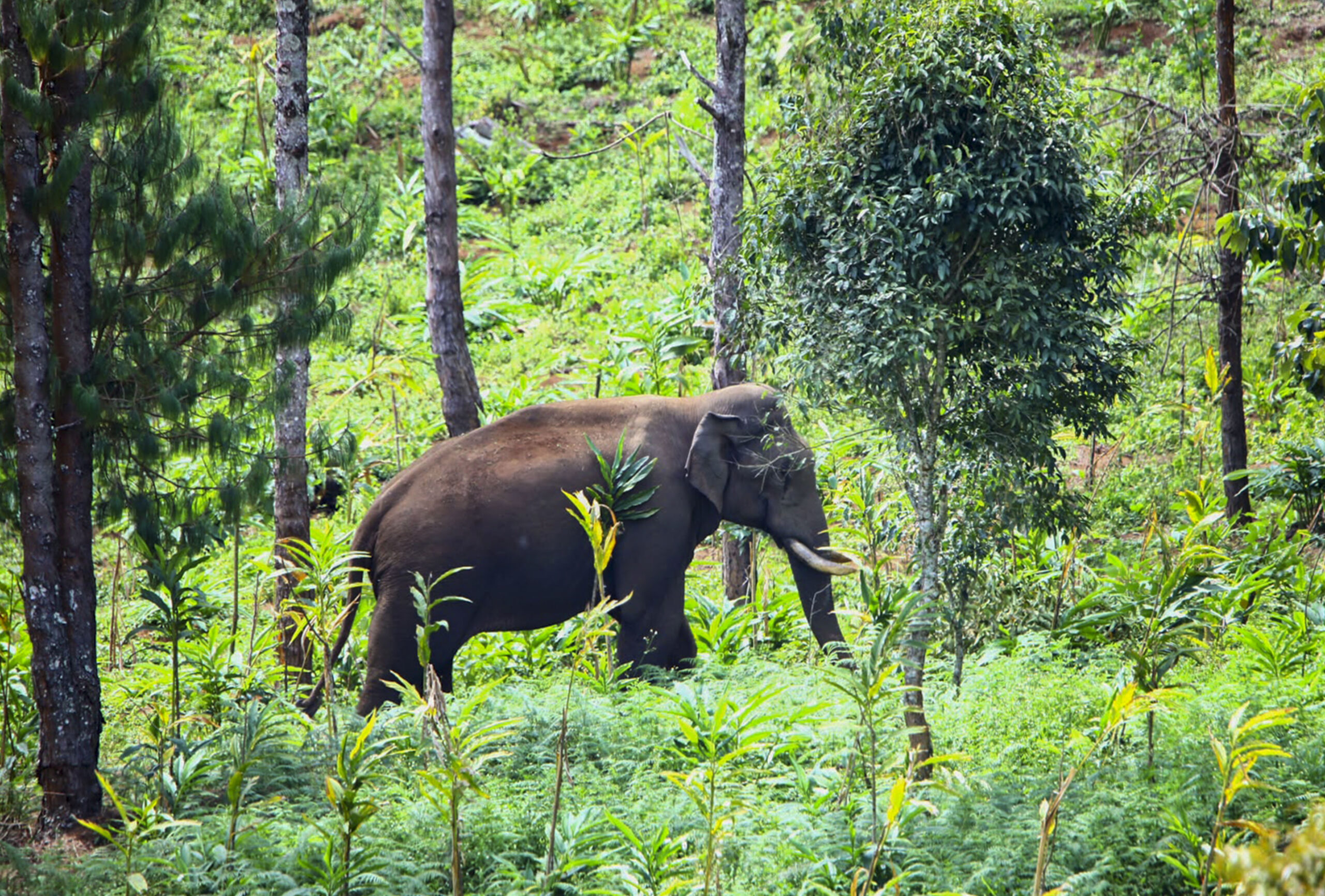
Idukki: In Kerala’s Idukki district, forest officials are on a mission to capture a wild elephant that now has fans as well as haters. Chakkakomban, the jackfruit tusker, has attained cult status among Malayalis, with another wild elephant, Arikomban, the rice tusker, not too far behind.
While Chakkakomban earned his name for his fondness for jackfruit, Arikomban loved rice, and both tuskers’ food preferences led them to seek out human settlements frequently. The elephants’ interaction with the human settlements around the Chinnakanal area, leading to attacks on people and damage to property, has become the centre of a debate over human-elephant conflict in Kerala.
While the conflict raises serious concerns about the safety of people in the area, the virality of citizen-shot videos of these tuskers has garnered them a following for their rowdiness.
Following the protest, the government decided to tranquillise and radio-collar the wild elephant so that it could be monitored regularly and prevented from straying near human settlements.
Arikomban, too, was collared in a similar attempt in 2023. And much like in that high-profile hunt, the general public is closely watching the developments as if it were a sports match.
Mission preparations
Ahead of Wednesday’s operation, the district administration imposed prohibitory orders in wards 1, 2, 9, 10, 11 and 12 of Chinnakanal panchayat.
Educational institutions, including anganwadis, in these areas remained closed. Residents were asked to avoid unnecessary travel, stay away from the operation site and not gather to watch the elephant.
The public was also prohibited from using drone cameras, night cameras and camera traps in and around the operation zone. Emergency medical arrangements were made at five hospitals in the region in case of any eventuality.
Two trained kumki elephants were also brought to Chinnakanal as part of the preparations to tranquillise and radio-collar Chakkakomban. Kumkis are trained captive elephants that forest departments use to track, calm, herd and capture wild elephants, and to drive them away from settlements.
For forest officials, the task is not simply to capture the elephant but to ensure that it is handled safely before being fitted with a radio collar and released into the forest. The collar is expected to help track its movements and provide information that could assist officials in responding to future human-elephant conflicts.
But the attempts to capture Chakkakomban and another wild elephant, Murivali, have also drawn opposition from environmental groups.
The Co-Existence Collective, a group of environmental organisations, has submitted an urgent petition to the Union Ministry of Environment, Forest and Climate Change, seeking an immediate halt to the operation. The group has called for independent scientific, ecological and veterinary studies before any attempt is made to capture or relocate the elephants.
It has also sought the restoration of elephant corridors and water sources in Chinnakanal, along with an inquiry into human deaths and the use of firecrackers and explosives to drive elephants away. The petition also suggests measures such as trenches and early warning systems to reduce conflict between people and elephants.
Mission Chakkakomban
A day-long effort to capture and radio-collar Chakkakomban ended without success on Wednesday, as rain and thick fog forced forest officials to call off the operation. A 140-member team of forest personnel had begun the operation around 4 am, hoping to tranquillise the elephant, fit it with a radio collar and release it safely into the forest.
Chakkakomban had been under close watch near the Anayirankal Dam. Forest teams first located it early in the morning and followed its movements using ground patrols, boats and drones. A team in a boat tracked the elephant across the dam reservoir, while drone cameras helped officials monitor its movements and share information with personnel on the ground.
The elephant, which was resting on a small island, moved towards the Panniyar area after about an hour. Forest personnel used firecrackers to guide it towards a suitable location away from residential areas. It reached the area around 10 am and later tried to move back towards the dam, but a team in a boat drove it away.
The tranquilliser dart was eventually fired when the elephant reached a grassland near the Oommanukuttan area, close to Singukandam. However, the animal did not become fully sedated. The operation was called off around 4 pm, as the elephant ran towards the forest, making it harder for the team to follow.
A 24-member special team, including four veterinary doctors, was assigned to the mission. The larger team included Rapid Response Teams from different forest divisions and members of the Elephant Squad. A base camp was set up at Fatima Mata High School in Chinnakanal to coordinate the operation. Officials from the Forest Department, Police, Revenue, Fire and Rescue Services and Health Department also worked together.
Renewed attempts today
The forest department said today that it is preparing a fresh plan to capture and radio-collar Chakkakomban, the wild tusker that continues to roam the Chinnakanal area of the district.
Speaking to reporters on the second day of the operation, Chief Conservator of Forests D K Vinod Kumar said the elephant had been located in a cardamom plantation within the Chembarathukuzhi tribal settlement, but the prevailing conditions were not conducive to the operation.
“Visibility is poor, and we will not get the correct trajectory for darting. We will wait until the elephant moves to an open location and then attempt the operation again,” Vinod Kumar said.
He said all teams were already in the field and the resources used during Wednesday’s operation had been replenished. The teams had also been reorganised, and shortcomings encountered during the previous attempt had been addressed. The operation teams had been reduced from four to two to improve coordination and enhance safety, he said, adding that the focus this time would be on personnel safety rather than completing the immobilisation at the earliest.
The amount of equipment available to the two teams would remain the same, increasing the chances of a second attempt if the first darting attempt failed, he said.
The officer said the forest department would avoid using crackers to influence the elephant’s movement and would resort to limited measures to change its direction only if it moved in an unintended direction.
Kumar said Chakkakomban was currently stationary in the cardamom plantation but was expected to resume movement as the day progressed. He said the elephant generally rested in the morning and resumed its movement around noon. It had been moving through settlements, including Chembarathukuzhi, Idukkuzhi and 301 Colony, where the earlier attempt was made on Wednesday.
He said forest watchers were continuously tracking the movement of all 17 elephants in the Chinnakanal area. Information about elephant movements was being shared with residents on a priority basis, and people entering vulnerable areas could be restricted if necessary, he said.
Regarding the tranquilisation procedure, Kumar said the veterinary team would assess the animal’s response within 10 to 15 minutes of administering the initial dose. Veterinary doctors would monitor its mobility and other physical parameters before approaching it. Further doses would be administered depending on its breathing and other vital signs until the operation was completed, he said.