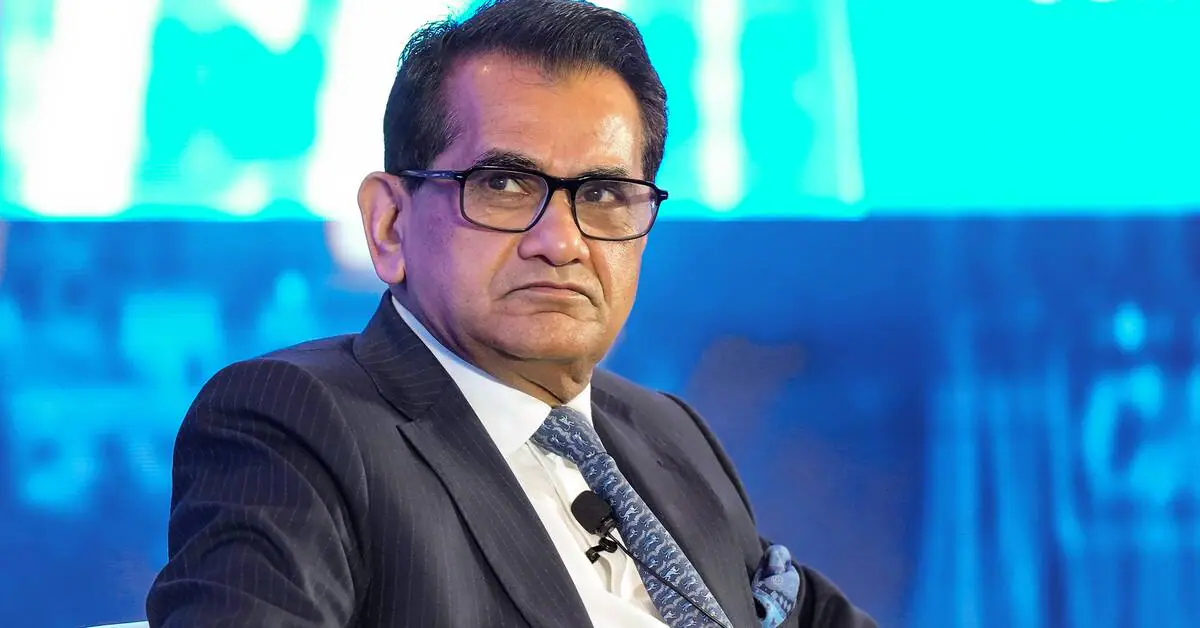
Former NITI Aayog CEO Amitabh Kant has strongly criticised the Corporate Average Fuel Economy (CAFE-3) norms, calling them a “huge missed opportunity” that are “backward looking at worst and status quoist at best”.
Taking to X, Kant said the new norms represented a missed opportunity for India to make a technological leap similar to what it had done with UPI and smartphones.
“This was an opportunity to technologically leapfrog like India has done with UPI & Smartphones. Instead, it is a case of a huge missed opportunity. The new CAFE norms are backward looking at worst and status quoist at best. They lack vision and a clear road map for the future. The regulation follows the industry instead of leading it. Electric vehicles become one option among many, when they should be the destination,” he said.
On Tuesday night, the Ministry of Power notified the CAFE-3 norms, setting new fuel-efficiency and carbon dioxide (CO2) requirements for passenger vehicles from April 1, 2027, to March 31, 2032.
India cannot win the future of mobility by protecting the past: Kant
Kant argued that India cannot “win the future of mobility by protecting the past”, pointing to the country’s dependence on imported oil. “We import almost 90% of our oil. We are building battery and EV manufacturing capacity. Our fuel-efficiency rules should push the industry toward that future, not give it room to delay,” he said.
He also pointed to the electric vehicle (EV) adoption target under the new norms, saying they target 11 per cent electric cars by 2032, while EVs are already close to 8 per cent of car sales in the current financial year. Criticising the Bureau of Energy Efficiency (BEE), Kant said: “How can (it) sell credits? A regulator can’t be a player in the market it regulates. This was the moment to pole vault. We missed it thanks to a retrograde regulator.”
This is not the first time Kant has criticised the CAFE norms. Before the formal notification of the CAFE-3 standards, he had repeatedly criticised drafts released by the Bureau of Energy Efficiency.
Small-car concession removed
The rules apply to M1-category vehicles, which broadly cover passenger cars such as hatchbacks, sedans, SUVs and MPVs, with up to eight passenger seats apart from the driver.
One of the biggest changes is that small petrol cars weighing up to 909 kg will not receive a separate CAFE concession. Maruti Suzuki India had sought such a benefit, while Tata Motors, JSW MG Motor and other automakers opposed it.
The September 2025 draft had proposed a 3 g/km reduction in the CO2 figure used for CAFE calculations for petrol cars weighing up to 909 kg. The final rules remove that separate benefit.
Vehicle weight to influence CAFE targets
CAFE targets are calculated for each manufacturer based on the weighted average unladen weight of its new vehicles.
The final rules set the reference weight at 1,229 kg. The annual weight multiplier will decline from 0.00158 in FY28 to 0.00131 in FY32. For carmakers, this could influence vehicle weight, engine efficiency, powertrain choices and the mix of models they sell.
EVs retain compliance advantage
Another major feature of CAFE-3 is the super-credit mechanism, which gives manufacturers additional compliance value for selling cleaner vehicles.
Under the final rules, one battery electric vehicle (BEV) will be treated as three vehicles while calculating the manufacturer’s fleet performance. The same 3x factor applies to range-extended electric vehicles (REEVs). The higher the factor, the easier it is for a carmaker to reach its emissions target.
For plug-in hybrids and strong hybrids running on flex-fuel, the factor is 2.5x. Strong hybrids get a 1.6x factor, while flex-fuel vehicles get 1.1x. Any fuel blend with a minimum of 85 per cent ethanol is called flex-fuel.
The final structure is considerably different from the first proposal. The June 2024 draft had offered a 4x factor for BEVs, 2x for PHEVs, 1.2x for strong hybrids and a 5x factor for hydrogen fuel-cell vehicles. Hydrogen fuel-cell vehicles do not feature in the final super-credit table.
Credit-debit system introduced
CAFE-3 also introduces a credit-debit system. A carmaker that performs better than its target earns credits, while one that performs worse accumulates debits. These are recorded in a manufacturer-level passbook.
Credits can be carried forward within a compliance block. The first compliance block covers FY28-FY30, while the second covers FY31-FY32. Unsettled credits lapse at the end of the relevant block.
Carmakers can also trade credits with other manufacturers. A manufacturer with a deficit can buy credits from the Bureau of Energy Efficiency. The price starts at ₹2,500 per g CO2/km in FY28 and rises to ₹4,500 in FY32. Credit trading and buyouts will be allowed from October 1 to October 31 each year.