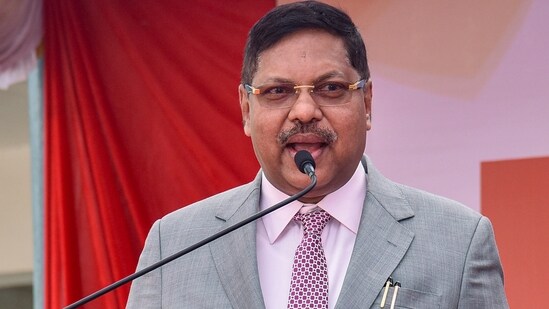
Former Chief Justice of India (CJI) Bhushan R Gavai on Saturday delivered a scathing reflection on the constitutional collapse during the Emergency of 1975, saying the period exposed how the judiciary, instead of acting as a safeguard against excesses of the State, “aligned with State power”, while Parliament, the Executive and the Judiciary all failed in the discharge of their constitutional duties.

Addressing the 19th Annual Sujata Jayawardena Memorial Oration in Colombo on the theme “In a True Democracy, is Parliament Supreme?”, Justice Gavai said the infamous Additional District Magistrate (ADM) Jabalpur vs Shivkant Shukla judgment represented “perhaps the most extreme judicial deference to executive and legislative power in India’s constitutional history”.
“What, then, did ADM Jabalpur judgment signify? It marked a moment where both Parliament and the executive appeared to be unchecked, and where the judiciary, instead of acting as a safeguard, aligned with State power,” Justice Gavai said.
“The Emergency revealed that Parliament, the Executive, and the Judiciary all failed in the discharge of their constitutional duties. Together, these failures exposed the fragility of constitutional guarantees when institutional duties do not operate as intended,” he added.
The remarks assume significance as they come from a former CJI reflecting on one of the darkest constitutional chapters in independent India, where civil liberties stood suspended during the Emergency imposed by the Indira Gandhi government between 1975 and 1977.
Justice Gavai revisited the constitutional crisis that culminated in the Supreme Court’s majority ruling in ADM Jabalpur, where the top court had held that during the Emergency, when enforcement of fundamental rights stood suspended, citizens had no locus to approach courts against unlawful detention.
He said that several high courts across the country, including the Allahabad, Delhi, Karnataka and Madhya Pradesh high courts, had initially held that the State could not deprive a person of life or liberty without authority of law even during the Emergency. However, the Supreme Court reversed those decisions in ADM Jabalpur.
Justice Gavai also paid glowing tribute to Justice HR Khanna, whose lone dissent in ADM Jabalpur has since come to be regarded as a high watermark of judicial courage.
“In this case, Justice H.R. Khanna, in his dissent, held that the right to life and personal liberty is not a gift of the Constitution, but a basic postulate of the rule of law, and cannot be extinguished even during an Emergency,” Justice Gavai said. He underlined that Justice Khanna’s dissent came at a “personal cost”, recalling that the judge was superseded for appointment as Chief Justice of India after refusing to fall in line with the majority view.
The former CJI also referred to the consequences faced by judges of constitutional courts who resisted the suspension of liberties during the Emergency. “Justice AP Sen of the Madhya Pradesh High Court, whose decision had affirmed the continuing protection of liberty, was transferred soon after,” Justice Gavai said.
Justice Gavai noted that the constitutional system eventually corrected itself after the Emergency. He referred to the 44th Constitutional Amendment, which ensured that the right to life and personal liberty under Article 21 could not be suspended even during an Emergency. He also pointed out that decades later, in Justice KS Puttaswamy vs Union of India (2017), the Supreme Court formally acknowledged that ADM Jabalpur was “seriously flawed”.
Tracing India’s constitutional evolution, Justice Gavai said the Indian model rejected absolute parliamentary supremacy in favour of constitutional supremacy. “In the Indian constitutional scheme, Parliament is not supreme in any absolute sense. Nor is any other organ. The only supremacy that the Constitution recognizes is its own,” he said, invoking Dr B.R. Ambedkar’s speeches in the Constituent Assembly.
The former CJI also discussed the evolution of the basic structure doctrine through landmark cases such as Kesavananda Bharati vs State of Kerala (1973) and Minerva Mills vs Union of India (1980), observing that constitutional safeguards emerged from repeated institutional conflicts between Parliament and the judiciary.
He further cited recent judgments involving misuse of Article 356, governors withholding assent to state bills, anti-defection disputes, repeated promulgation of ordinances, and “bulldozer demolitions” to underline the need for institutional checks and constitutional accountability.
At the same time, Justice Gavai cautioned that judicial review must remain within constitutional limits. “Judicial review must not slide into judicial overreach. Activism must not become adventurism,” he said.
Concluding his address, Justice Gavai answered the central question posed by the memorial lecture in emphatic terms: “Ultimately, it is not Parliament, nor the executive, nor even the judiciary that is supreme — it is the Constitution.”