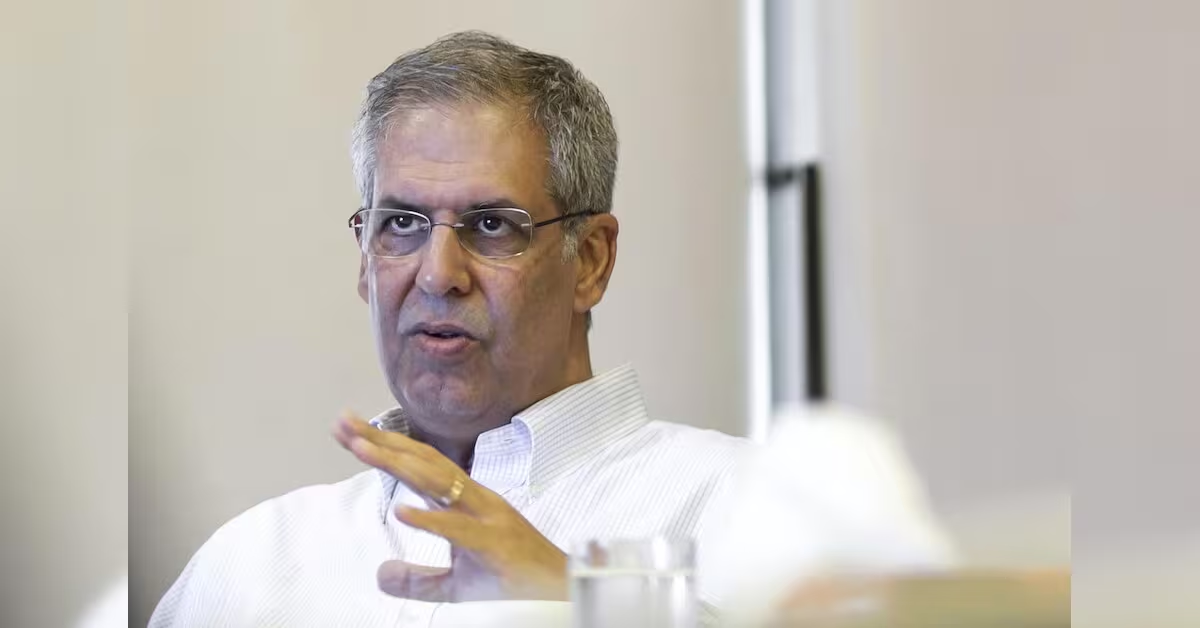
The Tata Sons board should review Tata Trusts’ restructuring proposal and make modifications, if required, in order to avert a stock market listing, Tata Trusts Chairman Noel Tata said on Tuesday.
Tata said he remains hopeful of persuading the Reserve Bank of India (RBI) to reconsider its case for not being considered an upper-layer non-banking financial company. “This is very common practice in India and we hope that RBI will find common ground with us,” Tata said, while speaking at an event hosted by Republic TV.
Listing, according to Noel, will fundamentally change how the company and the group have been working over the past 150 years. “When JRD Tata was asked about the companies’ strategy 100 years ago, he answered in three words: What India needs,” he said. He added that once a company goes public, investors seek profits and it would be difficult to manage the contradiction between that and the philanthropic purpose of Tata Trusts.
Tata Trusts, which holds 66 per cent in Tata Sons, outlined a proposal on Monday to merge Tata Electronics Systems Solutions Private Ltd (TESS) and Tata Consulting Engineers (TCE) with Tata Sons. It said this would provide Tata Sons with its own operations and revenues, ensuring that the holding company of the salt-to-software conglomerate would neither be a non-banking financial company (NBFC) nor a core investment company (CIC).
In a statement issued on Monday, Tata Trusts had said: “To recall, as recently as 2004, Tata Consultancy Services was a business division of Tata Sons before it was demerged into a separate subsidiary.” It argued that other operating businesses of Tata Sons too were divisions of the holding company before they were spun off.
“Accordingly, the proposed reorganisation will result in Tata Sons reverting to its previous operating model, with its own operations and revenues, in addition to being a holding company for the Tata Group,” Tata Trusts had said.
The Tata Trusts proposal came in the wake of a fractious few days for Bombay House. On September 17, the Tata Sons board voted to prepare for listing and provide Chairman N Chandrasekaran with a fresh five-year term. Noel Tata was the lone dissenting voice on both those proposals. He has called the board’s move illegal.
Tata Sons, he said, has always stood by group companies when they faced troubles. And banks, lending agencies, shareholders and suppliers have taken comfort in the fact that Tata Sons stood behind those firms. “If you have individual shareholders, will they agree to allow us to invest in troubled companies, we don’t know,” he said.
Tata Sons was placed on the RBI’s upper-layer NBFC list in September 2022. As a result, the company had three years to list. To avert that, Tata Sons cleared all its debt and filed an application in 2024 to voluntarily surrender its CIC status, aiming to remain private. Earlier this month, the RBI rejected that application, asking the company to comply with the norms.
Philanthropy
On balancing his work as the chairman of the philanthropic trusts and the Tata group’s controlling shareholder, he said the trustees do voice their opinions on the Tata Sons board and make sure that the philosophy of the group remains unchanged.
“Tata Sons is the engine that increases the value of the corpus of our Trust. It has grown at the rate of 20 per cent for the last 30-35 years,” he said. The company’s role, he said, is to make sure that the trusts’ income stays ahead of inflation so that the spending power keeps going up year over year.
Asked how the trusts allocate expenditure, Tata said, “The spending is dominated by health, education and skill development. Health and education is something that we are [not involved in] from the company side. That’s how both complement each other,” he said.
According to Noel, primary education is another sector that the Trust wants to invest in to improve outcomes in early education. “There are probably a billion unfulfilled needs but most of them revolve around health, education and jobs.”
Addressing a key concern, Noel said that the gap between education and job requirements will have to be bridged. “There’s a bit of a mismatch. Companies are not finding the right talent and there are university graduates who cannot find appropriate jobs. Work needs to be done to match education and skills along with where the demand for a job will be coming from over the next few years,” he added.
Philanthropy, Noel said, has been at the core of Tata Trusts, much before it gained popularity. “All I have is a couple of trust documents. They say do good for India, we have left this money,” he said.
One of the measures he highlighted was Tata Steel’s decision to start a five-day work week. It also provided provident fund and retirement benefits before the law required it, he added. “This has not changed and remains the core of the company. However, the methods have changed,” he added.