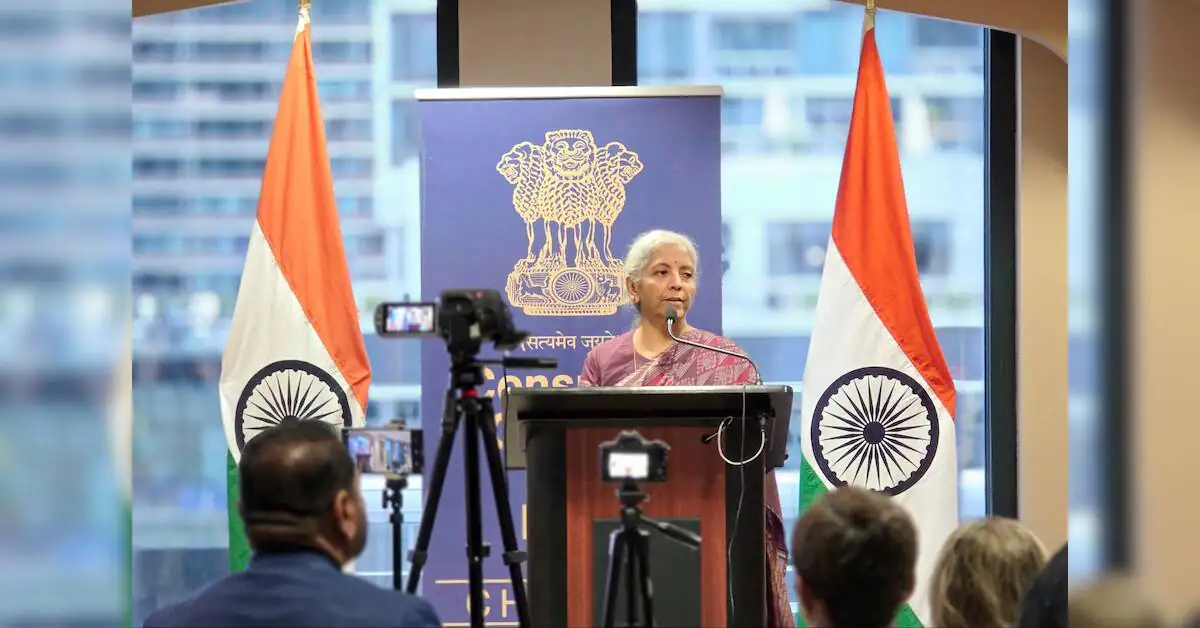
India’s economy is likely to sustain growth of 7 per cent or more in 2026-27 (FY27), continuing the pace seen in the years since the Covid-19 pandemic, Finance Minister Nirmala Sitharaman said on Sunday.
“Since then (Covid), we are sustaining the growth at 7 per cent or more. This year too our growth will be in that range,” Sitharaman said while addressing the Indian diaspora in Chicago.
After contracting 5.8 per cent in FY21 amid the Covid-19 pandemic, the Indian economy has recorded annual growth of over 7 per cent in each of the last five years. For the current financial year, the economy is projected to grow 6.8-7.2 per cent, according to the Economic Survey for FY26. Meanwhile, the Reserve Bank of India (RBI) has estimated GDP growth of 6.7 per cent for FY27. The statistics ministry will release the June quarter GDP data for FY27 on Monday. Sitharaman said India is likely to maintain its growth momentum despite geopolitical uncertainties and supply-chain disruptions following the US-Iran conflict and the closure of the Strait of Hormuz.
“Continuously keeping in touch with global uncertainties as much as understanding India’s own requirements have kept us floating. Whereas many countries are completely disturbed, their calculations have gone haywire,” she said.
The disruption in the Strait of Hormuz initially affected supplies of key commodities such as petroleum products, natural gas, and fertilisers to India, but the country managed to reroute supplies, Sitharaman said.
The government has also kept fertiliser prices unchanged for farmers through subsidies despite a sharp rise in international prices, she said. “The forthcoming season will also require fertilisers from November. We are adequately stocked.”
Sitharaman said the government would continue with systemic reforms and seek to mobilise more capital, particularly from overseas, as the economy expands.
While private investment has picked up domestically following the government’s push on its own capital expenditure, India also needs to attract international investment to meet its growing capital requirements, she said.
“Because of the ambitions that we have, we need capital. Therefore, my trip (to Canada and the US) and other ministers as well as the prime minister himself, all of us are talking to global funds,” Sitharaman said. “Showcasing what India has already done and hearing their expectations so that we can go back and provide clarity” is part of the effort, she added.
Last week, Commerce and Industry Minister Piyush Goyal also visited Japan, where he pushed to mobilise investments worth 10 trillion Japanese yen (around $60 billion) by 2035.
“We are also talking with several countries for Bilateral Investment Treaty (BIT) along with bilateral trade agreement,” Sitharaman said.
The government’s push to attract overseas capital comes amid a sharp slowdown in net foreign direct investment (FDI) inflows into India over the past four years. Net FDI fell from an annual average of around $40 billion between FY20 and FY22 to $6.95 billion in FY26, according to RBI data.