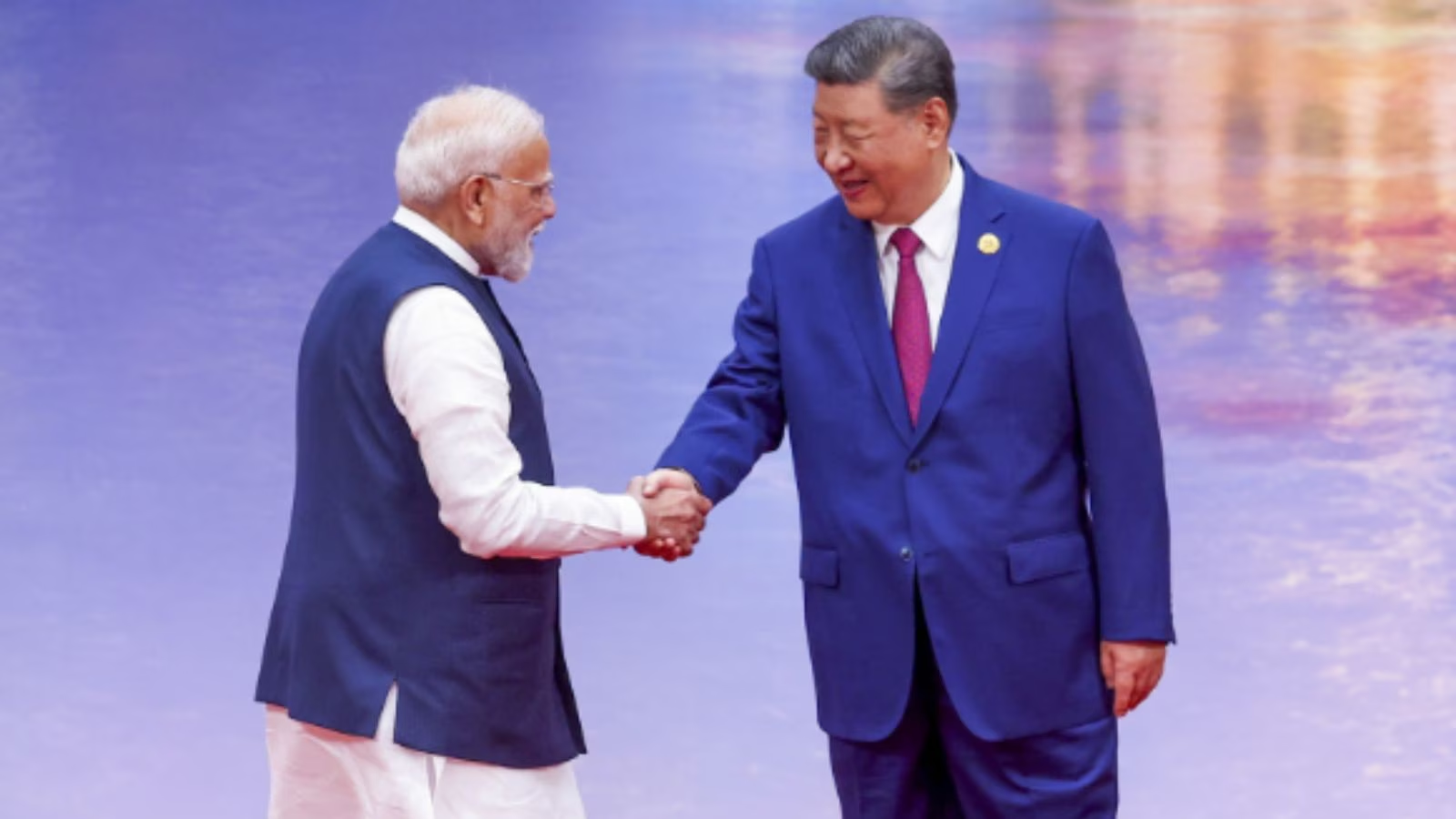
Underlining that “peace and tranquility in the border areas” has enabled “progress towards gradual normalization of bilateral relations”, Indian and Chinese officials have held talks in Beijing on delimitation, border management, mechanism building and cross-border cooperation.
The meeting of the Working Mechanism for Consultation and Coordination on India-China Border Affairs (WMCC) took place Wednesday.
The two countries have been trying to restore ties that plummeted after Chinese incursions along the Line of Actual Control in eastern Ladakh triggered a military standoff six years ago.
Disengagement of troops from friction points was completed in November 2024, a month after Prime Minister Narendra Modi and President Xi Jinping met in Kazan, Russia. But an estimated 50,000 troops remain deployed in the depth areas on each side of the LAC in the region as the two countries move to restore ties.
In an official statement Thursday on the 35th meeting of the WMCC in Beijing, the Ministry of External Affairs said, “The discussions were constructive and forward looking. The two sides reviewed the situation in the India-China border areas. They expressed satisfaction with the progress made in maintaining peace and tranquility in the border areas, which has enabled progress towards gradual normalization of bilateral relations.”
The Indian delegation was led by Sujit Ghosh, Joint Secretary (East Asia), while Hou Yanqi, Director General of the Boundary & Oceanic Affairs Department of the Chinese Ministry of Foreign Affairs, led the Chinese delegation.
Ghosh had earlier served as Director (China) and was India’s Deputy High Commissioner in the UK. Hou Yanqi was China’s Ambassador to Nepal (2018 to 2022). So, both officials have a background in dealing with the border issues between India and China.
Story continues below this ad
Xu Feihong, China’s Ambassador to India, in a post on X, said, “Both sides conducted constructive dialogue in a practical and friendly atmosphere and acknowledged that the border area maintained lasting peace and tranquility.”
“The two sides held discussion on boundary delimitation, border management, mechanism development and cross-border communication and cooperation, and agreed to keep communication through diplomatic and military channels, maintain peace and tranquility in the border area and actively prepare for the 25th Round of Talks between the Special Representatives of China and India on the Boundary Question,” Xu said.
While these remarks echoed Delhi’s statement on the border issues, the Chinese statement did not mention the issue of trans-border river cooperation which was flagged by the MEA.
“The two sides discussed issues pertaining to delimitation, border management, mechanism building and cross-border cooperation,” the MEA statement said, adding that the “Indian side stressed on early meeting of the next Expert Level Mechanism on Trans-border Rivers” – a reference to the Brahmaputra, a trans-border river flowing from China to India to Bangladesh.
Story continues below this ad
It said “both sides agreed to maintain regular exchanges and contacts at the diplomatic and military levels through mechanisms including those that were agreed as part of outcomes of 24th SR Talks”.
This was a reference to the outcomes of talks between the Special Representatives, NSA Ajit Doval and Chinese Foreign Minister Wang Yi, held on August 19, 2025 in New Delhi, days before Prime Minister Modi’s visit to Tianjin, China, for the Shanghai Cooperation Organisation summit.
During the Doval-Wang talks, the two sides had agreed to utilise the border management and control mechanisms through diplomatic and military channels. The series of outcomes included an expert group under the WMCC to explore early harvest in boundary delimitation, a working group under the WMCC to advance effective border management for peace and tranquillity in the border areas, general level mechanisms in Eastern Sector (Arunachal Pradesh) and Middle Sector (Himachal Pradesh and Uttarakhand), in addition to the existing general level mechanism in the Western Sector (Ladakh).
The MEA statement on the WMCC meeting also said, “The two sides agreed to work together to make substantive preparation for the next meeting of the Special Representatives (SR), to be held in China.” This means that NSA Doval will travel to China later this year.
Series of steps
Story continues below this ad
Ever since the disengagement of troops from friction points in eastern Ladakh, China and India have taken a series of steps to repair ties: reduction in visa curbs, resumption of direct flights, revival of the Kailash Mansarovar Yatra, easing restrictions on Chinese businesses.