
Carrieis Mike Flanagan’s fourth Stephen King adaptation after Gerald’s Game (2017), Doctor Sleep(2019), and The Life of Chuck(2024). King’s debut novel got the stylish Brian De Palma treatment in 1976. “We knew from the beginning we weren’t going to be remaking Carrie because there is really no point,” Flanagan says over a video call from New York. “It’s been done so many times,” he adds.

Carrie White, played by Summer H. Howell in the miniseries, is curious, kind and a voracious reader, except for Mary Shelley’s Frankensteinbecause she “doesn’t do scary”. “Every other version of Carrie has a Carrie White who is traumatised and terrified,” the 48-year-old director says.
“She is trembling the whole time. In a lot of ways, we were looking for the opposite of that character. Instead of someone who is terrified, here’s someone who is eager, curious, earnest, and kind, and let’s see what she thinks of our world today and what our world would do with someone like that. That was one of the new ways we were trying to get into the story.”

Mike Flanagan
| Photo Credit:
Special Arrangement
Carrie has always been a story of female empowerment and the female experience, Flanagan says. “There is this dialogue in the fourth episode where we say, ‘we live in a world that seeks to watch powerful, strong, and unique women fall.’ That is awful, but it’s a truth about our world and was something we were interested in talking about.”
The theme was present in Stephen King’s novel, Flanagan says and the series gave it more time and space to develop it further.
There is no clear monster in Carrie, Flanagan says. “Cruelty and the way we’ve normalised violence is the villain. We didn’t want Chris Hargensen (Alison Thornton) or Margaret White (Samantha Sloyan) to simply be villainous monsters. Tragedies tend to have many authors, and it was more interesting to think about the single decisions that ordinary people make every day that can lead to these tragic outcomes.”

Summer H. Howell in a still from Mike Flanagan’s ‘Carrie’
| Photo Credit:
Prime Video
The mini-series draws a connection between Joan of Arc and Carrie. “In the book, Stephen King hints at the presence of gifted women throughout history,” Flanagan says. “In the writers’ room we talked about the different ways that those powers would have presented themselves, and how historically those women might have been greeted by their cultures.”
That led to some fascinating conversations about the Salem witch trials, and the witch trials in Germany, Flanagan says. “To me, however, Joan of Arc was a fascinating example of someone who seemed to display what could be argued as a supernatural ability, and then, of course, was dealt with the way so many of these powerful and gifted women are throughout history. They are devoured by the very people that had relied on them for protection to begin with.”

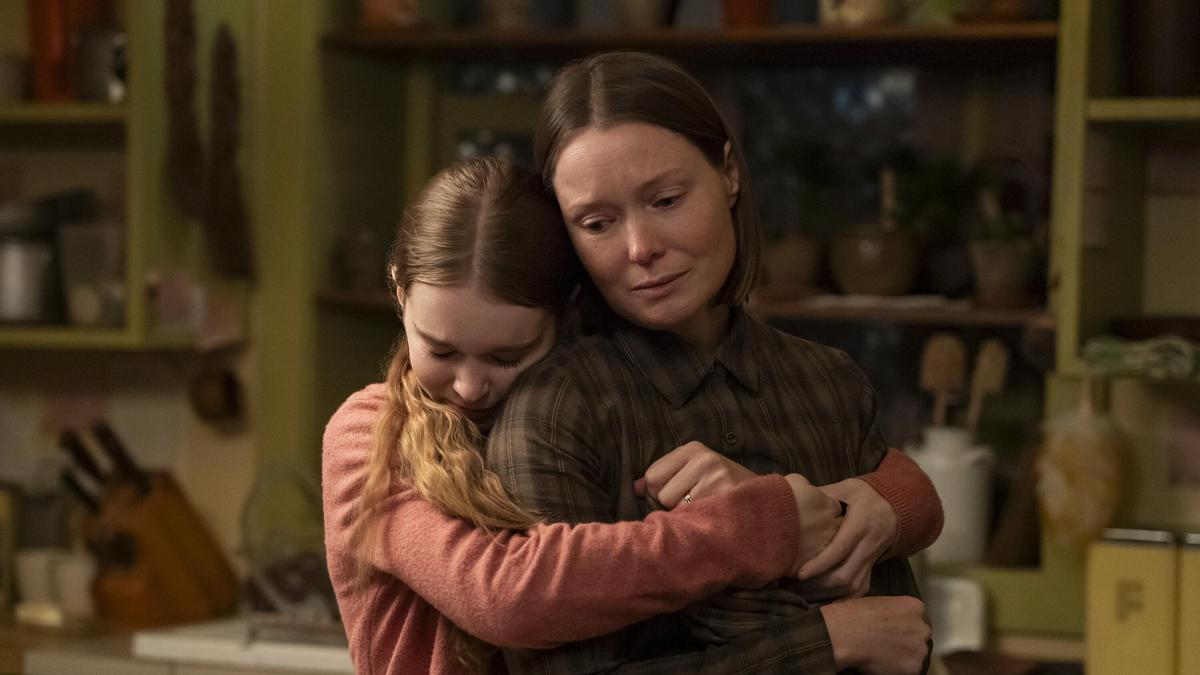
Summer H. Howell and Samantha Sloyan in a still from Mike Flanagan’s ‘Carrie’
| Photo Credit:
Prime Video
Carrie and Chris sometimes feel like distorted reflections of each other; especially in the scene when they leave a party with both sitting in the passenger seats and gazing dreamily at the passing scenery.
That was intentional, Flanagan says. “Under different circumstances, Carrie and Chris could have been very good friends. That is the case even with people that we may find ourselves in antagonistic postures with. If our circumstances were different, if their circumstances were different, we may be a lot more alike than we ever would have believed or guessed.”

That was important for Carrie and Chris, Flanagan says. “Any of these characters could have been actually close. Many of the characters have a lot more in common than they believe, and that is something that we think is true of all of us.”
Carrie is currently streaming on Prime Video