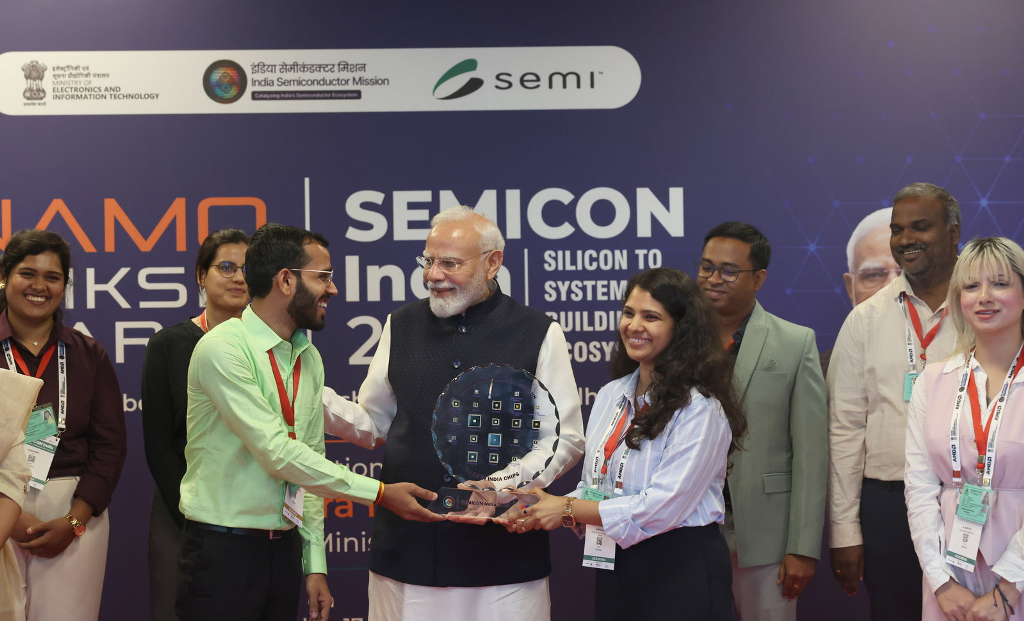
Rourkela: Odisha’s emerging capabilities in semiconductor design received a national spotlight at SEMICON India 2026 in New Delhi, with a security chip developed by the National Institute of Technology Rourkela (NIT-R) being presented to Prime Minister Narendra Modi as part of a commemorative emblem showcasing chip-design contributions from 20 institutions across India.
The presentation at the three-day semiconductor exhibition, being held from September 17 to 19 at Yashobhoomi, also brought NIT-R’s young semiconductor researchers into focus. Pradeep Kumar Mohanty, a PhD scholar in the Department of Electronics and Communication Engineering (ECE), was among the student designers who interacted with the Prime Minister during the presentation.
The chip showcased by NIT-R, ASCON AEAD Security Chip (C2S0091), has been designed by Mohanty under the supervision of Prof. Ayas Kanta Swain and Prof. Kamalakanta Mahapatra. It is a lightweight cryptographic chip aimed at providing secure data encryption and authentication for resource-constrained Internet of Things (IoT) devices and embedded systems.
The development assumes significance in the context of India’s efforts to build an indigenous semiconductor ecosystem, moving beyond chip consumption towards domestic design, fabrication and application.
The NIT-R chip was developed under the Ministry of Electronics and Information Technology’s (MeitY) Chip-to-Startup (C2S) Programme, which seeks to strengthen semiconductor design capabilities by giving students and academic institutions exposure to the complete chip-development cycle.
At NIT-R, the C2S project is being led by Prof. Kamalakanta Mahapatra and Prof. Ayas Kanta Swain. The chip was subsequently fabricated at Semiconductor Complex Limited (SCL), Mohali, taking the project from academic design to fabricated silicon.
For NIT-R, the achievement also represents the culmination of more than two decades of work in semiconductor education and chip design. The institute has been engaged in developing semiconductor manpower and research capabilities since 1999 under the guidance of Prof. Kamalakanta Mahapatra.
Over the years, the institute has sought to provide students and researchers with exposure to different stages of semiconductor development — from circuit and chip design to fabrication and system-level applications.
The recognition at SEMICON India 2026 places NIT-R among the academic institutions contributing to India’s expanding semiconductor talent pool. It also highlights the role of institutions outside the country’s traditional technology hubs in building the human resources and research capabilities required for the semiconductor industry.
NIT-R is now seeking to expand its semiconductor research and training activities, with an emphasis on developing skilled professionals, designing indigenous chips and converting chip-level technologies into intelligent systems for applications of societal and national importance.