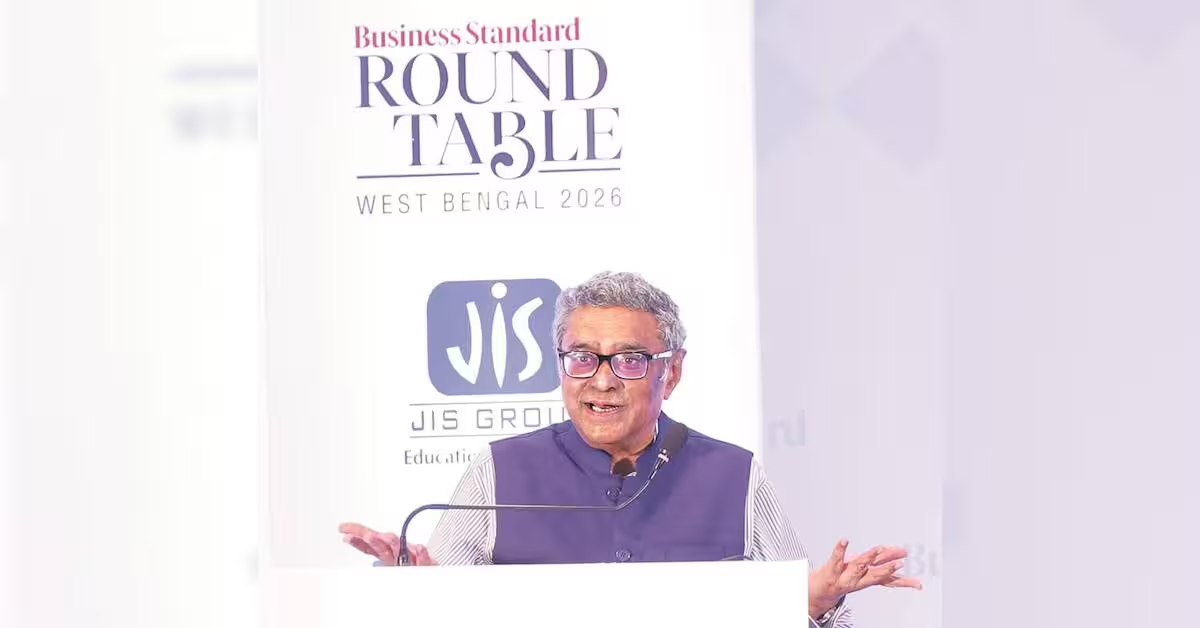
West Bengal Finance Minister Swapan Dasgupta laid out a reform agenda spanning power, global capability centres, startups, and building regulations at the Business Standard Roundtable, Bengal Beckons, on Monday, as the state seeks to sharpen its appeal to investors.
Power sector reform, he reckoned, was a “low-hanging fruit”, with an “Open Access” policy under consideration to help lower electricity prices in the state.
Existing and potential investors know there is a need to bring tariffs down, he said. Elaborating, Dasgupta said an “Open Access” would give corporations the right to buy power from whichever source best suited their needs — including from other states.
This would be particularly important for data centres, which require water and power, he said. “Water we have,” he pointed out.
Dasgupta also highlighted the need for a policy to attract global capability centres (GCCs) to West Bengal and said startups needed a degree of encouragement. “We need to plug in with the national policy,” he said.
Building norms were another area Dasgupta saw scope for change. The floor area ratio allowed for hotels in West Bengal was lower than that for residential buildings – in most other parts of the country, it was the other way around, he pointed out.
Bengal’s push to woo investors comes with a significant fiscal constraint. While incentives are expected in the “coming days”, Dasgupta pointed to the state’s inherited liabilities. The government started its innings with ₹8 trillion in public debt. Maharashtra, he said, had ₹9 trillion in public debt, but the difference was that Maharashtra was a going concern, while Bengal was yet to demonstrate that it was a fully going concern.
Pointing to the Centre’s backing, Dasgupta said: “We were fortunate that in this particular Budget of ours we managed to plug in and bring on board various central schemes.”
He added that a back-of-the-envelope calculation put the cumulative value at about ₹70,000 crore of central resources that would flow into the state over the next seven or eight months.
The “gamble”, he said, was based on the government’s aim of seeing entrepreneurship, enterprise, business, and every other form of economic activity grow.
The government is also betting on attracting a “big corporate house” in India that would repose its faith in West Bengal. “It may be in manufacturing, it may be in deep tech of a particularly high level, or any other thing. I’m not specifying, but a breakthrough is very important and we will do all that’s possible to ensure it happens,” he said.
The question of land assumes a great deal of importance in this, he added, pointing to it as a big, complex and infuriating issue, with its various forms of tenancy.
Dasgupta acknowledged that it was something the government would have to contend with. “These are certain realities of West Bengal, which we have to encounter. We have to confront and face them frontally, otherwise it’s not going to happen,” he said.