By P R Sanjai, Saikat Das and Ruchi Bhatia
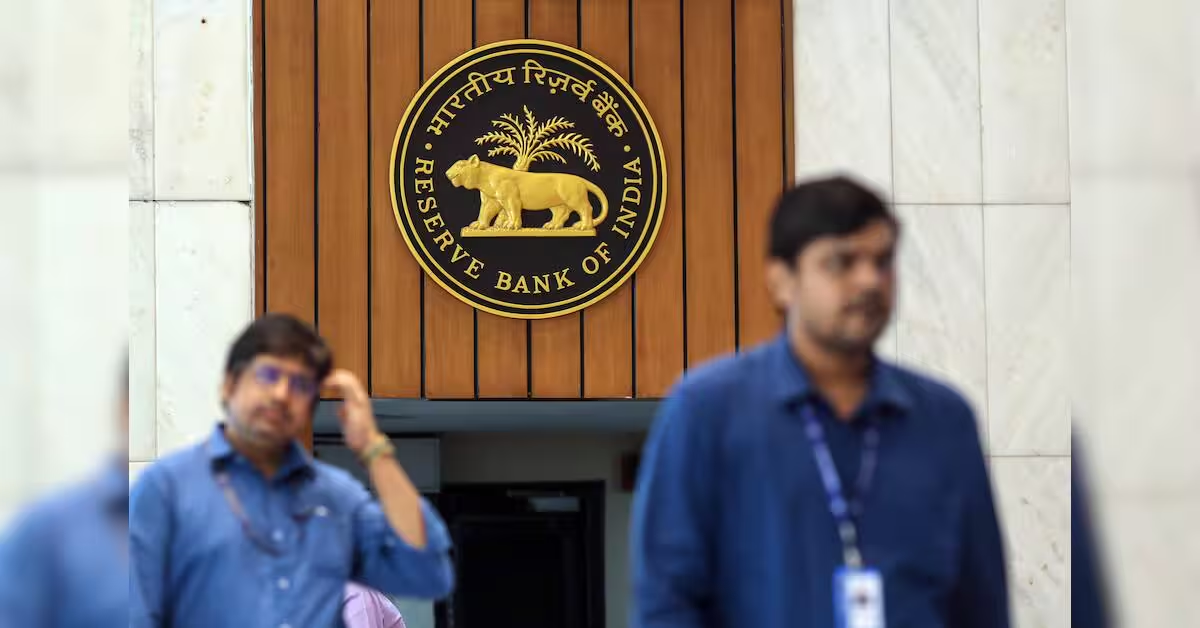
The Indian central bank’s refusal to relax listing rules for Tata Group’s holding company delivered an outcome long sought by the conglomerate’s biggest minority shareholder, though the road to going public is far from smooth.
The Reserve Bank of India’s decision came months after reclusive billionaire Shapoor Mistry, who helms the debt-laden Shapoorji Pallonji Group, published an open letter to the regulator seeking a listing of Tata Sons Pvt. to help unlock value for the group’s 18.4% stake. Valued at about $31 billion by Bloomberg Billionaires Index, nearly three-quarters of Mistry’s net worth is coming from the Tata shareholding.
Executives close to SP Group also held meetings with Indian government officials in recent months to press their case, according to people familiar with the discussions, who asked not to be named because they’re not authorized to speak publicly. The executives convinced some senior government officials of potential contagion risk if the construction giant were ever to default, the people said.
Representatives of the RBI, India’s finance ministry, Tata Sons and SP Group did not respond to a request for comment on the regulatory decision last week and what led to it.
The RBI’s decision does not give a timeline for the Tata Sons IPO, which could help resolve SP Group’s broader financial challenges. A potential legal wrangle between Tata and the RBI could stretch this out even further.
The contagion concerns stemmed from the scale of SP Group’s recent bond sale — it was one of India’s largest private credit transactions — where the construction giant raised about 151 billion rupees ($1.6 billion), with global investors including Farallon Capital Management, Davidson Kempner Capital Management and Cerberus Capital Management each buying roughly $175 million to $200 million of the bonds.
The investors were encouraged by prospects that the engineering group could eventually monetize its Tata Sons stake, potentially unlocking billions of rupees in liquidity, according to a July report. Deal terms reviewed at the time indicated an 18-month timeline for monetizing the stake either through a public listing or some other arrangement.
Exemption Plea
RBI published a list of systemically important shadow banks in September 2022 that included Tata Sons, with a three year timeline to list. While that deadline expired in September 2025, the regulator continued to consider Tata Sons’s petition for an exemption from this list. A year later, the regulator declined to grant a waiver in a relief for the SP Group.
Barely days after sending a letter quashing Tata Sons’ request for an exemption from the listing requirement, the RBI filed a caveat in the Bombay High Court to ensure its position is heard before any order is passed, the Economic Times reported.
In an April statement, Mistry had sought to convince the Indian regulators that a Tata Sons IPO is essential to unlock value for investors, calling it “not merely a regulatory compliance but a necessary evolution.”
“Despite the round-one win awarded to the SP Group’s by RBI’s decision, multiple bouts remain before its debt woes see a clear conclusion,” said Utkarsh Sinha, managing director at boutique investment banking firm Bexley Advisors. “At the heart of SP Group’s desire to list” is their need to monetize their Tata Sons equity.
At the same time, the government could not ignore the implications for the Tata Group, one of India’s most prominent corporate houses, the people said, suggesting there may be room for Tata’s concerns to be taken on board.
The Tata Group, with $185 billion revenue, controls over two dozen listed companies that make everything from salt to luxury cars and offers financial services in India. It is also key to India’s high-end technology ambitions as it has committed to producing the first homegrown semiconductor chips in the western Indian state of Gujarat.
Dilute Control
Tata Sons has been contesting its classification as an upper-layer non-banking financial company — a designation that requires such entities to list under RBI’s regulatory framework. The holding company for Tata Group — which owns brands ranging from Jaguar Land Rover and Taj hotels to Tetley tea — has argued that it is not a typical NBFC and should not be subject to rules designed for large lenders, according to the people.
A listing is also seen as problematic for the Tata Group because it could dilute majority shareholder Tata Trusts’ control over Tata Sons, expose the holding company to tighter regulatory oversight and investor scrutiny, and potentially alter the balance of power within the conglomerate, people familiar with the group’s thinking said earlier. Tata Trusts, led by Noel Tata, own 66% in Tata Sons.
People familiar said the situation drew comparisons with another shadow lender, Shanghvi Finance, which was placed in the upper layer alongside Tata Sons in 2022 but avoided the listing requirement after repaying its borrowings and surrendering its registration. Still, in Tata’s case, the people said the regulator was firm that norms governing top tier NBFCs could not be eased.
While the RBI considered Tata Sons’ request for a listing exemption in depth, and its reasoning that it does not accept public deposits, the people said the central bank ultimately chose to stick to the rule.
A RBI circular in May this year made it clear that a shadow lender could not de-register if it deals directly with customers in its day-to-day business. This is not the case with Tata Sons, but it is with Tata Capital. While Tata Sons has pared its own debts, its affiliated companies, including wholly-owned subsidiary Tata Capital, are still raising money from individuals and institutions.
All eyes are now on the critical Sept. 17 board meeting of Tata Sons, where the board directors are expected to focus on the RBI’s directive, the company’s stance to comply or contest this ask and potentially discuss Chairman Natarajan Chandrasekaran’s continuity, the people said.
Chandra had last month announced his decision to step down at the end of his term in February after months of friction with Noel over the listing issue, as well as capital allocation within the sprawling Tata Group.