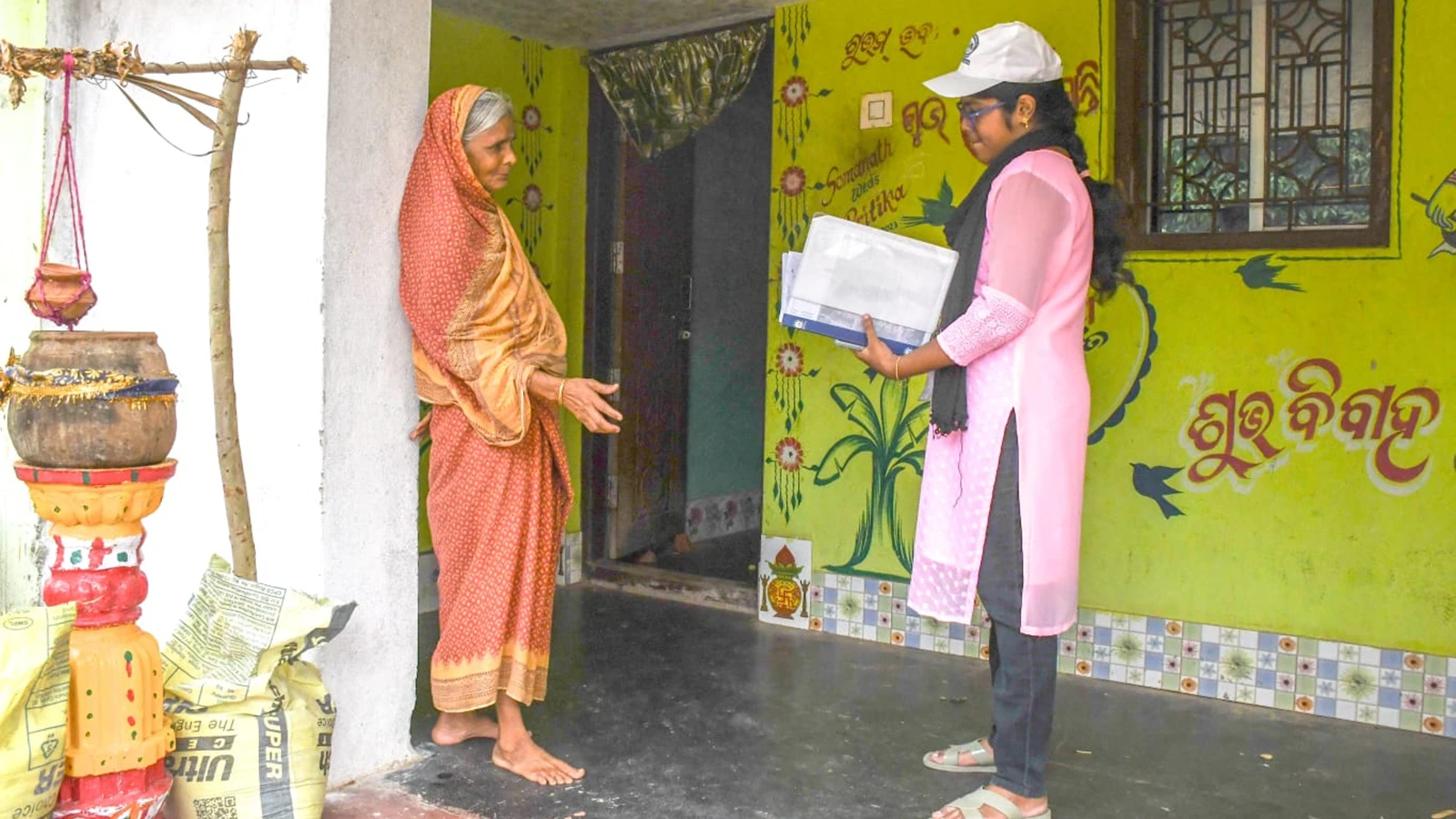
Even before the clock strikes 7 am, Sarmishta Sahoo is ready to head to Banamalipur in Odisha’s Khordha district. The 25-year-old, dressed in a pink and black salwar kameez, is prepared: she’s packed two water bottles, a few packets of ORS, and official papers in her backpack.
“I was 10 when the last Census was done in the country. I know there’s pressure to complete the survey by May 15, but I like it. It’s a national duty and we have to do it. We don’t really have a choice,” she says, parking her bike at Banamalipur bazar, a small rural market that is her first stop.

Sahoo, an assistant teacher at a government primary school, is a Census enumerator. As house listing operations get underway across the country as part of Phase 1 of the Census 2027 since April 16, over 1 lakh enumerators — mostly teachers such as Sahoo — have been engaged for door-to-door enumeration to map buildings and collect data on amenities using a mobile app.
This comes amid reports of the death of two enumerators allegedly due to ‘heatstroke’ and the assault on women Census officers in Dhenkanal district. The Odisha government recently issued a standard operating procedure (SOP) to ensure the safety and security of enumerators and supervisors in the field, including an advisory to avoid work during peak summer hours of 11 am to 3 pm. Officials at the census directorate said they haven’t received any official report on the death of the two enumerators.
 Sarmishta Sahoo going from door to door to map buildings and collect data on amenities using a mobile app. (Express photo: Sujit Bisoyi)
Sahoo has been mandated to survey 256 buildings comprising 430 Census houses, and for this task, she must arm herself: sufficient water, and a cap she got from the Census authorities, along with the backpack and identity card. She has also marked her attendance at Banamalipur Primary School, where she is employed.
After parking her scooter at Banamalipur bazar, she puts on the and enters the first building: a mix of commercial and residential units. At each house, she puts on a smile and repeats the same line: “Ghare kie achanti… janaganana ru asichi (Is anybody around, we are from the Census).”
Her questions are always the same: “What food grains do they have? Do they have access to the Internet, do they own smartphones, laptops, computers and radio? Do they get drinking water? What sort of toilets do they have? Does the household belong to SC/ST families? Is the house owned or rented? Does the family have an LPG or PNG connection?”
Story continues below this ad
She has a list of 33, and she must get through them. Some hosts are warm and invite her in for a glass of water. Others are wary, answering her questions from the doorway. They have questions too. “Why are you here?” one asks. “Why do you want our phone numbers? Why is this information needed,” asks another.
She must answer all of them before getting to her own mandated ones. She does it with a smile.
 Sarmishta Sahoo has been mandated to survey 256 buildings comprising 430 Census houses. (Express photo: Sujit Bisoyi)
“Despite wide publicity about the Census, most people lack awareness here since it’s a rural area. Residents hesitate to provide exact information about the assets in their houses, some express reservation in sharing mobile numbers, while others ask what benefit they will get from the Census,” Sarmistha tells The Indian Express.
Each house takes between 7 and 10 minutes. She feeds the information she gets into the HLO (Houselisting Operation) mobile app. Occasionally, she’s asked to “come again later”.
Story continues below this ad
At 9 am, she stops for a drink of water and takes a call from her supervisor. Everything is going okay, she tells her supervisor reassuringly.
Then, she heads to Pradhanpatna village. At the first house, a little girl answers and asks her to return later. A woman responds at the next house.
She must strictly follow a mapping order devised before the survey began. “If a household is locked or people ask me to come again later, the app doesn’t allow me to proceed to the next house. In that case, I note down data in accordance with the house number and feed it later in the app. To cover these houses, I will have to come again tomorrow,” she says.
There are also technical glitches — the app occasionally hangs. Asked about the heatstroke deaths and the alleged assault of enumerators, Sahoo admits she’s disturbed but says she has never faced such hostilities herself.
Story continues below this ad
Still in Pradhanpatna village, Sahoo looks at her watch: 11 am. It’s a hot 35° Celsius, and Sahoo calls it a day.
“Census is crucial for the nation’s development and our role is significant in collecting accurate information. In that way, we are happy contributing our part in the nation building process,” she says.