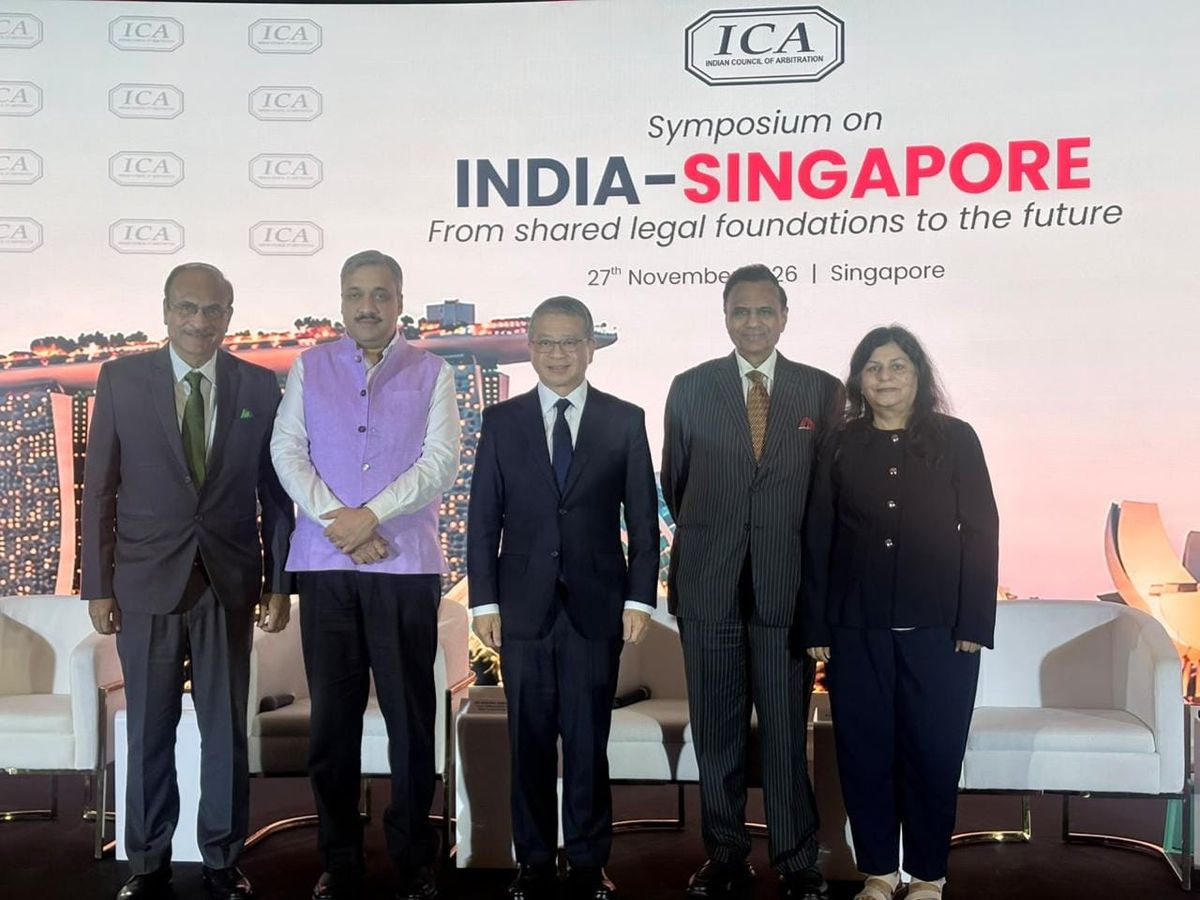
Marking 200 years of Singapore’s Second Charter of Justice, a symposium brings into focus the need for predictable dispute resolution, early mediation and innovation in international arbitration.
Singapore, November 27: Two centuries after the Second Charter of Justice laid an important foundation for Singapore’s legal system, India and Singapore are looking to their shared legal heritage to shape a framework of cooperation better suited to the demands of an increasingly interconnected global economy.
The growing economic engagement between the two countries, and the need for legal institutions to keep pace with it, formed the central theme of a symposium organised by the Indian Council of Arbitration (ICA) at The Fullerton Hotel, Singapore, on Friday.
Titled “India–Singapore: From Shared Legal Foundations to the Future”, the symposium brought together members of the legal fraternity, policymakers, diplomats and business leaders from both countries, with discussions extending beyond conventional dispute resolution to the preservation of commercial relationships and the future of the legal profession.
In a video address to the symposium, Chief Justice of India Justice Surya Kant called for greater cooperation between India and Singapore in institutional design, professional standards, training and technology, while emphasising the importance of encouraging mediation at an early stage of commercial disputes.
“Predictability in dispute resolution is not an afterthought to commerce, it is part of the confidence that enables it,” the Chief Justice said.
Economic ties and the imperative of legal certainty
The scale of economic engagement between India and Singapore lends particular significance to the discussion. Singapore is India’s largest trading partner within the Association of Southeast Asian Nations (ASEAN), with bilateral trade growing from approximately US$6.7 billion in 2004-05 to US$34.3 billion in 2024-25.
Singapore has also emerged as one of the principal sources of foreign investment into India, accounting for cumulative foreign direct investment inflows of approximately US$174.88 billion between April 2000 and March 2025 — nearly 24% of India’s total inflows during the period, the Chief Justice noted.
As commercial transactions grow in scale and complexity, the ability to resolve disputes fairly, efficiently and predictably becomes integral to sustaining investor confidence.
Justice Surya Kant pointed to India’s growing engagement with mediation, including the establishment of the Mediation Council of India, as an opportunity for closer institutional cooperation. He also highlighted the potential of multi-tiered dispute resolution mechanisms, which allow parties to explore negotiated settlements before proceeding to arbitration or litigation.
“Sometimes the best outcome is not a victory for one side, but an agreement that enables both sides to move forward,” he said.
Referring to the Memorandum of Understanding on Cooperation in Law and Dispute Resolution signed between the two countries in 2024, the first meeting of the India-Singapore Joint Consultative Committee in 2025 and the India-Singapore ADR Conclave held in New Delhi in September this year, the Chief Justice stressed that the partnership must be founded on reciprocity rather than the replication of institutional models.
“Neither needs to replicate the other’s institutional model. The opportunity is to learn from each other. The corridor must be a two-way channel for expertise, professional opportunities and institutional knowledge, measured by the confidence it creates on both sides,” he said.
Moving beyond success in international arbitration
Delivering a special address, Singapore’s Minister for Law and Second Minister for Home Affairs Edwin Tong underscored the relationship between investor confidence and the credibility of dispute resolution mechanisms.
For businesses committing capital across borders, he said, the assurance that disputes would be resolved fairly, transparently and predictably was fundamental.
India’s engagement with Singapore’s arbitration ecosystem has been particularly significant. In 2025, 178 Indian parties were involved in arbitrations administered by the Singapore International Arbitration Centre (SIAC), making India its third-largest foreign user jurisdiction. The contribution of Indian legal professionals, Mr. Tong noted, extends well beyond disputes involving Indian businesses, with Indian counsel and arbitrators participating in cases involving parties from other jurisdictions.
The Minister also drew attention to one of the more complex challenges confronting contemporary international arbitration. Commercial transactions increasingly involve multiple contracts and interconnected parties, sometimes resulting in related disputes being heard in separate forums, with the possibility of inconsistent outcomes.
“Arbitration is built on party consent. So how do we preserve that principle whilst ensuring that interconnected parties and their disputes can be resolved effectively?” he asked.
Addressing such challenges, he suggested, would require innovation and collaboration among arbitral institutions, legal practitioners and courts.
“India and Singapore should aspire not merely to succeed in international arbitration, but to make international arbitration better,” Mr. Tong said.
A partnership extending beyond traditional sectors
India’s High Commissioner to Singapore, Dr. Shilpak Ambule, placed the discussions within the broader context of an expanding bilateral partnership that increasingly encompasses emerging technologies and new areas of economic cooperation.
From skills development, digital payments and connectivity to semiconductor manufacturing, aircraft maintenance, energy and healthcare, the relationship between the two countries has acquired considerable depth and diversity.
Dr. Ambule noted that more than 12 visits by Indian Chief Ministers to Singapore had taken place over the past two years, reflecting growing engagement at the State level. Singaporean investments, he said, were also increasingly extending beyond established economic centres such as Bengaluru and Hyderabad.
The diversification of these economic ties brings with it a corresponding need for legal and institutional frameworks capable of supporting businesses across sectors and jurisdictions.
Dr. N.G. Khaitan, President of the Indian Council of Arbitration and Senior Advocate, highlighted the role of predictable regulation, effective commercial dispute resolution and strong enforcement of law in Singapore’s economic success. He emphasised that closer legal cooperation would complement the already substantial economic relationship between the two countries.
Two centuries of legal heritage
The choice of November 27 for the symposium carried historical significance. It was on this day in 1826 that the Second Charter of Justice was granted, extending the Court of Judicature to Singapore and marking a defining moment in the development of its legal system.
Drawing a connection between that historical milestone and contemporary economic aspirations, ICA Director General Arun Chawla said trust remained central to the relationship between commerce and justice.
“Commerce needs confidence, investment needs certainty, and both need assurance of justice,” he said.
Mr. Chawla identified four broad pillars of the India-Singapore partnership: economy and enterprise; emerging technology; energy and environment; and exchanges and engagement.
“The future of arbitration cannot be only about resolving yesterday’s disputes, it must also be about enabling tomorrow’s partnerships,” he said.
The symposium also featured a panel discussion titled “Beyond Litigation: From Commercial Justice to Commercial Continuity”, moderated by Francis Xavier SC, Regional Head of the Disputes Group at Rajah & Tann Singapore LLP.
A subsequent conversation on “The Future of the Legal Profession: Perspectives from India and Singapore” was moderated by Avinash Pradhan, Head of International Arbitration and Co-Head of the South Asia Desk at Rajah & Tann Asia.
Running through the deliberations was a broader question about the purpose of commercial justice: whether the success of dispute resolution should be measured solely by the settlement of claims or also by its ability to preserve business relationships, protect investments and enable future enterprise.
Two hundred years after a landmark charter helped shape Singapore’s legal history, the conversation between India and Singapore is increasingly about what their legal institutions can build together — not merely to resolve disputes arising from a growing economic partnership, but to create the confidence necessary for that partnership to flourish.