AMMAN: For almost 2,000 years, Christians have lived, worshipped and built communities in the lands that now make up Jordan.
But on Oct. 23, that long history of coexistence was shaken by an act of violence that left a small village grieving and raised painful questions about the future of Christianity in the Middle East.
Gunmen opened fire on mourners gathered for a funeral at a church in Hamoud, in the southern governorate of Karak, killing nine people and injuring dozens more.
The attack, condemned as terrorism by King Abdullah II, prompted an outpouring of national grief and solidarity. Three suspects were subsequently arrested, while the country’s political and religious leaders rallied around the victims’ families.
Yet for Jordan’s Christian minority, estimated at just 2 to 3 percent of the population, the attack left wounds that will take far longer to heal.
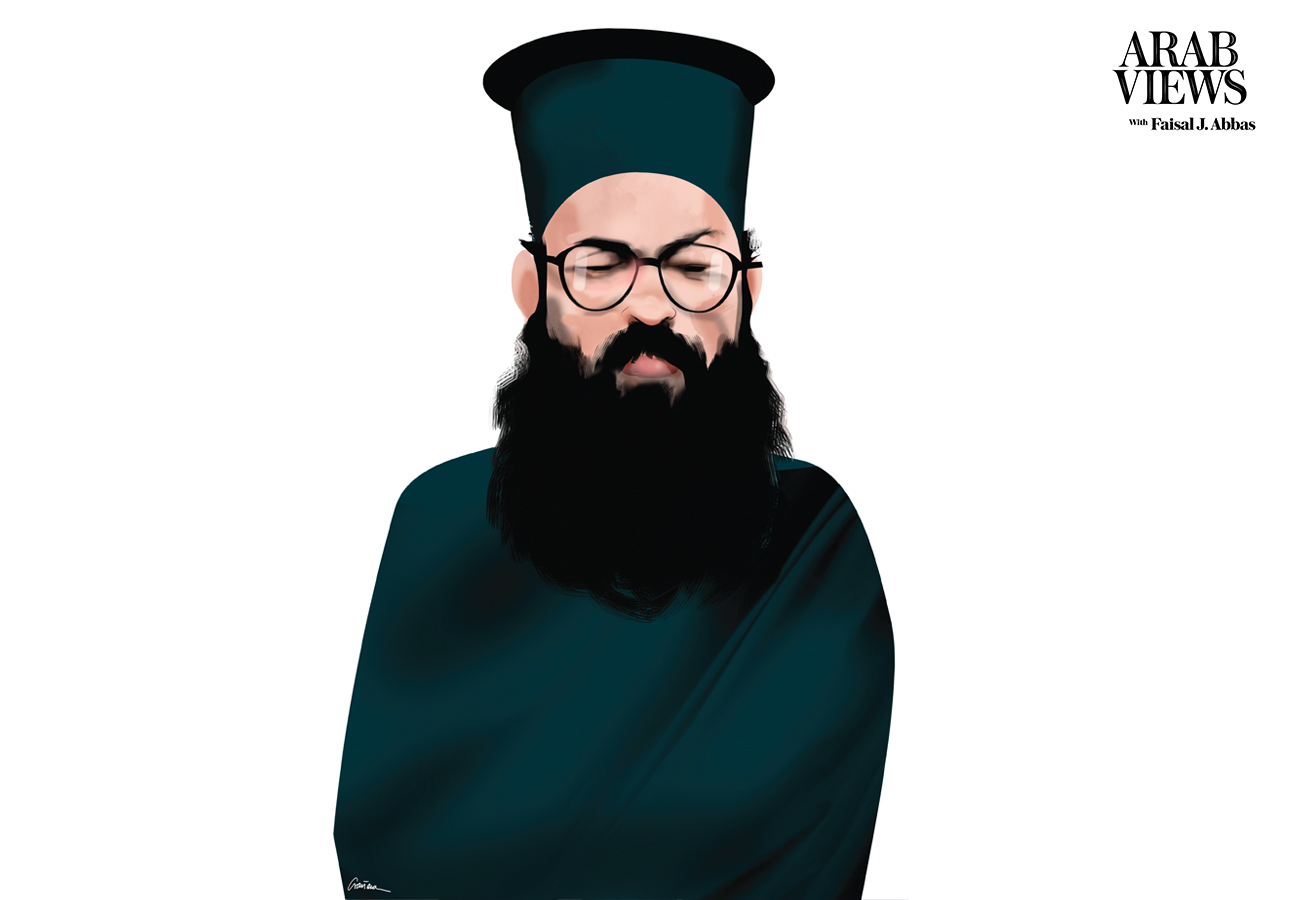
Among those struggling to make sense of the tragedy is Father Chrysanthus, a deacon at the Greek Orthodox Patriarchate of Jerusalem and head of the Christian Family House in Amman.
Speaking to Editor-in-Chief and “Arab Views” podcast host Faisal J. Abbas at his church in the Jordanian capital 10 days after the attack, Father Chrysanthus reflected on the horror of that day, the extraordinary solidarity shown by Muslim neighbors and the challenge of preaching forgiveness in the face of such violence.
He also offered a defiant message to those who believe the region’s dwindling Christian communities have no future in their ancestral homelands.
For Father Chrysanthus, the events of Oct. 23 began like any other Friday. He was working in his office in Amman when the first reports of an attack in Karak appeared on television.
“I was in my office, I was working, and suddenly I opened the TV to see the news, and I read one news item that said there’s an attack on Hamoud, Karak. And I was asking, which church? And we sent to the group of the fathers on WhatsApp, asking, is this our church?
“And suddenly we saw videos from the church, from the father who was there, and we saw the blood. We saw the people who were killed.”
As the scale of the violence became clear, the parish priest in Hamoud began calling colleagues in the capital, desperately seeking assistance.
“He was afraid. He was calling us: ‘Father, I want someone to help us.’ And we started to think: what shall we do?”
While some priests traveled south to Karak, Father Chrysanthus remained in Amman, where survivors were being transferred to hospitals for treatment.
There, amid the suffering and confusion, he encountered something he had not expected — expressions of faith from those who had narrowly escaped death.
“I saw injured people, and they were crying. But at the same time, I saw faith in their eyes. And one of the injured people told me: ‘Father, you know, now I trust God more and more, because He saved us.’”
The following day, Greek Orthodox priests buried the dead and sat with bereaved families. Yet Father Chrysanthus said the greatest challenge was not simply comforting those overwhelmed by grief, but attempting to answer a question for which there was no easy explanation.
“You know, the most difficult question was: Why did that happen?”
For priests expected to provide reassurance in moments of tragedy, the emotional burden can be immense. Father Chrysanthus acknowledged that religious leaders are not immune to the same feelings of helplessness experienced by those they serve.
“And many times we are very weak. We can’t give them the power. We can’t give them the courage. We can’t give them the support. I went to the hospitals to see people sometimes there to check on them. I want to go just to give them support in their illness. And suddenly I take the support.”
Despite the trauma, he insisted that Jordan’s Christians have not retreated from public worship. Nine days after the attack, the Sunday liturgy at his church in Amman drew a full congregation, offering a visible demonstration of the community’s determination to continue its religious life.

Asked whether he felt safe inside his church, Father Chrysanthus insisted he did. Nor, he said, had fear emptied churches elsewhere in the country.
“No, not at all. I want to be clear that it’s not something I’m telling you just now, or just in the media. Just go to the churches and you will see all the churches, they are full. Yesterday, on Sunday, all the churches were full.”
That confidence, he suggested, rests partly on the relationship between Jordan’s Christian minority and its Muslim majority — a relationship he believes the attackers failed to undermine.
In the immediate aftermath of the shooting, King Abdullah visited wounded survivors at Prince Ali Bin Al Hussein Military Hospital in Karak, condemned the killings as terrorism and promised a forceful response.
Two days later, Queen Rania traveled to Hamoud with Crown Princess Rajwa and Princess Salma, sitting with grieving families and sharing their sorrow. Crown Prince Hussein also visited mourners, conveying the King’s determination to confront those responsible.
Jordan declared three days of national mourning, underscoring that the killings were regarded as an attack on the country as a whole, rather than on one religious community alone.
But for Father Chrysanthus, some of the most powerful demonstrations of solidarity came not from the country’s leaders, but from ordinary Jordanians.
“In Jordan they were together. The Muslim guys were cleaning the church of blood. The Muslim guys were in the hospital with the Christian guys. So we stand with each other.”
He witnessed similar expressions of friendship at the Orthodox school in Amman where he teaches.
Recalling an encounter between two students after the attack, he described how humor and familiarity helped overcome the suspicion that the gunmen had sought to provoke.
“One Christian guy was hugging a Muslim guy, and they were talking together. And the Muslim said: ‘You are not afraid of me?’ And he hit him, a slap, and he told him: ‘Now who is afraid? You or me?’”
Such moments reinforced his conviction that the violence had not fundamentally changed relations between Jordan’s religious communities.
Father Chrysanthus grew up attending a Christian school where most of his classmates were Muslim. Asked whether he had experienced discrimination or intimidation, he instead recalled an incident in which a Muslim pupil defended the school’s Christian identity.
“And one day, one of my Christian colleagues said that we will not put up the cross. He wanted to do something, you know, as a kid.
“And I remember one of my Muslim colleagues took the cross and put it back on the wall, and he said: ‘You should respect the cross. It’s a Christian school. You should not say that.’ So this is the image of Christians and Muslims in Jordan.”
Nevertheless, he acknowledged that the shooting had created anxiety among some Christians, even if that fear was directed at violent extremism rather than their Muslim neighbors.
“Maybe some people, they have fear. They are a little bit afraid. But we should put many lines under this word, because they are afraid, but not of their neighbors. Not of the Muslim people. Not of their families. Not of their country. They are afraid of this thought that came suddenly.”
As both a priest and a teacher, Father Chrysanthus believes the response to such fears must extend beyond religious instruction to include compassion, understanding and space for young people to express themselves.
“These young people, they don’t want someone to tell them about the faith or someone to tell them about God. They want someone to love them, someone to understand them. Someone to give them the space so they can speak, they can do whatever they want, but they know about their responsibilities, also.”
That emphasis on compassion will become particularly important as Christmas approaches.
For many Christian families, the festive season is traditionally a time of celebration and togetherness. But in Hamoud, where parents have buried children and families are still coming to terms with their losses, the prospect of returning to normality so soon is difficult to contemplate.
“And it will be so weird that we are telling them, two weeks after what happened in Karak, to move on and go for the celebration for Christmas.”
Beyond the immediate tragedy, the attack has also revived a much broader question about the future of Christianity in a region where ancient communities have been shrinking for decades.
In Iraq, more than a million Christians lived in the country before the US-led invasion of 2003. Today, only a fraction of that population remains, following years of sectarian violence, persecution and displacement.
Syria’s Christian communities have likewise been depleted by war and emigration, while Bethlehem, the traditional birthplace of Jesus Christ, has experienced a long-term decline in its Christian population.

Against that backdrop, might it be easier for Christians to leave the region altogether and seek greater security in Europe?
For Father Chrysanthus, the suggestion overlooks the inseparable relationship between Christianity and the history, culture and identity of the Middle East.
“In my mind I can’t imagine the Middle East without Christians, because the Middle East without Christians is without history. How will you deal with the history of 1,400 years of the coexistence of Muslims and Christians?
“And even if they leave the other countries around us, stones will speak about them. The stones will speak about the Christian civilization, the Christian people who lived here. So how will they leave these stones to speak alone? They should be witnessed here.”
His argument is not merely about preserving churches, monasteries or archaeological sites, but about maintaining a living Christian presence in societies whose religious traditions have developed alongside one another for centuries.
Christian and Muslim communities, he said, share far more than geography. Their customs, relationships and everyday experiences have become intertwined in ways that cannot easily be separated.
“All our traditions are mixed. All our lives are mixed. I think it will be like food without salt. It will be like this. Or it will be a place without light, because, as the Bible says, we are the light of the world. So how are we the light of the world? By love.”
It is a conviction rooted in the longevity of the faith itself. Christianity has endured in the region through successive empires, wars, political upheavals and periods of persecution. For Father Chrysanthus, the latest attack must be viewed against that much longer history of survival.
“We have had 2,000 years of difficulties and we are still here. So I don’t think that one, sorry to say this word, one ‘silly’ attack … We will not be afraid, of course.”
Yet the determination to remain raises another difficult question: How should a community whose faith teaches love and forgiveness respond to those responsible for killing its members?
Three days after the shooting, Jordanian police arrested three suspects — two brothers and their brother-in-law — following a dawn shootout in Karak.
Asked whether he could forgive the alleged perpetrators, Father Chrysanthus acknowledged that the wounds were still too fresh for such a question to be answered easily.
“Now, it’s very difficult to speak about this, but of course, our faith says that we forgive.
“Of course we forgive. We forgive because it’s the commandment of our Lord. Forgiveness does not mean forgetting. And forgiveness does not mean to accept what happened.”
For him, forgiveness is therefore neither an excuse for violence nor an abandonment of the demand for accountability. Rather, it is a religious obligation that can coexist with the pursuit of justice.
And while the Church will continue to comfort the bereaved and support those recovering from their injuries, he insisted that responsibility for bringing the perpetrators to justice belongs to the Jordanian authorities.
“We will not do anything ourselves, as Christians, as a people. But we trust our government, our military, our armed forces. They will take action.”
Watch the full interview here