LONDON: For the Arab Americans of Michigan, whose backing was credited with having helped to return Donald Trump to the presidency, there was perhaps more than a little irony in the president’s health secretary choosing the state as the platform for his anti-Arab comments on Monday.
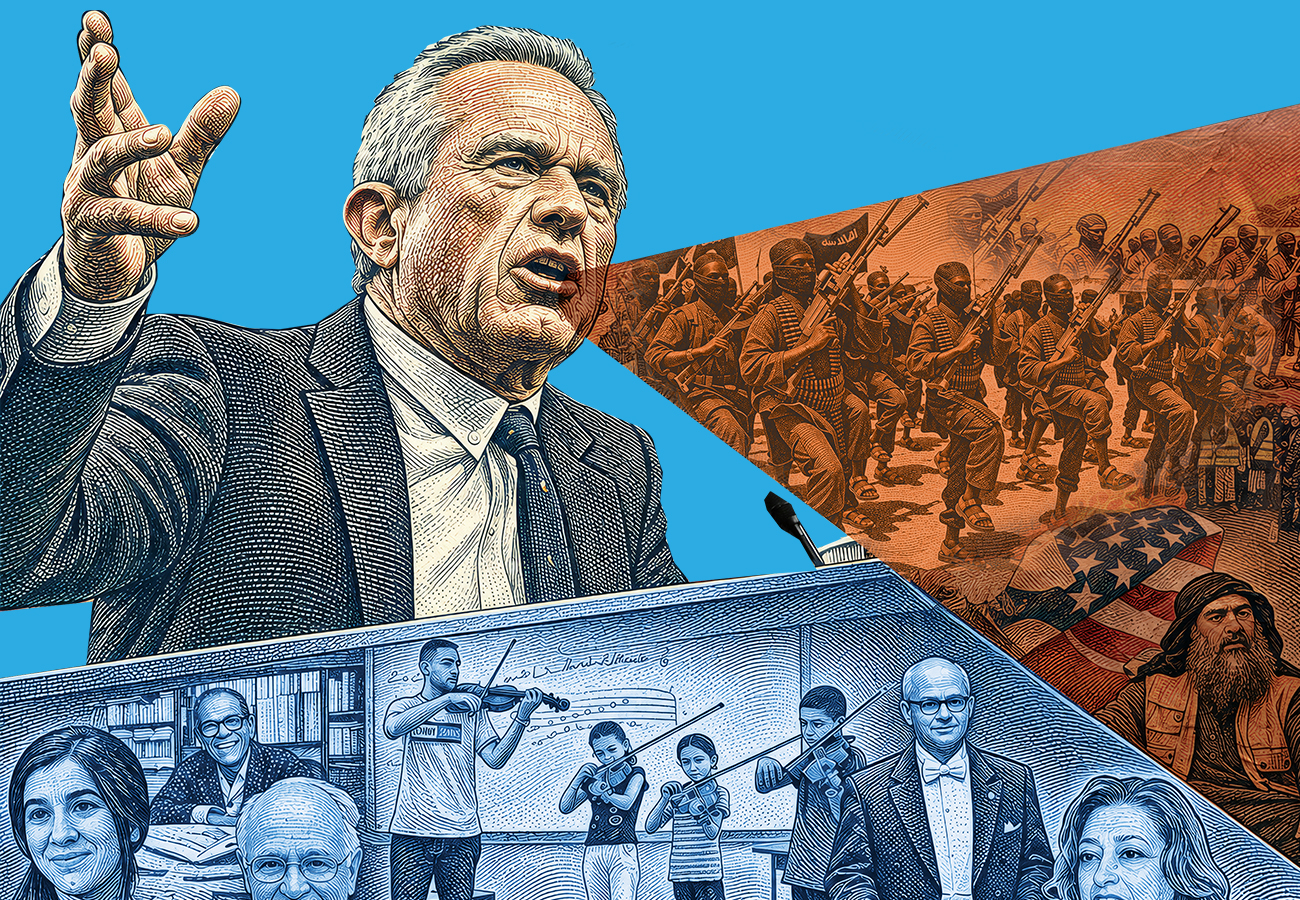
Speaking at a campaign event in Grand Rapids, Robert F. Kennedy Jr. claimed that Arabs “don’t produce science, they don’t win the Nobel Prize, they don’t win the Fields prize, they don’t win the Wolf Prize, they don’t produce literature.”
His comments were demonstratively false. Arabs have won all of those prizes and have produced a breadth and volume of literature to rival that of any culture.
In 1988, Egyptian author Naguib Mahfouz was awarded the Nobel Prize in Literature for a body of work that amounted to “an Arabian narrative art that applies to all mankind.”
In 2025, Palestinian American Omar Yaghi was one of three scientists awarded the Nobel Prize in Chemistry for developing “a new form of molecular architecture … to harvest water from desert air, capture carbon dioxide, store toxic gases or catalyze chemical reactions.”

But Kennedy, who is often accused of taking an unscientific approach to his public health brief, did not seem overly concerned about facts, but rather with denigrating Egyptian American Abdul El-Sayed, the Democrat nominee in the race to become a Michigan senator.
It was, as El-Sayed’s spokesman Cole Wozniak told The New York Times, “rich to have an anti-scientist come to Michigan to lecture a doctor with two doctoral degrees who has spent his entire career working on public health.”
With the Nov. 3 midterms imminent, and voter support for President Trump at an all-time low, the Republican party is facing the very real possibility of the Democrats taking control of both chambers of Congress — and the Michigan race could dictate which party controls the Senate.
Michigan, as Dr James Zogby, the president of the Arab American Institute wrote on Monday, “is this year’s most important election.”
If elected, El-Sayed would be the first Muslim in the Senate, “a breakthrough that hasn’t been lost on Republicans and President Trump, who have made a determined effort to exploit it at every turn.”
Born and raised in Michigan, El-Sayed’s campaign has focused on America’s cost of living crisis. He describes himself as a “public servant running for US Senate because it shouldn’t be this hard to get by.”
The Republicans have run TV ads alleging that El-Sayed’s mother was affiliated with the Muslim Brotherhood in the 1970s, even though, said Zogby, “El-Sayed’s parents separated when he was three; she moved back to Egypt and he grew up with his father in Michigan.”

Planted hecklers have raised the issue repeatedly at El-Sayed’s campaign events, although the candidate has only gained admiration — and a social media following — for the way he has handled them.
In Grand Rapids on Monday, Kennedy was campaigning on behalf of Mike Rogers, the Republican party candidate for Michigan, who is facing a serious challenge from El-Sayed.
His comments about Arabs and Muslims echoed those of the president. Trump has repeatedly mocked El-Sayed, whom he always refers to as “Mohammed” (“Why? Because I feel like it”).
At a rally in Detroit on Saturday, El-Sayed responded: “My name and my faith are not the reason you can’t afford your gas (and) not the reason you can’t afford your groceries.”
Both Rogers and Trump are accused of leveraging Islamophobia in an attempt to sway the election.
In a televised debate on Oct. 8, the Republican nominee questioned whether a member of El-Sayed’s family might be on a “watchlist.” The following day, Trump posted on social media: “Mohammad is a Jihadist lunatic who hates our Country.”
On Sunday, in remarks at a rally in Port Huron, Trump again labeled El-Sayed a “jihadist” who was “on the side of the terrorists.” He then suggested that, if elected, he would “have to go through a metal detector before he’s allowed to go into the Senate.”
He also raised the specter of the 9/11 attacks, seemingly equating the need to block El-Sayed from office with the courage of the passengers who fought back on Flight 93.
Sadly, Zogby told Arab News, “we’ve seen periods like this before. In the 1980s, the political cartoons would be Arabs holding money bags, supporting this candidate, (and) I remember candidates giving money back: ‘They don’t want any Arab money.’
“If somebody had an Arab American on their campaign staff, AIPAC (the powerful American Israel Public Affairs Committee lobbying group) would come and say: ‘You’ve got to fire him, or else we won’t support your candidacy.’
“People lost their jobs. It was a very difficult environment.”

What’s different now, he said, “is that the bullhorn of the president is uniquely powerful. We’ve not seen it before.
“I remember one of George W. Bush’s campaign ads had a kind of ominous anti-Arab, anti-Muslim tone to it, but we protested, and they pulled it.
“But we’ve never had a situation where the President of the United States says it over and over again, and does so every day and every night, and in such vicious ways.”
Other Republicans have been following the president’s lead. Earlier this month, Republican senator John Kennedy, campaigning in Detroit for Rogers, even suggested that El-Sayed probably slept “in a bin Laden shirt.”
When Zohran Mamdani was elected as the first ever Muslim mayor of New York City in November 2025, Republican congresswoman Nancy Mace commented: “After 9/11 we said ‘Never Forget.’ I think we sadly have forgotten.”
In March, an Alabama senator reposted a photograph of Mamdani taking part in an Iftar dinner, alongside a picture of one of the 9/11 attacks. “The enemy,” wrote Sen. Tommy Tuberville, “is inside the gates.”
That, however, was mild compared with a social media post that month from Tennessee Rep. Andy Ogles, who wrote that “Muslims don’t belong in American society. Pluralism is a lie.”
He responded to criticism by adding “paperwork doesn’t magically make you American … Muslims are unable to assimilate; they all have to go back.”
In the run-up to the 2024 presidential election, Trump actively wooed the Arab American community.
Dismayed by the Biden administration’s support for Israel amid the Gaza war, many Arab Americans rejected Kamala Harris in favor of Trump, who had promised to bring peace to the Middle East.
In the Detroit suburb of Dearborn, where 60 percent of the population are Arab American, Biden received 30,000 votes in 2020. In 2024 Harris lost half of those votes, while Trump’s share jumped from 13,000 in 2020 to 18,000.
But since Trump’s return to office, Arab Americans could be forgiven for thinking they may have backed the wrong horse.
In 2024, Trump’s outreach to the community was facilitated by an organization called Arab Americans for Trump, founded that year by Palestinian American businessman Bishara Bahbah.
In 2025, in protest at Trump’s proposed takeover of Gaza, the group changed its name to Arab Americans for Peace. Trump’s latest attacks on El-Sayed have done nothing to heal the rift.
On Saturday, Bahbah told CNN that Trump’s “racist remarks are turning off the Arab and Muslim communities, and I’m sure turning off black Americans and Latinos as well.
“Mocking people because of who they are is just downright stupid and racist.”
There may, however, be something else motivating the verbal assault. Zogby highlighted that El-Sayed has been “a clear and consistent critic of US support for the Israeli genocide in Gaza.”
This, he wrote, explained why so much pro-Israel “dark money” has been funneled into defeating him via “super PACs” — Political Action Committees that can raise and spend unlimited amounts of money to influence elections — and “independent expenditure funds that are not required to report donors before elections.”
However Kennedy’s remarks might have played among Trump’s voter base, they have shocked many American academics.
On Monday, Dr. Peter Hotez, dean of the National School of Tropical Medicine at Baylor and Texas Children’s Hospital, posted on X that his former colleague Ahmed Zewail, the Egyptian American scientist and 1999 Nobel laureate in chemistry, “would disagree” with Kennedy.
“God rest his soul he didn’t have to endure this,” he said. “And of course RFK Jr forgets that it was the Arab scientists of the Middle Ages who kept Aristotle, Hippocrates, Galen alive to hand it down in the Renaissance.”
For Arab Americans considering how to vote in the midterms, Kennedy’s remarks stand in sharp contrast to comments that were made by President Joe Biden in March 2023, on the occasion of National Arab American Heritage Month.
In a presidential proclamation, Biden celebrated “the immeasurable contributions of Arab Americans to our Nation.”
Their achievements, he added, “are reflected in the arts and sciences; in businesses and faith communities; in classrooms and hospitals; and in police stations, firehouses, and every branch of the military.”
Arab Americans were also “proudly serving throughout my Administration, bringing a diversity of expertise that helps make this country stronger, more prosperous, and more just.”
Until recently, the text of Biden’s Proclamation 10539 could be viewed on the White House website. Today, the link is dead.