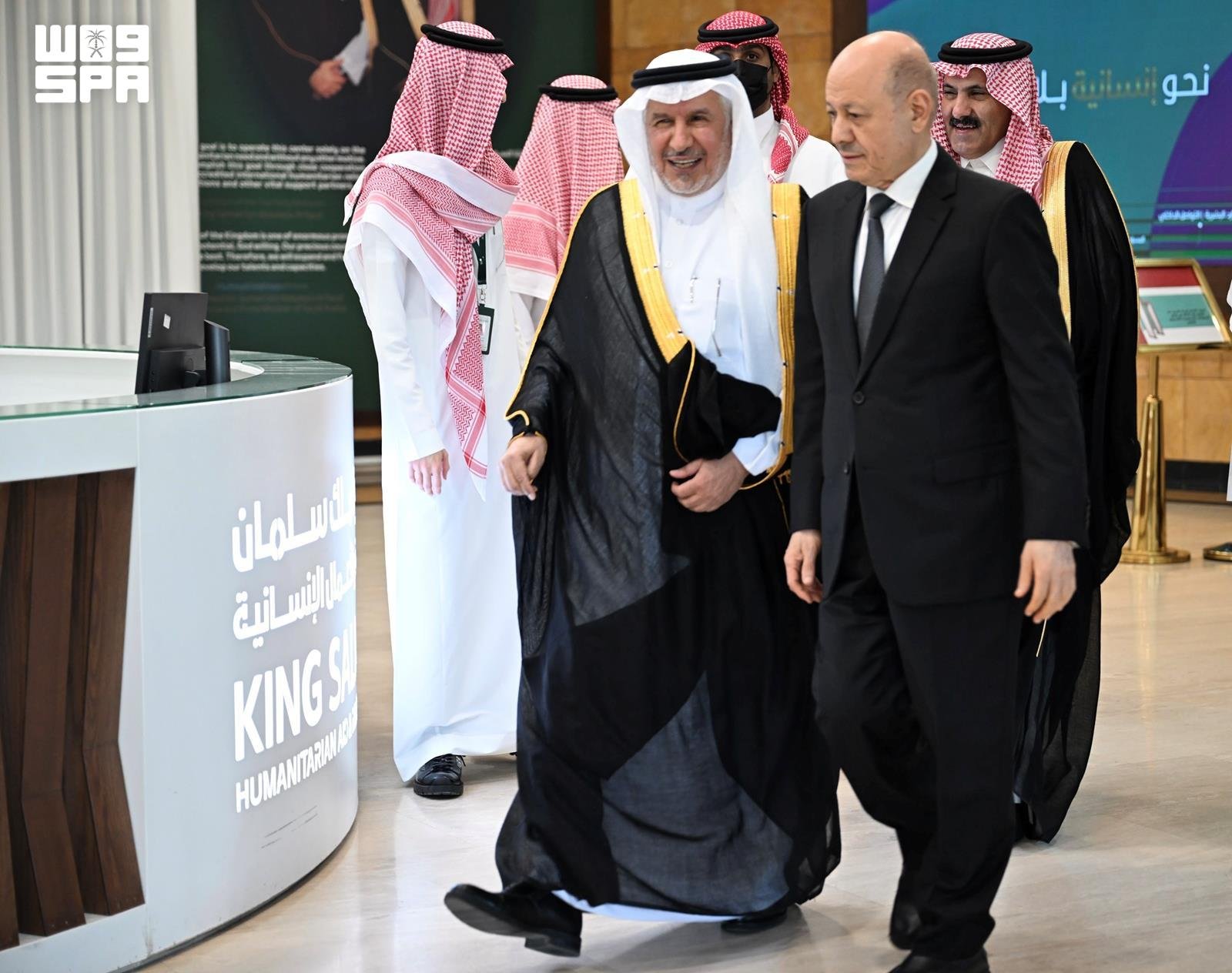

RIYADH: Saudi aid agency KSrelief on Tuesday launched a new package of humanitarian projects expected to benefit more than 3.4 million people in Yemen during a visit by Rashad Al-Alimi, chairman of Yemen’s Presidential Leadership Council, to its headquarters in Riyadh.
The initiatives, covering emergency food assistance, shelter, clean water and healthcare, were unveiled alongside 100 Saudi volunteer programs expected to benefit another 265,000 people, the Saudi Press Agency reported.
The announcement comes as renewed fighting between Yemen’s internationally recognized government and the Houthi militia has forced more than 276,000 people from their homes since June, according to the International Organization for Migration.
The UN agency said Taiz had received the largest number of displaced people, followed by Lahj and Aden, placing additional pressure on communities already struggling with shortages of food, water and basic services.
Among the projects launched on Tuesday were the distribution of 250,000 food baskets and 25,000 emergency shelter kits, along with 17,500 tents for displaced families.
The package also included projects to provide more than 16 million liters of water in Lahj, Taiz and Aden, as well as medical supplies, equipment and medicines for Yemen’s healthcare sector.
The 100 volunteer programs will provide specialized medical services, including open-heart surgery, cardiac catheterization, cataract treatment, cochlear implants and hearing rehabilitation.
Other initiatives will focus on specialized surgery, education, vocational training and economic empowerment.
In Taiz, where fighting and road closures have severely restricted access to essential supplies, the center will distribute an additional 5,000 food baskets and nearly 10,000 containers of infant formula, alongside essential medical assistance.
A separate housing project will provide 232 solar-powered homes equipped with public service facilities for displaced families in Hajjah governorate.
During the visit, Abdullah Al-Rabeeah, KSrelief supervisor-general, said Yemen remained the center’s top humanitarian priority, with 1,238 projects implemented across the country at a cost exceeding $4.8 billion, in partnership with 362 UN, international and local organizations.
He said King Salman and Crown Prince Mohammed bin Salman had directed KSrelief to expand humanitarian assistance across Yemen following the launch of Operation Dawn of Yemen, particularly in areas affected by displacement and those with the greatest needs.
The military operation, announced by Al-Alimi on Oct. 4, aims to regain territory controlled by the Houthis and restore government authority across the country.
According to the World Food Programme, an estimated 18.3 million people in Yemen face acute food insecurity, while 2.2 million children under the age of 5 suffer from acute malnutrition.
Al-Rabeeah also warned that humanitarian operations continued to face serious obstacles because of Houthi restrictions, accusing the militia of obstructing aid deliveries, detaining humanitarian workers, including UN personnel, and targeting assistance.
He urged the UN and international community to pressure the Houthis to open humanitarian corridors into Taiz, where restrictions on the movement of food, fuel and medical supplies have threatened essential services.
The UN has separately warned that road closures and insecurity in Taiz are preventing vital supplies from reaching residents, while dozens of its personnel remain detained by Houthi authorities.
Al-Rabeeah said Saudi Arabia had provided more than $29 billion in various forms of assistance to Yemen over the past decade, reaching communities across different governorates without discrimination.
He added that KSrelief had implemented 4,525 projects in 113 countries worldwide, worth more than $8.6 billion, with Yemen remaining the largest beneficiary.
Al-Alimi thanked Saudi Arabia for its continued humanitarian and development assistance, praising the Kingdom’s role in supporting Yemenis throughout the conflict.
He also commended KSrelief’s Masam landmine clearance project, which has worked to remove explosive devices from affected areas, and highlighted the center’s contribution to protecting lives and restoring communities.
Al-Alimi also held talks with Al-Rabeeah on strengthening humanitarian cooperation before touring the offices of KSrelief’s international partner organizations at the center’s headquarters.