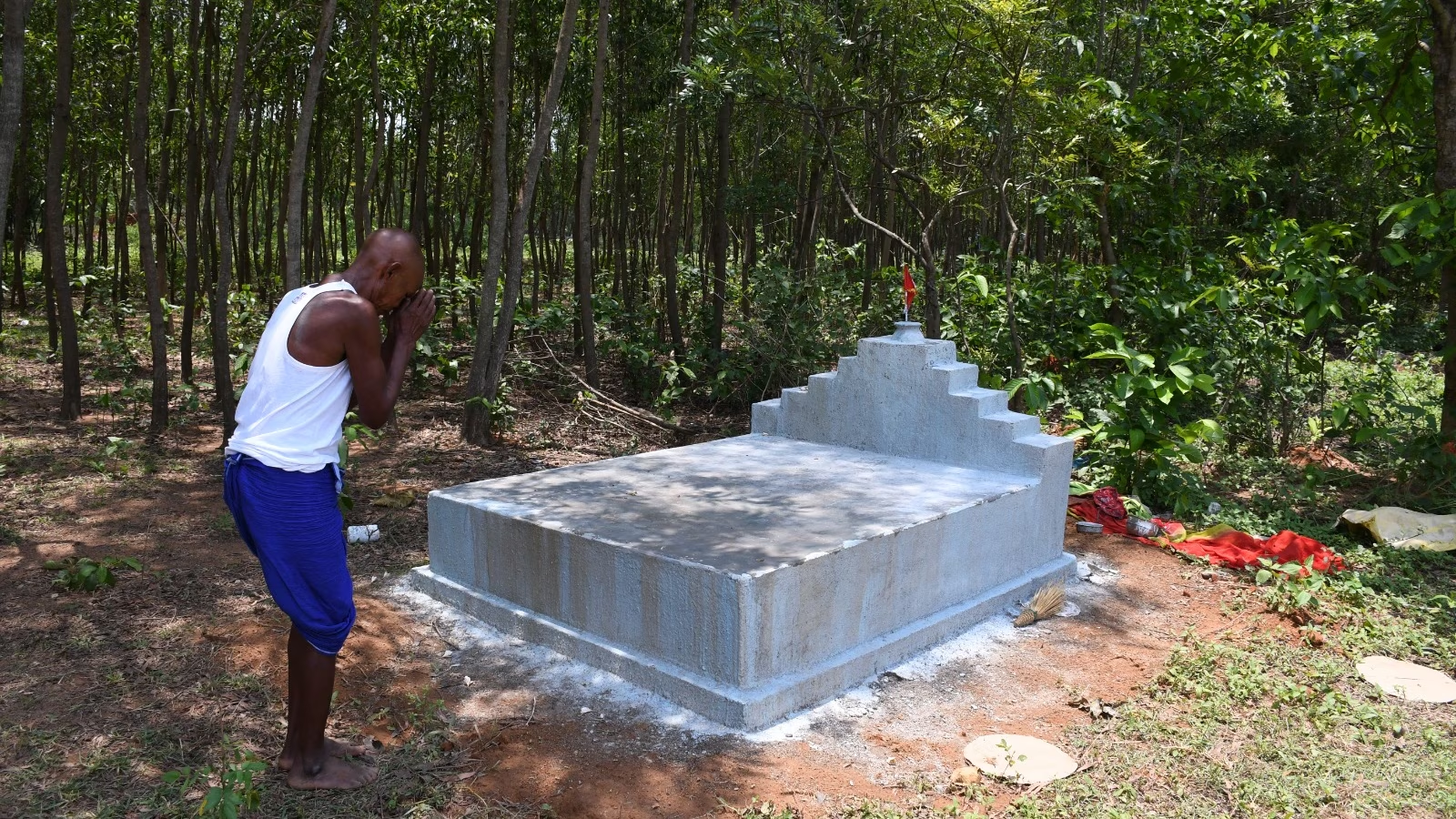
Near the doorway of his modest one-room concrete house at Dianali village in Odisha’s Keonjhar district, Jitu Munda sits surrounded by relatives, who have been visiting him daily. Jitu, who is in his 60s, has got tired telling the story, but every fresh group of visitors wants to know how he carried the skeleton of his sister to a local bank branch — and became a national headline. Every time that he does so, Jitu turns to his sister’s grave, located barely a few metres away, and folds his hand in apology.
Much has changed since April 27 when Jitu walked around 3.5 km barefoot to the Malliposi branch of Odisha Grameen Bank, carrying sister Kalara Munda’s skeleton. He wanted to prove to the bank officials that she was indeed dead, and they should let him withdraw the Rs 19,300 in her account.

With the incident, from the home district of Chief Minister Mohan Charan Majhi, triggering outrage, action followed swiftly. While Kalara’s death certificate was issued by the Patna Community Health Centre (CHC) within two days, the bank handed back over Rs 19,400 (including interest), and the district administration extended Rs 30,000 from the Red Cross Fund. The family home, allotted to Jitu’s elder brother Raibu under the Pradhan Mantri Awas Yojana got electrical connection almost overnight, while Jitu’s name was enrolled for subsidised rice under the PDS and for the Rs 1,000 monthly social security pension of the state government, of which the first instalment has already come. His Aadhaar card has been updated.
 Jitu Munda alleged that he was forced to exhume his dead sister’s skeleton because officials repeatedly denied his requests to withdraw his dead sister’s savings. (Credits: Social media/ Express Photo)
Jitu who had struggled to receive Rs 19,300 now has an account at the Patna branch of Bank of India with a deposit of Rs 10.95 lakh — all donated. Having never worn any footwear in his life, he now has multiple donated pairs. Other donations also stand out: an iron-framed cot, a pedestal fan, a cycle, and sacks and sacks of rice and potatoes, enough to last him six months, says Jitu.
Kalara’s grave is also changed; it’s cemented.
The siblings
After losing her husband and only child some four decades ago, Kalara had come back to her maternal home. Since Jitu was not married, the siblings lived together.
The family says the two mostly survived on government schemes which Kalara was a beneficiary of: 35-kg rice monthly under the Antyodaya Anna Yojana, and Rs 1,000 monthly each as part of social security pension and the Madhu Babu Pension Scheme, a state programme for the poor who are 60 years and above.
With no official documents in his name, Jitu was not a beneficiary of any scheme. He says he lost his Aadhaar card in January 2015.
Story continues below this ad
The money in Kalara’s account was from the pair of buffaloes they sold around two years ago, says Jitu. Since he did not have a bank account, they put the money in hers.
Then, Kalara fell ill late last year. For two months, she was bedridden. Jitu says he first went to the bank around that time, anticipating money issues should anything happen to her. “Each time the bank staff sent me back, saying the account holder needed to be physically present,” he says. “When I said Kalara could not walk, they said to carry her or bring her in a vehicle… They never explained what else I could do.”
On January 26 this year, Kalara passed away. Jitu says he kept trying to get a death certificate till February, but the red tape overwhelmed him. “The panchayat officials said it would take at least five years.”
A senior district administration official admits lapses on the part of the CHC in issuing Kalara’s death certificate. “They should have completed the process by March.”
Story continues below this ad
In the absence of a death certificate, his visits to the bank were again unfruitful, Jitu says. In desperation, he decided to dig up Kalara’s skeleton to prove “she was dead”.
“With her death, everything stopped – subsidised rice, pension money… I hoped to get some money to buy a pair of bullocks and work in others’ fields… How could I survive?” Jitu says.
The day of exhumation
In the tribal Ho community, people traditionally bury their dead, on their own land. Jitu and Kalara’s two other siblings Raibu and Dhaneswar are buried near where Kalara’s grave is.
Jitu says that after he decided that presenting Kalara’s body to bank officials was the only way to prove her death, he dug the grave on his own. “It took me around an hour.”
Story continues below this ad
Mangal Giri, 53, who works as a driver and is a native of Malliposi, remembers almost the exact time Jitu reached the bank. “It was around 12.45 pm. I was at the branch to withdraw money. There was commotion as he put the body outside. The bank staff immediately locked the grille door, to prevent him from entering the branch.”
Police came and it was only on their reassurance that Jitu agreed to leave, with the remains. As he carried the body back, again on foot, local police trailed him to ensure he reburied the skeleton.
Odisha Grameen Bank officials initially claimed that Jitu had not approached the Malliposi branch earlier, and that there was CCTV proof of this, as well as that he was drunk the day he arrived with Kalara’s skeleton.
However, a preliminary probe found “negligence on the part of the bank officials”. It said that the April 27 CCTV footage from the Malliposi branch showed Jitu was there for about half-an-hour trying to convince officials. And that he and Kalara had come to the branch several times earlier, and officials knew them.
The bank
Story continues below this ad
Odisha Grameen Bank was established a year ago, on May 1, 2025, with the amalgamation of Odisha Gramya Bank and Utkal Grameen Bank. The bank has 979 branches across Odisha’s 30 districts.
On the Malliposi branch’s account rolls are mostly members of tribal self-help groups, and government scheme beneficiaries. Officials said the branch handles monthly transactions of around Rs 8 to 10 lakh.
Besides a ‘bank mitra’, who helps customers with paperwork etc, and a “messenger” (for posting and receiving correspondence and doing office chores), the bank has two other staff, the cashier and the manager.
About a fortnight after Jitu came bearing a skeleton, bank mitra Rosy Barik is surrounded by a group of tribal women seeking her help.
Story continues below this ad
Barik, who attends to each patiently, was present on April 27 when Jitu arrived with Kalara’s skeleton. She was surprised, she says. “They always visited the bank together… When I asked him about his sister, he couldn’t give a proper reply.”
Gayatri Khatual, the cashier, says that while Jitu had approached her in the days leading up to April 27, she had clearly explained to him the process, and the need to get Kalara’s death certificate.
Manager Susant Kumar Sethi, whom Jitu also met, has been on leave since the incident and couldn’t be contacted.
The days after
The Ho community asked Jitu to undergo “purification” after the act of digging up Kalara’s body. So on the 10th day of exhuming the body, he shaved his head and took a ceremonial bath, and villagers sprinkled turmeric water on him and other family members. Jitu also hosted a lunch for around 200 people.
Story continues below this ad
Hadibandhu Mahanta, an ex-ward member of the village, says they then decided to develop Kalara’s grave as a permanent cement structure.
Jitu has not made any withdrawals since all that money came into his new account. He is not sure what to do with the money, except spending a part of it towards the education of elder brother Raibu’s children.
What he is sure of is that the events of April 27 will “haunt” him forever. He points to a corner of the room where Kalara and he cooked on a wood-fired stove, and says: “I seek her forgiveness for not letting her soul in peace.”