Being an old movie buff (my preferred era, as the rest of my family mocks, is black and white with mono sound), I particularly enjoy scanning old Tamil films for scenes of Madras. These are not so easy to come by, as much of the action those days was on sets, well within studios. Last week, I struck gold: though having seen the film so many times earlier, I should have known what it contained. I allude to the 1952 film Parasakthi, which launched Sivaji Ganesan on his meteoric film career.
Though the story is set in Rangoon and Madurai, Madras appears briefly, when the protagonist, played by Sivaji, comes to India by ship and disembarks at our harbour. A sweeping shot of the seafront reveals First Line Beach/Rajaji Salai – you can make out Dare House, the GPO, and a couple of other gleaming buildings. What followed next was a puzzle. The hero proceeds to an art deco-fronted building, which is a bank. Here, he collects cash against what I presume are travellers’ cheques (remember those?). The name of the bank was visible on the façade, but the letters were small and the print rather grainy. And I was stymied by which bank this could be.

The art deco building, as seen in Parasakthi
| Photo Credit:
Special Arrangement
I made the mistake of assuming that this was not in reality a bank but one of the art deco buildings our city was so liberally dotted with at one time. Having scanned all the photographs I have and come up with no answer, I thought of abandoning the search. For one last time, I gazed long and hard at the lettering on the building in that scene. The first word was clearly ‘The’, followed by something and then ‘Bank’. Below this was clearly an ‘Of’ and then in a third line were four words, the first short, the second long, the third another ‘the’, and the fourth of medium length. It finally dawned on me that this was The Chartered Bank of India, Australia, and China. And such is the perversity of YouTube that I was now rewarded with a clearer print that confirmed this.
Indo-Saracenic structure
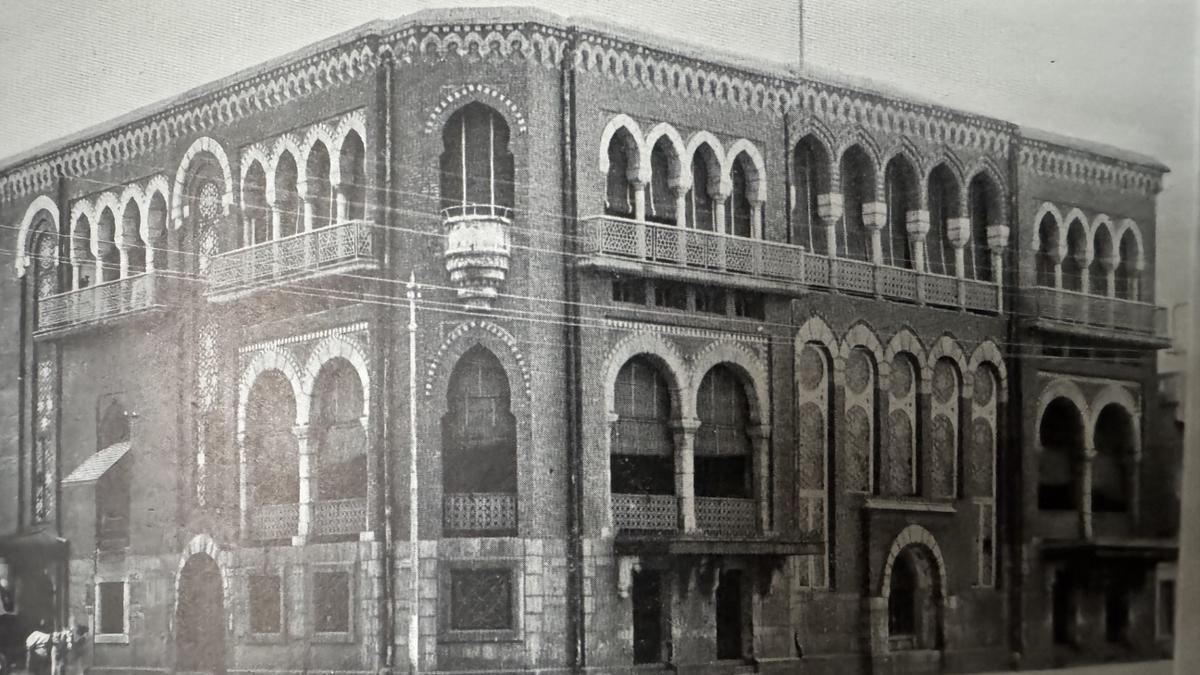
The bank, founded in 1853 in London, opened its branches in India and China in 1859. The Madras branch, however, was late in coming, only in 1900 or so, when it occupied a historic edifice at the intersection of Armenian Street and China Bazaar (now NSC Bose) Road. This was constructed in 1871 for the Agra Bank, which, having begun in 1833, was in Madras since 1845. The lovely Indo-Saracenic structure, probably designed by Chisholm, was photographed in all its glory sometime in the late 1880s. There are closeups and distant shots available, as also a picture of its magnificent interior.

The modernist building, courtesy S. Muthiah’s ‘Madras The Gracious City’
| Photo Credit:
Special Arrangement
Early in 1900, what was by then Agra & Masterman’s Bank was facing liquidation. The Chartered Bank came to occupy the premises and was featured in Somerset Playne’s masterly survey of Madras commerce – ‘Southern India’ – in 1917. What I did not realise was that sometime in the 1940s, Chartered Bank succumbed to the art deco mania then sweeping our city and brought down its Indo-Saracenic home and replaced it with a building in the new style. This is what Parasakthi captures. It also shows tramlines on NSC Bose Road, and within the bank, a completely refurbished office.
In 1969, the Chartered Bank merged with the Standard Bank of South Africa and became the Standard Chartered Bank. The merged entity operated from the old building in Madras until the 1980s when it demolished the art deco structure and replaced it with a modern building, in squat, brutalist concrete. A decade or so ago, the bank moved out of the premises and the building was brought down, replaced by a non-descript structure that survives. I doubt if there are many other premises in the city whose history is so clearly documented since 1871.

The present building, photographed by Surya Kumaran
| Photo Credit:
Special Arrangement
Not knowing about the art deco building in the interim, I had always assumed that the Indo-Saracenic building was demolished in the 1980s to make way for the modern construction. I am glad Parasakthi set me right.
For the record, the film shows some other city buildings too. There is Moore Market, captured in a long shot followed by a typical Moore Market transaction, which is clearly shot in the studio. The High Court’s tallest dome, then the lighthouse appears briefly and then, surprise, so does Kardyl Building of WE Smith & Co., in all its glory. We now refer to it as the Bharath Insurance Building, which is a misnomer, for that name applies to the art deco structure dating to the 1940s that fronts Kardyl Building, which goes back to the 1890s. The Madras University clock tower too appears, and what is more, with the clock working!
(Sriram V. is a writer and historian.)