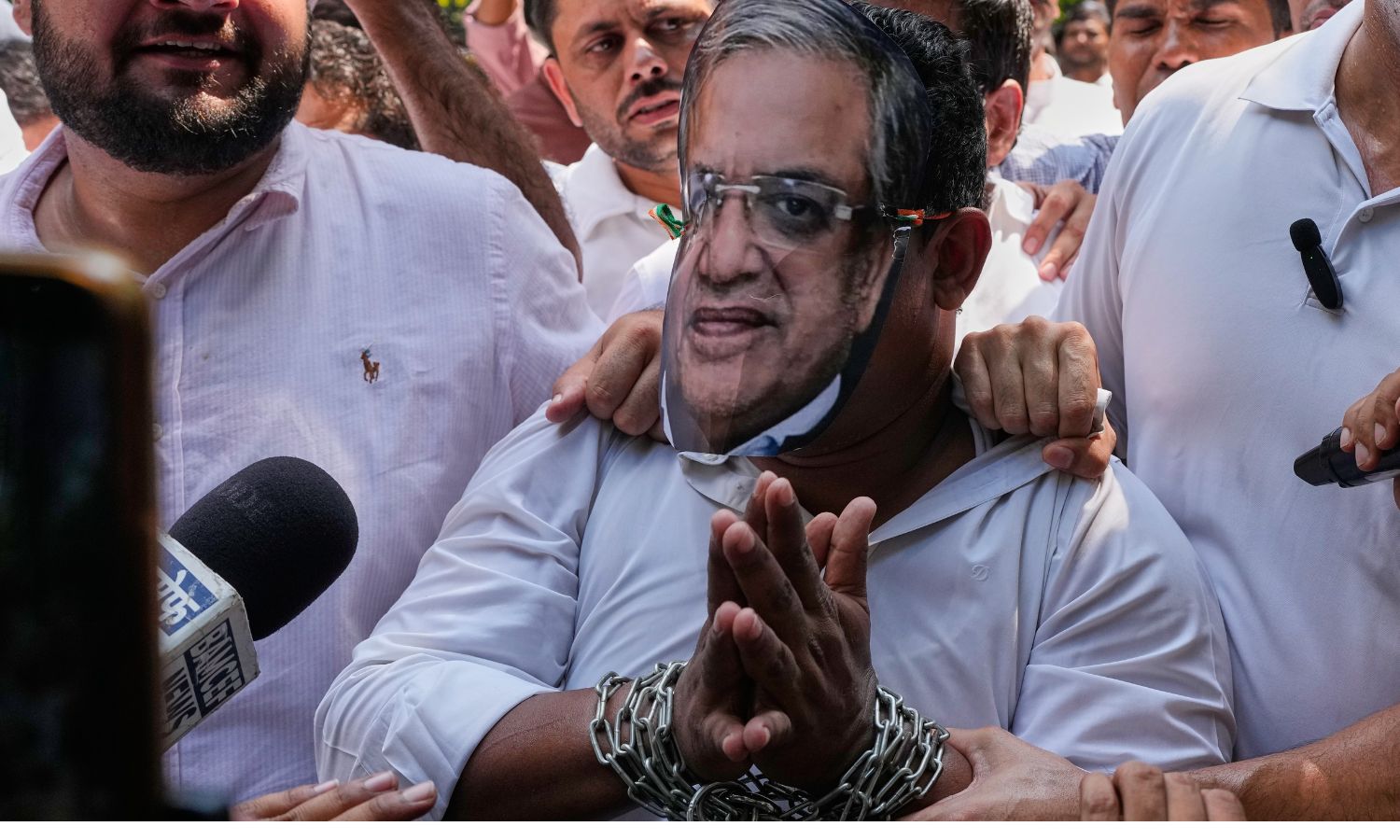
New Delhi: Gyanesh Kumar is the first Chief Election Commissioner against whom the Opposition has threatened to initiate impeachment proceedings over alleged irregularities in the Special Intensive Revision (SIR) of electoral rolls.
According to the Constitution and law on the appointment of the Chief Election Commissioner (CEC) and Election Commissioners, a CEC can only be removed by Parliament the way a sitting Supreme Court judge can be impeached.
According to the Chief Election Commissioner and other Election Commissioners (Appointment, Conditions of Service and Term of Office) Act, 2023, the CEC or an Election Commissioner may, at any time, submit a written resignation to the President.
“The Chief Election Commissioner shall not be removed from his office except in like manner and on the like grounds as a judge of the Supreme Court. The other Election Commissioners shall not be removed from office except on the recommendation of the Chief Election Commissioner,” the law said.
The Article 324 of the Constitution, which deals with the Election Commission, also says that a CEC can only be removed from his office like grounds as a judge of the Supreme Court.
According to the Article 124, which deals with the Supreme Court, a judge of the Supreme Court shall not be removed from his office except by an order of the President passed after an address by each House of Parliament supported by a majority of the total membership of that House and by a majority of not less than two-thirds of the members of that House present and voting has been presented to the President in the same session for such removal on the ground of proved misbehaviour or incapacity.
The Judges (Inquiry) Act of 1968 says that once a motion to remove a judge is admitted in any of the Houses, the speaker or the chairman, as the case may be, will constitute a three-member committee to investigate the grounds on which the removal (or, in popular term, impeachment) has been sought.
The committee consists of the Chief Justice of India (CJI) or a Supreme Court judge, the chief justice of one of the 25 high courts and a “distinguished jurist”.
At the conclusion of the investigation, the committee shall submit its report to the Speaker or, as the case may be, to the chairman, or where the committee has been constituted jointly by the Speaker and the chairman, to both of them, stating therein its findings on each of the charges separately with such observations on the whole case as it thinks fit.
The Speaker or the chairman, or, where the committee has been constituted jointly by the Speaker and the chairman, both of them, shall cause the report submitted under sub-section (2) to be laid, as soon as may be, respectively before the House of the People and the Council of States.
If the report of the committee contains a finding that the judge is not guilty of any misbehaviour or does not suffer from any incapacity, then, no further steps shall be taken in either House of Parliament in relation to the report and the motion pending in the House or the Houses of Parliament shall not be proceeded with.
If the report of the committee contains a finding that the judge is guilty of any misbehaviour or suffers from any incapacity, then, the motion together with the report of the committee, be taken up for consideration by the House or the Houses of Parliament in which it is pending.
If the motion is adopted by each House of Parliament in accordance with the provisions of Article 124 or, as the case may be, in accordance with the clause read with Article 218 of the Constitution, then, the misbehaviour or incapacity of the Judge shall be deemed to have been proved and an address praying for the removal of the Judge shall be presented in the prescribed manner to the President by each House of Parliament in the same session in which the motion has been adopted.
The move against CEC Kumar gained momentum as the Opposition India bloc met here on Wednesday to finalise an action plan for a joint agitation over alleged irregularities in the SIR with the Congress asserting that the opposition stands united to protect the Constitution from “repeated assaults” of the Modi government, including its “vote chori gameplan” to remain in power.
Sources said even though the opposition has not yet formally announced that it would again try to remove Kumar from office, the “move is very much on the card”.
The opposition had twice attempted to remove Kumar from the office of CEC.
The first attempt by submitting notices was rejected by both Lok Sabha and Rajya Sabha while the notices submitted in their second attempt was still pending in the Upper House.
If the opposition goes ahead with the fresh initiative, it will be the third attempt to remove CEC Kumar through impeachment.
The opposition meeting comes days after The Indian Express reported that Election Commissioners Sukhbir Singh Sandhu and Vivek Joshi objected on record at least 14 times over the past 10 months to decisions and orders on the SIR (Special Intensive Revision) that they said were issued without their knowledge or recommendation.
As part their agitation programme, all opposition MPs on October 6 will march to the Election Commission.
The leaders of opposition will seek appointment from the President of India and will make a representation in the second week of October against “the vote chori government”.