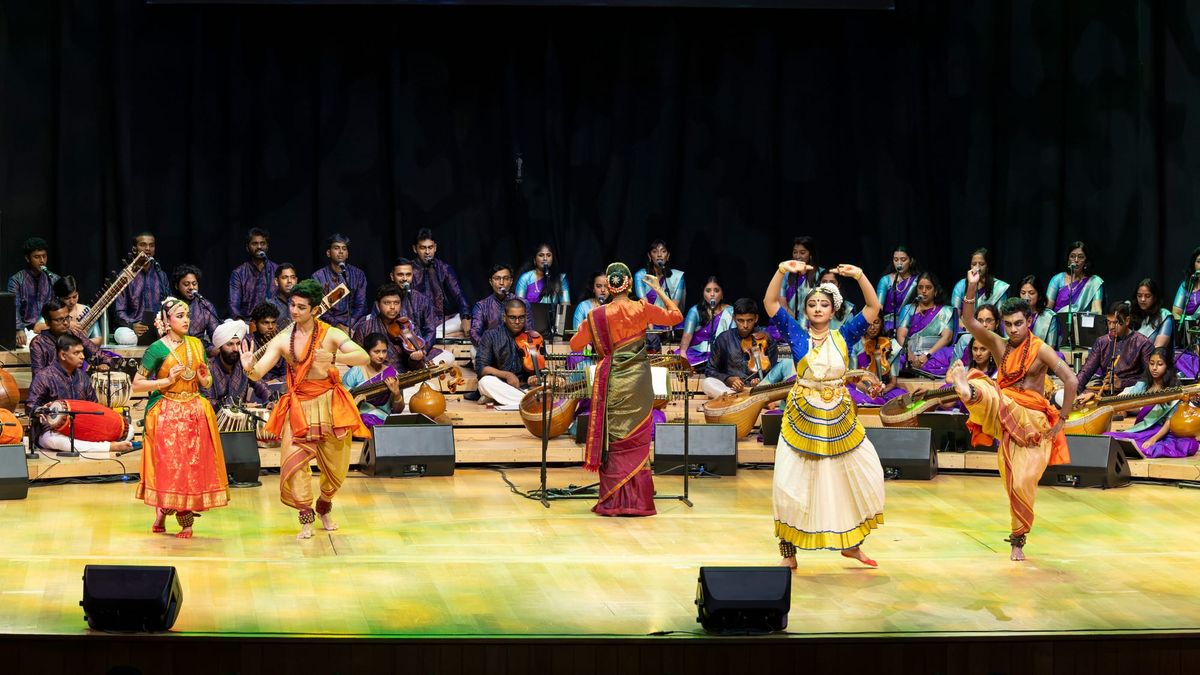
SIOC’s ambitious production brought together orchestral music, dance, narration and AI-driven animation to explore the nine emotions at the heart of the human experience.
By Rajesh Kumar | PravasiExpress
Some stories survive because they are repeatedly told. Others endure because every generation discovers a new way of telling them.
At Singapore’s Esplanade Concert Hall on Sunday evening, Navarasä – 9 Emotions, 1 Epic offered the Ramayana not merely as a familiar tale from the past, but as a living landscape of human emotion. Presented by the Singapore Indian Orchestra and Choir (SIOC) in collaboration with Esplanade – Theatres on the Bay, the sold-out production unfolded through the nine rasas described in the Natya Shastra: love, valour, disgust, fury, wonder, compassion, fear, laughter and peace.
The presence of Singapore President Tharman Shanmugaratnam and his wife added distinction to an evening that was already significant for the Indian performing-arts community. More importantly, the scale of the production demonstrated how deeply Indian classical traditions have taken root in Singapore—and how confidently local artistes are reimagining them for contemporary audiences.
Rather than presenting the Ramayana as a conventional chronological narrative, Navarasä used its defining moments to illuminate nine essential human emotions. The epic provided the narrative framework, but emotion remained the true protagonist.
This approach gave the production an immediacy that transcended mythology. Love was not simply an exchange between legendary characters; fear, anger, courage and compassion emerged as experiences recognisable in our own lives. The ancient epic consequently felt less like a distant cultural inheritance and more like a mirror held up to the present.
At the centre of this ambitious undertaking was SIOC’s founder, conductor, creative and managing director, Smt Lalitha Vaidyanathan. Her musical vision shaped the production’s expansive character, bringing together a strong Carnatic foundation with choral textures, orchestral arrangements and a wider instrumental vocabulary.
Having founded SIOC in 1985, Lalitha has spent four decades creating a distinctive space for Indian classical-based orchestral and choral music in Singapore. In Navarasä, that experience was evident in the manner in which music carried the emotional narrative—moving effortlessly between intimacy, tension, celebration, sorrow and dramatic force.
Equally integral to the production was Vicknesvari Vadivalagan, SIOC’s resident conductor, senior instructor and artistic head. A versatile musician, vocalist, instrumentalist, composer and arts educator, Vicknesvari brought decades of artistic experience to the undertaking. Her contribution, alongside Lalitha’s leadership, was central to sustaining the musical discipline and emotional coherence required by a production of this scale.
The production also reflected the creative contribution of composer and musician Dr Mohan Vaidhya, who specially composed and arranged material around the Navarasä theme. The music did far more than accompany the action; it gave each rasa its own pulse, colour and emotional identity.
One of the evening’s greatest strengths was its collaborative spirit. Musicians, vocalists and dancers from several of Singapore’s major Indian arts schools and institutions came together on a common stage. Coordinating performers trained in different artistic traditions, teaching lineages and institutional environments would have required an extraordinary degree of rehearsal, trust and discipline.
That collective effort was visible throughout the performance. The dancers supplied the physical vocabulary of emotion through expression, gesture, movement and stillness, while the orchestra and choir created its inner atmosphere. Narration provided clarity and continuity without reducing the work to mere explanation.
Technology formed another important layer of the production. The large AI-driven animations and screen visuals expanded the stage into kingdoms, forests, battlefields and psychological spaces. They helped the audience move between different moments in the Ramayana while strengthening the emotional environment surrounding the live performers.
Led by animation director Aarathi Venugopal in collaboration with Webspiron, the AI animation project demonstrated how new technology can be thoughtfully incorporated into a production rooted in classical traditions. Rather than appearing as a novelty, the visuals largely functioned as a bridge—making the storytelling more immediate and accessible to younger and more diverse audiences.
The most effective moments were those in which technology, music and movement appeared to breathe together. The screens elevated the storytelling without taking away from the musicians and dancers, whose live presence remained the emotional centre of the production.
The journey eventually arrived at Shāntam—peace—with the return of Rama, Sita and Lakshmana to Ayodhya and the celebratory Pattabhishekam. The musical crescendo of “Aanandam” carried the production towards a sense of release, before the concluding Navarasa Mangalam gathered the nine emotional strands into a final expression of wholeness.
Yet the evening’s lasting impression came not from any single scene. It came from witnessing the magnitude of a shared cultural undertaking.
Behind every seamless transition were countless hours of rehearsal; behind every musical phrase, years of training; and behind every dancer and musician stood teachers, institutions, families, production teams and volunteers who have sustained Indian arts in Singapore across generations.
Navarasä was therefore more than an artistic presentation. It was a statement about what can be achieved when a community’s creative resources come together with a unified purpose.
The production also affirmed SIOC’s continuing evolution as it moves through its fifth decade. After years of nurturing Indian orchestral and choral music in Singapore, the organisation is now exploring increasingly ambitious forms in which classical music can converse with dance, theatre, digital art and contemporary stagecraft.
At a time when attention is increasingly fragmented and cultural traditions are often compressed into brief spectacles, Navarasä chose scale, patience and artistic collaboration. It invited audiences to experience nine emotions and recognise that the Ramayana’s enduring power lies not only in its heroes, battles or divine interventions, but in its profound understanding of the human heart.
For Singapore’s Indian arts community, the evening was both a celebration and a milestone. For the wider audience, it was a reminder that tradition remains most alive when it has the confidence—and the courage—to speak in a new language.