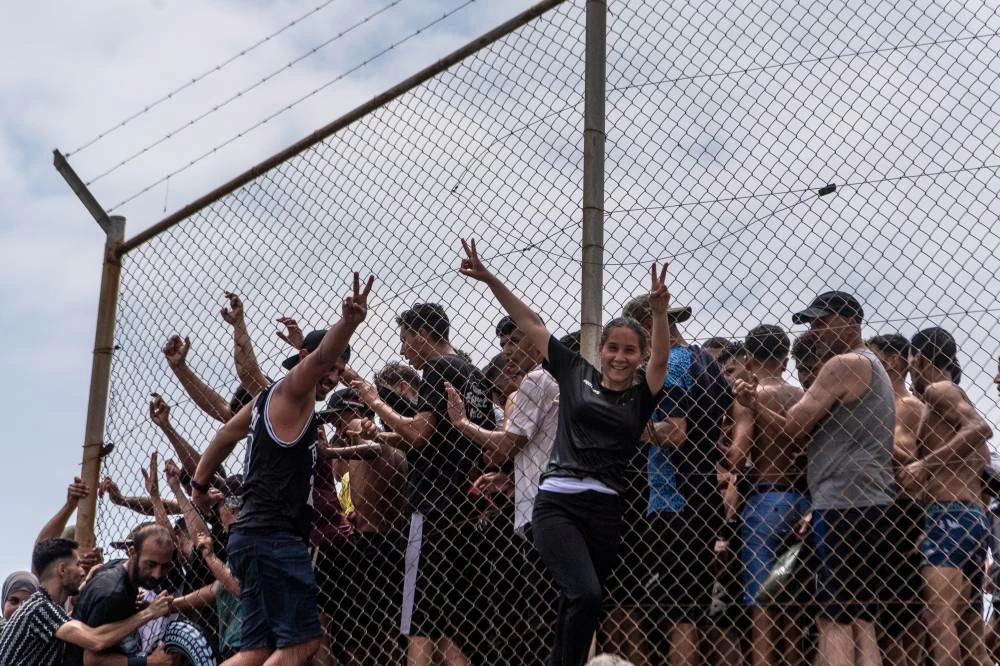
Around 60,000 people were estimated to have crossed into Ceuta in the past few days, the leader of the Spanish enclave in North Africa, Juan Jesus Vivas, told reporters on Friday, more than half of Ceuta’s population. After hours of efforts, Spain said it had reversed the huge rush of migrants into a Spanish enclave in North Africa, with thousands of people who had crossed the border by land and sea already heading back voluntarily.
Latest updates here:
Thousands heading back voluntarily
Moroccan forces beat back crowds with batons and tear gas at the gates to Ceuta, trying to prevent more from storming across into the tiny Spanish territory that juts on a spit of sandy land into the Mediterranean from Morocco.
Spain’s Interior Ministry said around 50,000 people had crossed the border since Thursday morning, and estimated that around 25,000 had already turned and gone back.
The mass storm of the border caused division in Europe, where leaders of fellow EU states called for Spain to ensure that the incident was contained. Right-wing parties around the continent blamed the incident on Spain’s comparatively lax migration policies, including an amnesty granted to hundreds of thousands of unauthorised migrants this year.
Spanish military vehicles lined up along sections of the border as dozens of migrants watched from a hilltop in Morocco, unable to cross.
People seen returning to Morocco
Several hundred people could be seen returning to Morocco through border posts and holes in the fence, with some saying they could not find food or shelter in Ceuta.
“Honestly, I don’t even know why I came, and now I’m going back,” a young Moroccan man, who said he was from Tangier, told Reuters. “I haven’t eaten since lunch yesterday, even though I brought some money with me … What we’re doing is neither good nor enjoyable.”
Spain says 25,000 migrants voluntarily returned to Morocco
An estimated more than 25,000 migrants have voluntarily returned to Morocco from the Spanish enclave of Ceuta so far on Friday after some 50,000 rushed into the tiny territory in North Africa starting in the early hours on Thursday, according to Spain’s Interior Ministry.
At least 34 people have died in Spain’s border crisis
At least 34 people have died in Spain’s border crisis with Morocco, Ceuta President Juan Jesús Vivas said.

UK PM says Spain migrant crossings are ‘concerning’
British Prime Minister Andy Burnham said on Friday the situation where migrants had flooded into a Spainish enclave in North Africa was “concerning”, and his government had contacted Madrid to understand the implications and provide support.
“It’s a concerning situation, and I know people will see those scenes and want something to be done,” Burnham told reporters.
“We are making contact with the Spanish government, the Spanish authorities, to provide support, but also to understand the implications of that situation.”
Britain has for years been trying to deter illegal migrants from coming to its shores. About 41,000 people arrived in small boats on the south coast of England in 2025.
‘Violation’ of Spain’s territorial sovereignty: PM
The mass crossings of tens of thousands of people from Morocco into Spain’s North African enclave of Ceuta was a “violation of Spain’s territorial sovereignty,” Spanish Prime Minister Pedro Sanchez told reporters on Friday.

Germany welcomes Spain’s intention not to allow illegal migrants in
German Chancellor Friedrich Merz said on Friday he welcomed Spain’s intention not to allow illegal migrants onto the European mainland.
The German government was in contact with the Spanish one on the matter, he said.
France ready to help out Spain
France is in touch with Spanish and Moroccan authorities over the huge numbers of migrants who crossed over from Morocco into Ceuta, French President Emmanuel Macron’s entourage said on Friday.
France stands ready to help out Spain if necessary, including via the European border and cost guards agency Frontex, they said, adding Macron asked Interior Minister Laurent Nunez to beef up checks at the borders with Spain.
Spain, Morocco try to halt deadly rush on Spanish enclave

Spain and Morocco reinforced the border fence of a Spanish enclave on Friday and appeared to have largely halted mass crossings after tens of thousands of people arrived by sea and land in a day, with at least 19 dead bodies found in the water.
The Spanish Department of National Security said on its website that more than 49,000 people were estimated to have crossed illegally in 24 hours, citing the Interior Ministry. The statement was later deleted from the website with no immediate explanation.
The mass crossing into Ceuta, a tiny Spanish-held spit jutting into the Mediterranean from Morocco, caused shock and division in Europe. France said it was increasing checks on its border with Spain, and Italy threatened to suspend Spain from the EU’s internal open border scheme.
Water cannon trucks deployed at the gate
At the gates into Ceuta, Moroccan authorities had deployed water cannon trucks and pushed people back. The charred remains of a bus and seven cars could be seen nearby from clashes with the crowds.
Spanish authorities said they would try to expel those who had entered illegally as quickly as possible, despite a court ruling that put some restrictions on special “border rejection” rules that allow immediate expulsions from the enclave. Prime Minister Pedro Sanchez was due to visit Ceuta on Friday with Interior Minister Fernando Grande-Marlaska.
Unprecedented migrant surge
Ceuta and Melilla, another Spanish autonomous city in northern Morocco, have the European Union’s only land borders with Africa. The two cities, each home to around 85,000 people, both periodically experience surges in attempted crossings by migrants seeking to reach Europe, but the scale of Thursday’s rush had little precedent.
Territorial Policy Minister Angel Victor Torres said on Friday that among factors contributing to the surge may have been a ruling by Spain’s Supreme Court earlier this month that migrants intercepted at sea while attempting to reach Ceuta or Melilla cannot be summarily returned under special rules.
How it started
Torres told a local radio station the Spanish government had reacted immediately to the surge and would proceed to eventually return the migrants, while respecting court rulings and migrants’ rights.

On the Moroccan side of the border, thousands of migrants streamed into the town of Fnideq overnight despite a reinforced deployment of security that foiled most attempts to cross. Although the crossing appeared blocked, groups moved along the coast seeking routes around the fence. Some prepared to swim.
“I was late,” said Brahim, 32, who gave only one name. He said he had arrived from Tangier hoping to cross through the gate but found it effectively shut. Among those hoping to cross were women and children, from both Morocco and sub-Saharan African countries further south.
Helpless police
In a post on X, Spain’s Guardia Civil police association AUGC said there had been too few police in place to monitor the fence during the surge on Thursday, making them unable to stop it.
Migration is a sensitive issue across Europe, where right-wing parties have surged in the decade since a 2015 crisis when more than a million people crossed the continent mainly on foot and sought asylum, most fleeing war in Syria.