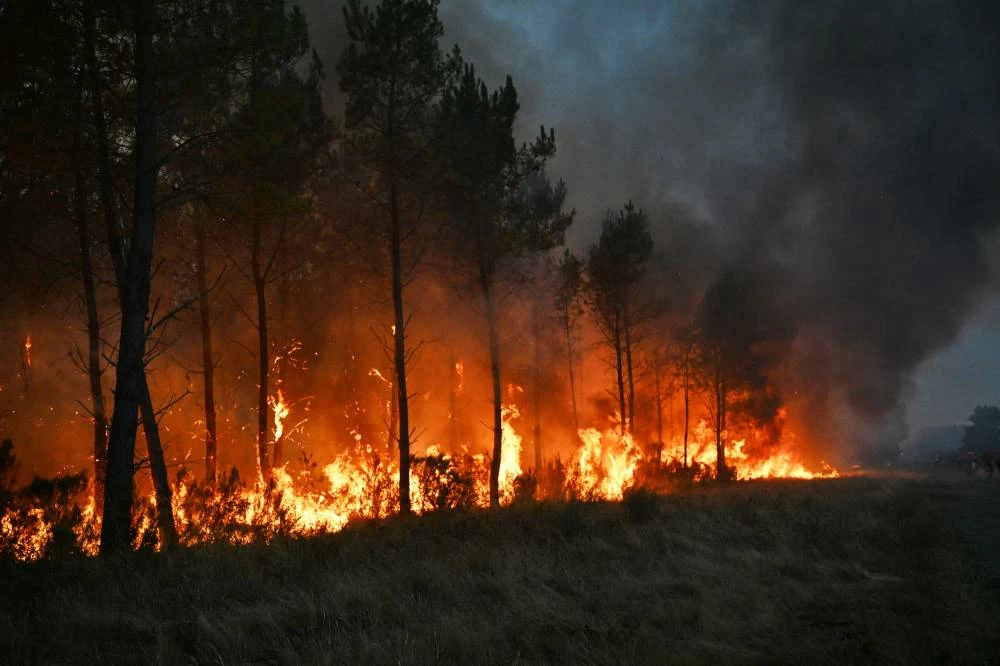

Brussels: Climate change could nearly triple the amount of land burned by wildfires across Europe by the end of the century, with regions that have historically experienced few major fires facing growing risks, according to a new study.
The warning comes as several European countries, including Belgium, France, Greece, Portugal and Spain, battle severe wildfires following weeks of hot, dry weather and record summer temperatures.
Researchers said increasingly extreme fire-weather conditions are likely to make wildfires more difficult to predict and control, even in countries with well-developed firefighting capabilities.
“Climate change is driving up fire activity across Europe as hot, dry and windy conditions become more severe,” said lead author Maik Billing, a researcher at the Potsdam Institute for Climate Impact Research.
“Our results indicate there could be widespread increases in burned area even under comparatively low global warming of around 1.8°C,” he added.
The study found that under a low greenhouse gas emissions scenario, annual burned area could increase by around 39% by the end of the century compared with current averages.
Researchers used two fire models in their analysis. While one projected a significant increase in wildfire damage, the other suggested burned areas could decrease under lower warming scenarios. However, scientists cautioned that the second model relied heavily on historical patterns that may not hold under future climate conditions.
Billing warned that increasingly severe fire-weather conditions could overwhelm even advanced firefighting systems.
“Under increasingly extreme fire-weather conditions, fire behaviour may become more unpredictable and fires may overwhelm even well-developed firefighting capacities,” he said.
The study’s projections become more severe under higher greenhouse gas emission scenarios.
If global temperatures rise by around 3.6°C, researchers expect wildfire activity to increase sharply across the Mediterranean region and expand into large parts of Western and Central Europe, including areas that have traditionally experienced relatively few fires.
Under this high-emissions scenario, nearly 192% more land could be burned annually by 2100, almost three times the area affected today.
The researchers said improved wildfire management could significantly reduce the impact of climate-driven fire risks.
According to the study, enhanced investment in wildfire prevention, training, equipment and coordination could reduce burned areas by between 72% and 92% compared with scenarios without such improvements.
However, the authors cautioned that the effectiveness of these measures could diminish if global warming accelerates significantly.
“If Europe increases investment in wildfire management, training fire crews, proper equipment and good coordination, our projections show that this can make a significant difference,” said study co-author Thomas Hickler of the Senckenberg Biodiversity and Climate Research Centre in Germany.
“But if fires become really extreme, our ability to contain them might break down and we do not know yet where this point is,” he added.